Sunday, 22 December 2013

Does James Bond play Scrabble?

In a post published in December 2010, I wondered how James Bond celebrates Christmas. Based on information presented in the novel, On Her Majesty's Secret Service, I suggested that Bond celebrates a fairly traditional Christmas – tucking into turkey and plum pudding, attending carol services, and so on – though doesn't get too involved with the organisation of the day or the preparation of the food.

If James Bond celebrated Christmas with the same sort of festivities enjoyed by Ian Fleming (not an unreasonable assumption, given that Fleming gave many of his own idiosyncrasies to his creation), then based on the letters of Ann and Ian Fleming, Bond might either take to the slopes in St Moritz, or escape to some cosy, romantic spot – a secluded hotel or country-house estate, perhaps – and eat tangerines, Stilton, and smoked salmon, drink vodka, and play Scrabble, bridge and table tennis.

I admit I was struggling to picture James Bond play Scrabble (and indeed table tennis), but I recently discovered some evidence that suggested that he played Scrabble, or was present when it was being played, at least one Christmas.

I acquired a set of reproduction lobby cards for film of On Her Majesty's Secret Service. As I was looking through them, and wondering why the poster campaign would include images of production crew (in one Telly Savalas is having his coat brushed as he sits at his desk presumably waiting for the cameras to start rolling), I noticed an interesting detail one of the photographs.

The image shows James Bond (a kilted George Lazenby) enjoying a drink with one of the 'Angels of Death' ('the Jamaican Girl', played by Sylvana Henriques). The set had been dressed to convey notions of homely seasonal conviviality, and in the background on a wooden cabinet to the left there's a pile of what appears to be reading matter and games. The object at the top of the pile is especially interesting. The image is fuzzy here, but it is just possible to make out a box marked Scrabble in the familiar colours and style.

James Bond with 'the Jamaican Girl', and a set of Scrabble in the background

This doesn't prove conclusively that Bond plays Scrabble, or that he played it while on mission in Switzerland, but it is possible. (There's of course another Scrabble connection in Skyfall – Q's coffee mug – so I'm sure Bond is familiar with the game.) In any case, the image reveals that the set designers, like Fleming and many others, associated the game with Christmas. So, when I dust off my Scrabble set in a few days' time, I will be doing something at least a little bit Bondian. Happy Christmas!

Sunday, 15 December 2013

After Bond: On the trail of Chitty Chitty Bang Bang

Just as some actors never like to see themselves on screen, I don't like to read anything I've written after it's been published, at least not for a while, just in case I spot a typo or factual error. Occasionally, such mistakes slip through, and unfortunately one appeared in my article, 'On the Trail of 007', recently published in MI6 Confidential on James Bond's journey through Kent in Moonraker. In the article, I stated that the M20 motorway, which connects the M25 London Orbital motorway with Folkestone, was constructed between 1975 and 1986. In fact, the first section was opened in 1960, and the final sections were completed in 1993. Well, I'm in good company: even Ian Fleming made mistakes.

I was alerted to my chronological mistake when I was flicking through the original Chitty Chitty Bang Bang adventures. As the story takes the Potts family to some of the same parts of Kent visited by James Bond, I was keen to compare Fleming's descriptions. One obvious difference was that in Chitty Chitty Bang Bang (published in 1964), the M20 motorway makes an appearance. Commander Pott lives beside a lake somewhere in Kent in sight of the motorway and about 20 miles away from Dover (near Ashford, perhaps). Naturally when he takes the newly-restored Chitty out for a spin, he chooses to take her onto the motorway. The car reaches 100 miles per hour, passing all the other cars “as if they were standing still.” 

The Farningham bypass in Kent. Bond speeds along this road in Moonraker. The M20, not built in Bond's time, is on the other side of the hill.
Later, when the Potts decide to have a picnic on the coast, they take the motorway again towards Dover, get stuck in traffic, take a detour through smaller roads and into Canterbury, then fly the rest of the way to Dover and out over the sea.

The descriptions of Kent in Chitty Chitty Bang Bang are interesting because they reveal how dramatically the landscape in Kent changed in the nine years since the publication of Moonraker in 1955. The experiences of Caractacus Pott hint at the effect that the construction of the motorway must have had on the residents of Kent and beyond, for example popularising coastal trips and giving greater access to continental Europe, especially France. The descriptions also reveal how changes in the cultural environment were constantly influencing and shaping Fleming's writing. His books may be 'of their time', but this gives them value as historical documents that usefully reflect contemporaneous developments and events.

In my MI6 Confidential article, I speculated that had the M20 been available to Fleming when he wrote Moonraker, he would have taken James Bond onto it and described Bond's appreciation of its almost racetrack-like conditions. That Fleming took Commander Pott onto it just three or four years after the motorway opened supports this view. For Fleming, it seems it wasn't so much the journey that was important, but how one reached the destination.

Sunday, 8 December 2013

More on the James Bond breakfast at the Dorchester

In my previous post, I reviewed the 'Solo Breakfast' served at the Dorchester Hotel in celebration of the publication of William Boyd's Solo. As part of the experience, guests were given a copy of the hotel's breakfast menu dated to 1969, the year in which Solo is set. I was fascinated by the document. It offers a snapshot of life in 1969, and it's interesting to compare the menu with today's breakfast habits. I was also curious about the prices given. As I enjoy playing with numbers, I had the idea of costing up the various breakfasts Bond enjoys during the course of his adventures. If he were to eat more regularly at the Dorchester in 1969, what would he be expected to pay?

The Dorchester's breakfast menu is divided into 'Plain Breakfast' and 'A La Carte'. The plain breakfast options – tea, coffee, cereals, toast, marmalade, muffins, croissants and so on – seem reasonably standard even to modern eyes. That said, muffins might confuse today's consumers, who would now be expecting the small cake rather than the bread-like English muffin. The simplicity of the coffee is also notable; there were no Americanos, lattes, or mocaccinos in 1969.

There was plenty to choose from in the a la carte menu. Much of it, though, has disappeared from the modern menu. The fried egg, grilled sausages, and bacon offered as separate items in the Dorchester menu is now in Britain more usually offered together as the 'Full English Breakfast'. A time-traveller returning to 1969 might struggle to properly reconstruct the full English at the Dorchester. The 1969 menu has no baked beans, hash browns, or black pudding (actually, this isn't  always available today), and while tomatoes and mushrooms are on the menu, they are provided with other dishes. Still, I'm sure the staff at the Dorchester in 1969 would be obliging enough to put a fair approximation to the full English together.

The Dorchester menu is relatively heavy on the fish. Apart from kippers, which I haven't seen on any hotel or restaurant breakfast menu for many years, there is also herring, plaice, haddock, whiting and fillet of sole (given a chance, I'd go for this last mentioned just for its loose Bondian connections). None of these is part of the modern breakfast. Similarly, grilled kidneys, liver, chops and cutlets, listed on the 1969 menu, are now absent today. And I'd be very surprised to see stewed prunes or pears and a baked apple in a modern menu.

One of the few items which is just as popular today as it was in 1969 is Bond's favourite, scrambled eggs (a fact which in some small way may have helped to keep Bond relevant today; if he ate little else other than kedgeree, he might seem more old-fashioned). But it's not as if the items long gone from the breakfast menu have disappeared altogether from modern diets; they're still available, but are now only eaten during the evening meal (no doubt rarely in the case of liver and stewed fruit).

So, looking at the prices given in the Dorchester menu, we can see that the breakfast William Boyd gives Bond cost 3 shillings and 6 pence (not including the coffee). If Bond had ordered the breakfast he ate in New York in Live and Let Die – comprising scrambled eggs, bacon, toast, marmalade, coffee and orange juice – he'd pay 6 shillings and 6 pence. Another of his breakfasts described in Live and Let Die (pineapple juice, cornflakes, shirred eggs, bacon, Café Espresso, toast and marmalade) is slightly cheaper at 5 shillings and 6 pence. Shirred or baked eggs aren't on the menu, but I've assumed that the Dorchester staff would have cooked them for Bond and charged him the cost of a fried or poached egg.

The breakfast Bond consumes at his London home (From Russia, with Love), comprising a boiled egg, coffee, toast, jam and marmalade, is relatively cheap at 4 shillings, as is his café complet eaten in France (3 shillings) in Goldfinger. In contrast, his breakfast prepared by Dr No's staff (scrambled eggs, toast, bacon, a grilled kidney, and an English pork sausage) is comparatively extravagant at 7 shillings.

Unfortunately I can't give a reliable cost for green figs and yoghurt, which Bond orders in Istanbul (From Russia, with Love), and one of Bond's Jamaican breakfasts – paw-paw, red bananas, purple star-apples, and tangerines (Live and Let Die), although individual pieces of fruit at the Dorchester vary from 6 pence (for a banana) to 1 shilling and 6 pence for a pear or half a grapefruit.

The breakfast menu for 1969 offers insights in how breakfasts have changed over time. For modern readers of the Bond books, it is also strangely familiar. With a few exceptions, the Dorchester would have had little difficulty fulfilling Bond's breakfast demands. An obvious point to make, from a memetic angle, is that Bond's breakfasts are naturally a product of prevailing cultural environments. There was very little chance that Fleming would describe breakfasts of more modern form, simply because they were not yet popular or indeed did not exist.

Sunday, 1 December 2013

Breakfast with Bond

Me about to tuck into my 'Solo' breakfast
Throughout October and November, London's Dorchester Hotel was offering guests a 'Solo' breakfast in celebration of the publication of William Boyd's James Bond novel, Solo. The book begins with Bond eating breakfast at the hotel. I left it to the last minute, but on the final morning of the special breakfast, I managed to make it to the Dorchester to enjoy my own breakfast with Bond.

Sitting down in the ornately-decorated breakfast room, I was handed a complimentary copy of Solo and a facsimile of a breakfast menu dating to 1969, the year in which the book is set (more about the menu in a separate post). As much as I was tempted by the kedgeree, grilled chop or stewed prunes, I was here to have what Bond had, and that was helpfully described on the back of the menu: “...four eggs, scrambled with pepper sprinkled on top, half a dozen rashers of unsmoked bacon, well done, on the side and a long draught of strong black coffee.”

James Bond's breakfast choices, as described in the original novels, are more varied, and I was able to supplement the breakfast Boyd gives Bond with items mentioned by Fleming. I ordered orange juice (which Bond orders for breakfast in New York in Live and Let Die), and had my eye on a pot of marmalade on the table (Bond takes toast and marmalade during the same New York breakfast, and marmalade is mentioned again in From Russia, with Love).

As for the scrambled eggs and bacon, I can only say that they were cooked to perfection. The eggs were perhaps not as runny (baveuse) as Fleming – and presumably Bond – would like, but they were moist and delicious (and peppered as Boyd described), and nicely balanced by the crisp bacon. The meal was accompanied by a pot of coffee, which I initially drank black as Bond would have done, although I confess I added sugar, which would have received Bond's disapproval. I duly had some toast and marmalade, and selected a few items from a basket of pastries, breads and croissants that had also been placed on the table. The basket is not as un-Bondian as it seems. Bond breakfasts on café complet – which typically includes croissants and bread – at Orleans' Hotel de Gare in Goldfinger.

If the Solo breakfast wasn't the best breakfast I have ever had, it was certainly close, and for a Bondian experience it was unforgettable. I must also mention the staff. As you'd expect from the Dorchester, the staff were more than excellent. They were attentive and sensitive, and no request was a problem. It was no trouble, for example, that my three-year old daughter went off-menu and wanted boiled eggs (we weren't charged for them either). Incidentally, I didn't mind my daughter's preference for boiled eggs. After all, James Bond likes a boiled egg too.

Monday, 25 November 2013

Are James Bond novels getting longer?

In an interview by Sathnam Sanghera for the Times Magazine in September, William Boyd said that he thought his James Bond book, Solo, “might be the longest Bond novel at 336 pages” ('...pretending he doesn't know this for a fact', Sathnam Sanghera commented). Boyd admitted at the 'Boyd on Bond' event at the Southbank that he hadn't read any continuation Bond novels except Kingsley Amis' Colonel Sun and Sebastian Faulks' Devil May Care, and so we can excuse the inaccuracy. In fact, the longest Bond novel is Jeffery Deaver's Carte Blanche, which at 432 pages is almost 100 pages longer than Solo.

Boyd's claim notwithstanding, his comment perhaps reflects a wider view that, certainly by modern standards, Ian Fleming's novels are rather on the short side, possibly even too short to be taken very seriously. Indeed, in his preview of the Designing Bond exhibition in London in July 2012, design critic Stephen Bayley, writing in the Times (2nd July 2012), dismissed the original novels as novellas. But is this fair? Are Fleming's books really so short? Are Bond books increasing in length over time? Let's have a look at some numbers.

I collected data for all of Fleming's books, except Octopussy (a statistical outlier), and all continuation novels, except the novelisations of Pierce Brosnan's Bond films. I chose to ignore several variables that might affect book length, such as font size, pages size, margins and spacing, simply taking instead the number of the last page in the UK first edition hardback. This gave me a dataset of 39 books.

Here are some basic statistics. As stated, the longest Bond book is Carte Blanche. The shortest is John Gardner's Nobody Lives Forever (1986), which is 192 pages long. In fairness to William Boyd, Solo is the second longest book (actually 322 pages). The longest Fleming novel is Goldfinger (1959) at 318 pages, only four fewer than Solo. The shortest Fleming novel is Casino Royale (1953) at 218 pages. Sebastian Faulks' Devil May Care (2008) is within the top quarter with 294 pages, while Kingsley Amis' effort (1968) is roughly in the middle with 255 pages. Raymond Benson's novels are generally on the higher end, his longest being The Man with the Red Tattoo (2002), Doubleshot (2000) and Never Dream of Dying (2001), all being 320 pages in length. The longest Gardner novel is The Man from Barborossa (1991) at 303 pages. The overall mean across the dataset is 262 pages.

The sequence of books produced by Fleming, Gardner and Benson allows some interesting comparison. The mean length of Fleming's novels is 253 pages. This is slightly more than the mean for Gardner's books (241 pages) but somewhat smaller than the value (301 pages) for Raymond Benson's novels. The standard deviations for the books of Fleming and Gardner are also quite similar (27 and 29 pages respectively), but more than that for Benson (25 pages). This suggests that Benson's novels are more consistent in terms of page length, while the books of Fleming and Gardner varied rather more. This is confirmed by the overall range (that of Fleming is 100 pages, compared with 61 for Benson), and the coefficient of variation (standard deviation divided by mean), which standardises groups of data of different size. That for Fleming and Gardner is 0.12, while that for Benson is 0.08.

These values suggested to me that Gardner's novels are practically the same sort of length as Ian Fleming's, but that Raymond Benson's are different; judging by the means, Benson's books are consistently longer. I tested this by first combining into a single list Fleming's and Gardner's books and ranking the books in size order. I could see that the novels were fairly evenly mixed. There was a Gardner, then a Fleming, then two Gardners, followed by two Flemings, four Gardners then a single Fleming, and so on, as if randomly intermixed. When I compared Fleming and Benson, again combining the lists and ranking the books by page length, most of Benson's books were at high end of the list. There were eleven Flemings (out of 13) ranked below the shortest Benson. Evidently Benson's books were generally longer than Fleming's (and no doubt Gardner's too), and a Mann-Whitney test confirmed there there was a significant statistical difference between the lengths of Fleming's and Benson's books.

So while there has been no steady rise during the time that Fleming and Gardner were writing (1953-1996) (it could even be suggested that Gardner deliberately copied the length of the original novels for greater authenticity – his Herbie Kruger novels, for example, are much longer than his Bonds), the continuation novels of Raymond Benson and subsequent authors have been generally longer than earlier novels.

Much of the explanation for this is likely to be cultural, with authors (Gardner excepted) matching, to some extent unwittingly, the length of their Bond books with that of their other works or other contemporary fiction. It is probably true to say that when Fleming was writing, contemporary novels were the same sort of length as his own. Raymond Chandler's Philip Marlowe books averaged about 250 pages per book. William Boyd's novels are more consistently over 300 pages long. In other words, book length has been driven upwards over time, and authors conform to that trend. Nevertheless, does it really matter? After all, it's not the size of the book that counts, but what's inside it.

Tuesday, 19 November 2013

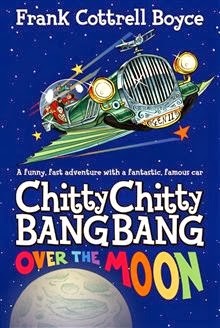
Over the moon about Chitty Chitty Bang Bang


Just as Ian Fleming wrote three Chitty Chitty Bang Bang adventures, Frank Cottrell Boyce has penned a third sequel to the original series. Chitty Chitty Bang Bang Over the Moon sees the modern Tooting family – who find and restore the famous racing car (with the help of a little Chitty magic) in their first outing – adrift 1966 when Chitty Chitty Bang Bang, now fitted with a time-travelling chronojuster, is stolen. There's only one to do: find the Pott family and the 'younger' Chitty, rescue the future Chitty, and go.... back to the future.

As with any story involving time-travel, the twists, complications and paradoxes soon mount up, and this latest Chitty adventure is no exception. What happens when the past and future Chitty Chitty Bang Bangs meet? What would become of the Tootings if the future described in the first two sequels never happened as a result of their saving the world in the 1960s? As with any time-travelling story, it's probably best not to think about it too much.

The story has much to enjoy. Meeting the Potts again is like seeing old friends. Or, rather, old-fashioned friends. Frank Cottrell Boyce nicely contrasts the attitudes of today with those of the 1960s, reflecting the changes in society that have occurred over the past 50 years. So, Commander Pott is authoritative, Jeremy is independent and capable, ever ready with a map, compass, pocket knife and catapult, Mimsie makes tea and thinks about picnics, while Jemima reminds everyone that she's not very good at things because she's a girl. Of course, the Potts soon learn that to overcome the villainous Tiny Jack, they all need to work together as a family – and with the Tootings.

There are nods to the Bond series and other films. Commander Pott drives an Aston Martin DB5. Tiny Jack, who's building up his collection of (stolen) cars, already has the Batmobile and Marty McFly's DeLorean. Other allusions are probably unintentional. When Tiny Jack hijacks Big Ben (actually the Elizabeth Tower), which is flying across the sky thanks to one of Commander Pott's inventions, anti-gravity paint, I was reminded of the plot of Bond spoof, Alligator, in which the eponymous villain steals the Houses of Parliament. I expect, however, that this vague similarity is purely coincidental.

With the Potts involved in much of the action, the spirit of Ian Fleming is never far away, and Frank Cottrell Boyce further links his adventures with the original stories with references to Crackpot's whistling sweets and Monsieur Bon Bon's 'Fooj' shop. And with these references, it seems that Chitty Chitty Bang Bang's adventures have come full circle, and to an end. But I hope not. I've enjoyed reading these new adventures, and would love to see Chitty take flight again. After all, in the words of Commander Pott, never say no to adventure.

Wednesday, 13 November 2013

James Bond's top ten books


Last week, a list of Ian Fleming's top ten books, as selected by me, was posted on Artistic License Renewed: An Art and Literary James Bond Blog and Tribute to Richard Chopping. Now it's the turn of James Bond. Far from being an occasional reader of books about golf and cards, Bond's library is far more varied. Indeed, Fleming wrote of Bond's 'book-lined sitting-room'. Visitors to Bond's London flat are likely to see not only sports books, but also detective and mystery thrillers, gothic chillers, books about politics, a book of 18th-century letters, and travel writing, among other works. Inevitably the interests of Fleming and Bond overlap, but I think Bond's library still retains a distinctive profile. Click the link to see my suggestions for Bond's top ten books. Many thanks to Artistic License Renewed for inviting me to write the article.