Monday, 21 December 2015

James Bond at Christmas - two Daily Express Bond film adaptations

Who wrote the first novelisation of a James Bond film? Christopher Wood, you say? His well-regarded work, James Bond and the Spy who Loved Me (1977) was certainly the earliest adaptation to appear in book form, but there were earlier novelisations – of sorts. In the run-up to Christmas 1971, readers of the Daily Express were treated to the serialisation by Victor Davis of the film version of Diamonds Are Forever. Three years later, again during the Christmas period, Victor Davis adapted the film of The Man With The Golden Gun (1974).
 
The banner for the Daily Express adaptation
The adaptation of Diamonds Are Forever was published over seven days from 17th to 24th December 1971. The structure and plot of the adaptation naturally closely followed that of the film. In Part 1 ('Blofeld was dead – but one question still nagged Bond'), Bond is on the search for Blofeld, just as he is in the film. Part 2 ('Two hired thugs and a cool dish called Tiffany'), we are introduced to villains Wint and Kidd and leading lady Tiffany Case, and in Part 3 ('Bond moves fast – and it's death by fire extinguisher'), Bond assumes the identity of diamond smuggler Peter Franks.

Part 4 ('The mob breaks up Bond's cosy date') sees the brief appearance of Plenty O'Toole, while Part 5 ('Two wheel drive – as Bond steers to safety') describes the car chase through Las Vegas. 'Blofeld comes back from the dead' is the title of Part 6, and the final offering on Christmas Eve is 'Bond gets a kiss with several kicks', a part that, as you might guess, features Bambi and Thumper.

Despite the somewhat uneven plotting – the helicopter raid on Blofeld's oil rig is described in two short paragraphs, while Bond's tussle with Bambi and Thumper is dealt with in nine – Victor Davis' adaptation is readable and exciting (no mean feat, given the challenge of condensing the script), and replicates to some extent the literary style of Ian Fleming. The best of Davis' Fleming-esque touches can be found in Part 1. Take this paragraph, for example:

“The urgency of the call would normally have given Bond that familiar charge of excitement, a heightened sense of perception that had always gone with the knowledge that he was about to be handed a new assignment in the field.”

Or this one:

“Bond smiled thinly at remembrance of the arduous and murderous trail that had led him across the world.”

Victor Davis knows his Fleming. Three years later, Bond was back in an adaptation of The Man With the Golden Gun. This time spread over five parts, the story ran from 16th to 20th December 1974.
 
Bond and Goodnight in the Daily Express
In Part 1 ('Who'd pay a million dollars to kill me?'), Bond receives the bullet on which his code number has been inscribed. Bond goes on the trail of the source of the bullet in Part 2 ('Sudden ambush by a very naked lady'), while Part 3 ('With eyes glazed, she was beautiful – dead beautiful') sees the death of Andrea Anders. Bond flies onto Scaramanga's island in Part 4 ('Champagne on the rocks with a bullet to pop the cork'), and in the final part ('A duel to the death as Scaramanga lays a trap in the fatal funhouse'), Bond goes head to head with Scaramanga.

Again, the sub-Fleming touches are there:

“Miss Moneypenny,far from her usual flirtatious self, ushered him straight through M's steel-plated and soundproofed door into the sanctum that the head of the British Secret Service had dressed overall more like a naval museum.

“James Bond's amused eyes passed lightly over the prints of the wooden ships of England, dashing in under French and Spanish cannon, and the rest of the mementoes, the flotsam of a distinguished seadog's life.”

Both adaptations by Victor Davis are interesting early entries in the sub-genre of continuation Bond – the film novelisation – and are well worth reading.

Sunday, 13 December 2015

The James Bond references in Spy (2015)

This year has seen the release of a higher than usual number of spy films, but I have to confess that I have not been keeping up with what has been termed the Year of the Spy, having missed almost every spy film released. (I did, of course, ensure I was in the cinema for Spectre.) The other week, however, I was able to catch up with one of the other entries in the unofficial series. And I'm very glad I did.

Spy is an espionage comedy, but is more than a parody of the spy film genre, offering genuine thrills, plenty of action, and an engaging plot. Essentially, the film answers the question of what would happen if Miss Moneypenny became James Bond. After the apparent death of an agent, the film sees desk-bound analyst, Susan Cooper (Melissa McCarthy), go into the field as an undercover agent to monitor and report the activities of an arms dealer, Rayna Boyanov (Rose Byrne), who knows the location of a stolen nuclear device. Needless to say, events do not run smoothly, and very quickly Susan Cooper goes beyond her orders as she tries to prevent nuclear disaster.

Director Paul Feig reportedly conceived the film as a humorous Casino Royale (2006), a favourite film of his, and it shows. Spy contains many nods to the James Bond films, in particular the classic films of Sean Connery and the more recent offerings of Daniel Craig.

The film opens with a pre-titles sequence featuring the cool, witty and dinner-suited Bradley Fine (Jude Law) – clearly a James Bond figure – in the course of a mission, with Barry-esque strains playing over the action. This is followed by a perfectly Bondian title sequence, accompanied by the equally Bondian song, 'Who can you trust?' (a title that might apply just as well to any of Daniel Craig's Bond films).

The Bond references keep on coming. We are introduced, for example, to Patrick (Michael McDonald), a Q-like character who supplies Susan Cooper with her equipment. Susan's visit to Patrick's workshop could almost have been lifted straight out of a Bond film. Equipment is hidden inside mundane items, and the scene includes gadgets being demonstrated (and going wrong) in the background. We also catch a glimpse of an Aston Martin (in this case a DB9).

Susan subsequently travels to Rome and visits a casino to keep close to Rayna Boyanov. Susan notices a waiter pour some poison into a cocktail intended for Rayna, and alerts Rayna to the threat in order to make contact with her. The poisoned cocktail naturally recalls the poisoned Vesper martini in Casino Royale. A private gambling room into which Susan stumbles is also reminiscent of Casino Royale.

In the casino, too, we see Jason Statham's rogue CIA agent Rick Ford (is there any other kind of agent these days?) in a white dinner jacket, presumably a nod to Bond's white jacket in Goldfinger (1964). Goldfinger is referenced again shortly afterwards when Susan is facing a suspicious Rayna outside the casino. Rayna's henchmen stand behind Susan, and when they lift their guns as if about to shoot Susan, she sees a reflection of their movements in Rayna's pendent. This brings to mind the pre-titles sequence in Goldfinger, when Bond sees the movement of a would-be killer reflected in the eyes of an exotic dancer. A later scene in which gun shots inside a plane depressurise the cabin must also allude to Goldfinger, specifically the well-known scene in which Goldfinger is sucked out of the plane.

There are doubtless other references, but those are the ones I spotted on first viewing. Throughout the film, however, Spy is an affectionate tribute to the Bond series, and contains the sort of exciting stunts, action and thrills that we'd expect to see in any Bond film. What's more, Spy is hilarious, and (I never thought I'd say this) Jason Statham is a revelation, as he sends up his tough-guy persona. The film is a must-see for any Bond fan.

Thursday, 3 December 2015

The evolution of the SPECTRE symbol

The name of SPECTRE isn't the only aspect of the organisation last seen – officially, at least – in Diamonds Are Forever to have been resurrected in the latest James Bond film. The organisation's octopus-like symbol made an appearance too.

The motif has seen a number of changes over the years. The first time we see the SPECTRE symbol is at a chess match in From Russia With Love (1963). The symbol is on a paper coaster delivered with a glass of water and a summons for Kronsteen, a chess grandmaster and SPECTRE agent. The symbol, with its four wavy tentacles and ghoulish head, is less an octopus than a jellyfish out for an evening's trick or treating. The device is seen again as an intaglio on a ring worn by Blofeld. 

From Russia With Love
The SPECTRE symbol next makes an appearance in Thunderball (1965), placed in a ring worn by SPECTRE No. 2, Emilio Largo. This time, the device is more octopus-like, presumably symbolising SPECTRE'S reach and omnipresence. The outer tentacles curve round to enclose the others, perhaps as much to fit the circular frame of the ring as for aesthetic reasons. The facial features of the octopus are reduced to alien-like eyes. 

Thunderball
The design is largely retained for You Only Live Twice (1967) and is seen on a ring worn by Blofeld. In Diamonds Are Forever (1971), however, the symbol is rather different. Adorning the front of Blofeld's bath-o-sub, the octopus has gained a thicker body and straighter and broader outer tentacles, giving the impression perhaps of an octopus wearing a cape or shawl. The eyes, though, remain alien-like.

 
Diamonds Are Forever
With SPECTRE off the screen until the latest film (apart from Never Say Never Again), there have been no developments in the symbol in the intervening period (although Stromberg's Atlantis has a certain resemblance to the octopus device). Almost to make up for it, however, Spectre (2015) contains two designs. Teaser posters for the film cleverly incorporated the octopus symbol within bullet-damaged glass, the tentacles and body being formed by the fissures surrounding the bullet hole. A similar motif was created within the film itself. 

Spectre teaser poster
SPECTRE itself adopts a more corporate-looking octopus logo, which is seen on the outside surface of a ring and on a computer screen. The body of this octopus is relatively thin and wide, while the tentacles are short and curve towards the centre, except the central tentacle, which is longer than the others and is straight and tapers like a dagger. Interestingly, the octopus only has seven tentacles. It's also worth noting that the 'shoulders' of the octopus are raised, and that the head lacks eyes.

Spectre ring 2015
Each incarnation of the SPECTRE/octopus motif is obviously different from the last, yet each could not have existed without those that preceded it. The exception is, of course, the first incarnation, and it is telling that in that case, the motif looks the least like an octopus, as if the designer was influenced mainly, if not solely, by the principal meaning of the word 'spectre'. It is possible that its resemblance to an octopus was coincidental, but was enough to influence the design of the symbol two films later.

There is one other comparison worth making. The Batman symbol has had a long history and has undergone many changes, far more than we have seen on the SPECTRE device. What is curious, though, is that the various designs of the SPECTRE symbol share certain traits with roughly contemporaneous Batman motifs. Thus, the octopus motif of Thunderball and You Only Live Twice has curved, enclosing sides, as does the bat motif used in Batman comics in 1964 and 1965. The thicker body and straight sides of the octopus in Diamonds Are Forever mirrors the thicker body and straighter sides of the bat motif that appeared in the 1966 TV series and in comics in 1970. The spidery lines seen in Spectre's 'bullet-hole' octopus recall the scored appearance of the bat motif used for The Dark Knight Rises in 2012. The official octopus symbol seen on the 2015 ring, meanwhile, has leaner qualities matched by bat motifs used in Batman Begins (2005) and later in comics, and itself has a vague appearance of a flying creature. 


These similarities are no doubt coincidental, am I am not suggesting that the motifs resemble each other in any significant way. However, sharing certain traits, the motifs suggest a common aesthetic, the designers responding to an extent to the same influences or selection pressures within the cultural environment (although the apparent influence of Christopher Nolan's Batman films specifically on the Bond films has been noted elsewhere). 

The SPECTRE symbol has seen a number of changes over the past 50 years, but remains a important and recognisable piece of Bondian iconography in popular culture and a potent symbol for James Bond's most tenacious adversary.


Note: The Batman logos are taken from an infographic published on the World of Superheroes website.

Thursday, 26 November 2015

From Bond girl to Bond woman

In interviews following the press event to launch Spectre, and leading up to the release of the film, Monica Bellucci, cast in the role of Lucia Sciarra, rejected the term Bond girl in favour of Bond woman or lady. “I am so much more mature. I'd prefer to be called a Bond woman or perhaps a Bond lady,” she told the Mail of Sunday in February 2015. In an interview for the Sunday Times, she said, “I am a Bond lady.”

The rejection of Bond girl was on the basis of her age, the description of girl simply being inappropriate for an older woman. This was echoed by former Bond girl Fiona Fullerton, who appeared as Pola Ivanova in A View To A Kill (1985). She told the Daily Express in August this year: “I kind of cringe when I'm referred to as a Bond girl because I'm not a girl any more. I'm very much of the older fraternity so I'm a Bond woman.”

A similar view was expressed in the reaction, some 20 years earlier, of actor Michael Williams to the news that his wife, Judi Dench, had been cast as M in GoldenEye. “Oh brilliant”, he said, “Bond-woman!” Judi Dench has used the term herself, writing in her autobiography, “I really shouldn't be called a Bond woman at all, but I call myself one”.

Others have accepted the term Bond women because they have considered Bond girl inappropriate for any woman, young or old, or have associated the term with passive female characters who provide little more than decoration. Halle Berry told the Daily Express in November 2002 that “Jinx [her character in Die Another Day] is the next step in the evolution of the Bond woman. Year after year, they become a little bit stronger, a little smarter.... Now they're Bond's intellectual equals and physical rivals.”

When Léa Seydoux was asked in the October 2015 issue of Total Film whether her character, Madeleine Swann was a Bond woman rather than a Bond girl, she replied, “She's a strong woman”, a response that neatly side-stepped the requirement to accept either label. The Daily Star claimed in October 2008 that Izabella Scorupco demanded to be called a Bond woman in GoldenEye, because she thought the usual term Bond girl was demeaning (although judging by interviews published in 1995, Bond girl appears not to have been so problematic).

Notably, in her foreword and chapter introductions in Bond Girls are Forever (2003), co-author Maryam d'Abo (Kara in The Living Daylights) rarely uses the term Bond girl. She writes, for example, that “it is the casting of the Bond women that garner the most attention,” and that “there has never been a Bond film without a Bond woman.” Reading this, one gets the sense that Maryam d'Abo is not entirely comfortable with the term Bond girl, although Bond girl is not rejected explicitly, and is naturally retained in the title of the book.

The earliest use of the term Bond woman that I know of dates to 1989. An advert for Elle magazine that appeared in the Daily Express in 1989 trailed the contents of the June issue. Women in the Bond films were the subject of one of the articles, presumably coinciding with the release of Licence to Kill. “A Bond girl's life has never been easy,” the advert claimed. “Wham. Bam. Thank you, ma'am. Then bang bang, you're dead. But the role of the Bond woman is changing,” the implication being that term Bond girl was not appropriate for characters such as Pam Bouvier (Carey Lowell), who was perceived as being Bond's equal. 

This trawl through various sources has traced the emergence of the term Bond woman and revealed two definitions. In one sense, it is a term that reflects age, being associated with older women. Despite the use of this newer term, Bond girl itself is not rejected. In another sense of the term, Bond woman is presented as an alternative to Bond girl, reflecting the perception that female roles in the Bond films have changed through the course of the series, and making the obvious point that the actors are women, not girls.

Whether women in the Bond films are Bond girls or Bond women, it could be argued that such labels, Bond girl especially, have largely been imposed on the actors, seemingly first emerging in the media (the earliest reference to Bond girl I know of is in the Daily Express and dates to February 1963), and becoming deeply embedded in the cultural environment. The result is that every interview at press conferences or in newspapers and magazines seems to oblige actors to engage with the term Bond girl. This may be the reason why many of the actors (beginning at least as far back as 1969 with Diana Rigg) claim that their characters are stronger, more independent, and more on equal terms with Bond than their predecessors.

Thursday, 19 November 2015

The food of James Bond - what is brizzola?

Food and eating are as much part of the James Bond books as drinking, gun-play, gambling and car chases. Reading the books today, many of the dishes Bond consumes – exotic or sophisticated in the 1950s and early '60s – are now commonplace and enjoy a regular place on the dining table. Spaghetti Bolognese and shrimp curry are two examples. Other dishes leave us scratching our heads. Why does Bond eat an avocado for dessert? And just what is brizzola?

I discuss Bond's odd views about avocados in a earlier post. As for the brizzola, it has been suggested that the dish is something of an Ian Fleming invention. In fact, not only does the dish exist (possibly the name derived from bresaola, an Italian salted beef), it was a favourite of a former US president.

 
(c) Penguin
Felix Leiter orders brizzola for Bond in a New York restaurant in Diamonds are Forever (chapter 8). Ian Fleming describes it as beef straight-cut across the bone, which is roasted, then broiled. This is not dissimilar from the description given to Lowell Sun journalist Earl Wilson in December 1971 by Robert Kreindler, president of New York's famous '21' Club. He defined brizzola as 'charcoal-broiled prime rib of beef with bone intact'. Evidently 21 was well known for the dish. Earl Wilson also reported that President Richard Nixon regularly ordered brizzola when he ate at the club during his visits to New York.

While James Bond dines at Sardi's, Ian Fleming had been to 21 (as well as Sardi's), and recommended the restaurant in his New York chapter of Thrilling Cities. Fleming often gave Bond the food that he himself had eaten. Whether he ate brizzola at Sardi's or 21 before putting it on Bond's plate is uncertain, but it is likely that his description is at least based on experience.  

How might you cook brizzola today if recreating the dish at home? My suggestion is to take a steak cut from a prime rib of beef – complete with bone – and cook it over a charcoal barbecue or, the second-best option, on a griddle pan. Larger cuts or joints of prime-rib beef should be roasted before being finished off on the hob or barbecue for that essential brizzola taste.

For more information about Bond's dining, and recipes inspired by the food he eats (though not, alas, brizzola), I recommend Licence to Cook, a cookbook of Bondian recipes. Or, for a comprehensive guide to food in the Bond books and films, there is James Bond's Cuisine: 007's Every Last Meal, by Matt Sherman.

Friday, 13 November 2015

Bond memes in Despicable Me and Minions

Another reference to Bond
I have to confess that I did not especially enjoy Despicable Me (2010). I found it a little dull, to be honest. Still, the film does contain aspects that derive from the James Bond films, which is to its credit. These references are obvious enough. The protagonist, Gru (presumably named after the GRU, the Soviet-era military intelligence agency), is a criminal mastermind who plans to steal the moon. He naturally recalls Blofeld, and the link is reinforced by his large workforce of minions, known of course as Minions, whose uniforms and loyalty parody the private armies of Blofeld in You Only Live Twice or Stromberg in The Spy Who Loved Me.

There are more allusions to the Bond films in the sequel, Despicable Me 2 (2013), which I enjoyed more (another case of the sequel being better than the original?). Having turned away villainy and settled down to family life and jam-making, Gru is persuaded by the Anti-Villain League (AVL), headed by M-like character Silas, to join forces with AVL agent Lucy. The powerful substance PX-41 has been stolen and their task is to track down the culprit. Lucy drives an unprepossessing car, but, as one might expect from a spy's car, has its fair share of gadgets. One of these is revealed when the car plunges into the water, the vehicle rapidly transforming into an underwater car. In another sequence, the car becomes a flying car.

The car's submersible and aerial capabilities bring to mind Bond's submersible Lotus Esprit (Wet Nellie) in The Spy Who Loved Me and Scaramanga's flying car in The Man With The Golden Gun. As I discussed in a previous blog post, the idea of a flying and underwater car has an older origin; For example, Robur the Conqueror, the super-villain in Jules Verne's 1904 novel Master of the World, has one. That said, James Bond's vehicles undoubtedly have greater cultural penetration, being the more recent and enjoying frequent exposure on big and small screens everywhere.

Apart from Gru, the film alludes again to Blofeld. Following a lead, Gru and Lucy enter a wig shop. They see the back of a chair in which the proprietor, Floyd Eagle-san is sitting. He rotates his chair to face Gru and Lucy, and on his lap is what we assume is a white cat, but which is then revealed to be a wig. It's a clever nod to Blofeld, particularly his appearance in You Only Live Twice and Diamonds Are Forever.

The association between cats and villainy (not necessarily originating with the Bond films, but boosted by them) is referenced in the third film, Minions (2015), which is a prequel set in the 1960s (the decade itself being an acknowledgement of the period that introduced the Bond films and saw the rise of spy- (as well as Bond-) mania). Minions Stuart, Kevin and Bob hitch a ride with a family, the Nelsons, on their way to Villain Con. The family's young daughter, tells the Minions of her ambition to be a super-villain, picking up and stroking her pet cat as she does so.

Bondian traits make a small but important contribution to the construction of the Despicable Me/Minions films. Interestingly, it's Blofeld, rather than Bond, who provides the principal references. Given that at the time the films were made, Blofeld had not been seen on screen since 1971 (or 1981 with For Your Eyes Only), the films are testament to the character's continued cultural prominence.

Thursday, 5 November 2015

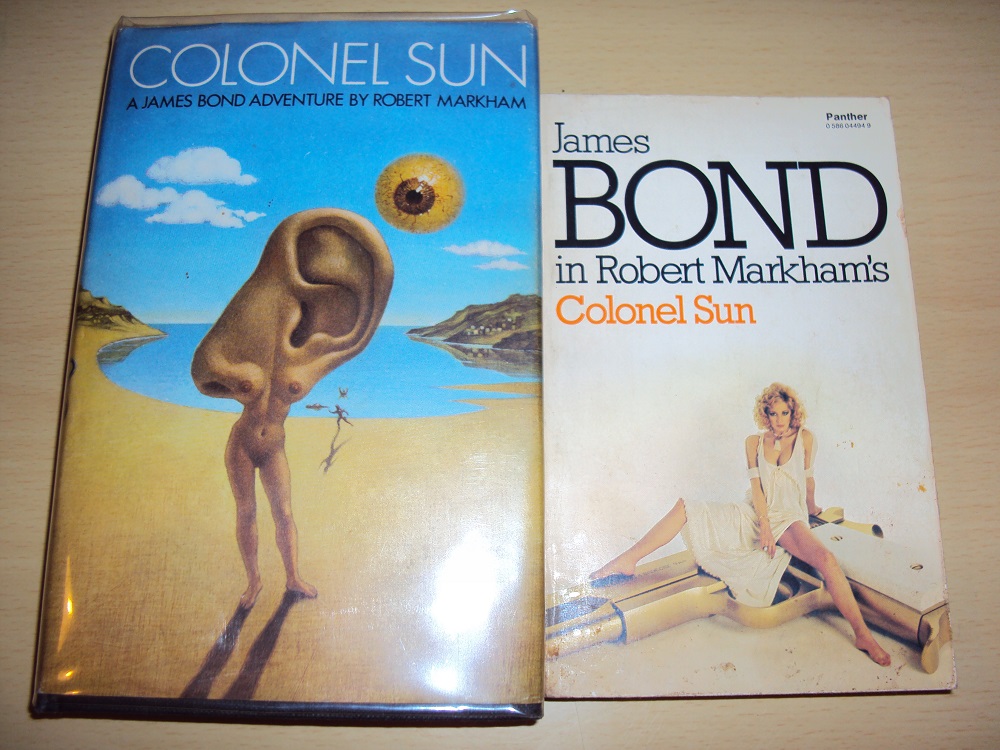
Colonel Sun in Spectre and other Bond films

The latest Bond film, Spectre, contains many references to previous films and Ian Fleming's novels, and I listed some of these in my last post. But as Ian Fleming Publications recently revealed, Spectre also incorporates elements from Colonel Sun, the 1968 continuation Bond novel by Kingsley Amis.
 

I've identified the scene below, and while I don't describe it in detail, those who have yet to see the film may wish to look away now.

One of the classic elements of a Bond film is a scene of torture. Casino Royale had one, as did Die Another Day and, before that, The World Is Not Enough. Spectre has one too, and it is this scene, involving thin pointy instruments applied to the head and set in the villain's lair, which is lifted from Colonel Sun.

If there was any doubt that the screenwriters had looked through the pages of Colonel Sun for inspiration, it is confirmed by a line given to the villain – a philosophical thought about what the lack of eyes does to the essence of a man – which is taken almost verbatim from the novel. (I'm not certain, but I think he has another line from the novel, said when he directs Madeleine Swann to a chair.) These references, by the way, are from chapter 19, 'The Theory and Practice of Torture'.

As The Book Bond has pointed out, this may not be the first time Colonel Sun memes have been included in a Bond film. Die Another Day has the character Colonel Tan-Sun Moon, and in The World Is Not Enough (those two films again!), M is kidnapped, just as M is kidnapped in Colonel Sun.

I wonder if there is another reference. On the final page of Colonel Sun, James Bond and Ariadne, the heroine and GRU agent, talk about having to part and return to their duties. Ariadne says, “People think it must be wonderful and free and everything. But we're not free, are we?” Bond replies, “No. We're prisoners. But let's enjoy our captivity when we can.” This reminds me of the final exchange between Camille and Bond in Quantum of Solace (“I wish I could set you free. But your prison is in there”, Camille says, indicating Bond's mind).

Admittedly, this final reference seems less convincing than the others, but given the repeated nods to Colonel Sun in recent films, the writers, chiefly Robert Wade and Neal Purvis, clearly have had Amis' book in mind when coming up with ideas, and it is reasonable to suggest that their films contain other references.

Incidentally, Amis wrote Colonel Sun as Robert Markham, but the new edition of the book, published by Vintage, has dropped the pseudonym altogether. This no doubt improves the book's marketability, but the timing is interesting too. Any new Bond film brings with it glut of Bond-related books and reissues, all hoping to benefit from the film's publicity. But the reissue Colonel Sun has been a while coming; the last UK edition appears to have been published in the mid 1990s. Given that Spectre unambiguously contains elements of the novel, Vintage could almost have published Colonel Sun as a film tie-in.

Returning to Spectre, the references to Colonel Sun are significant, as until now it had been thought that there was reluctance within EON to adapt the continuation novels. Does that mean that we're going to see more of the continuation novels in the Bond films? If so, top of my list for an adaptation is Anthony Horowitz’s excellent Trigger Mortis. I wouldn't mind betting that the motor racing section of the book, which is based on material by Ian Fleming and includes Fleming's own words, will eventually make it to the big screen. Remember, you read it here first!