Friday, 11 September 2015

Trigger Mortis by Anthony Horowitz - a review

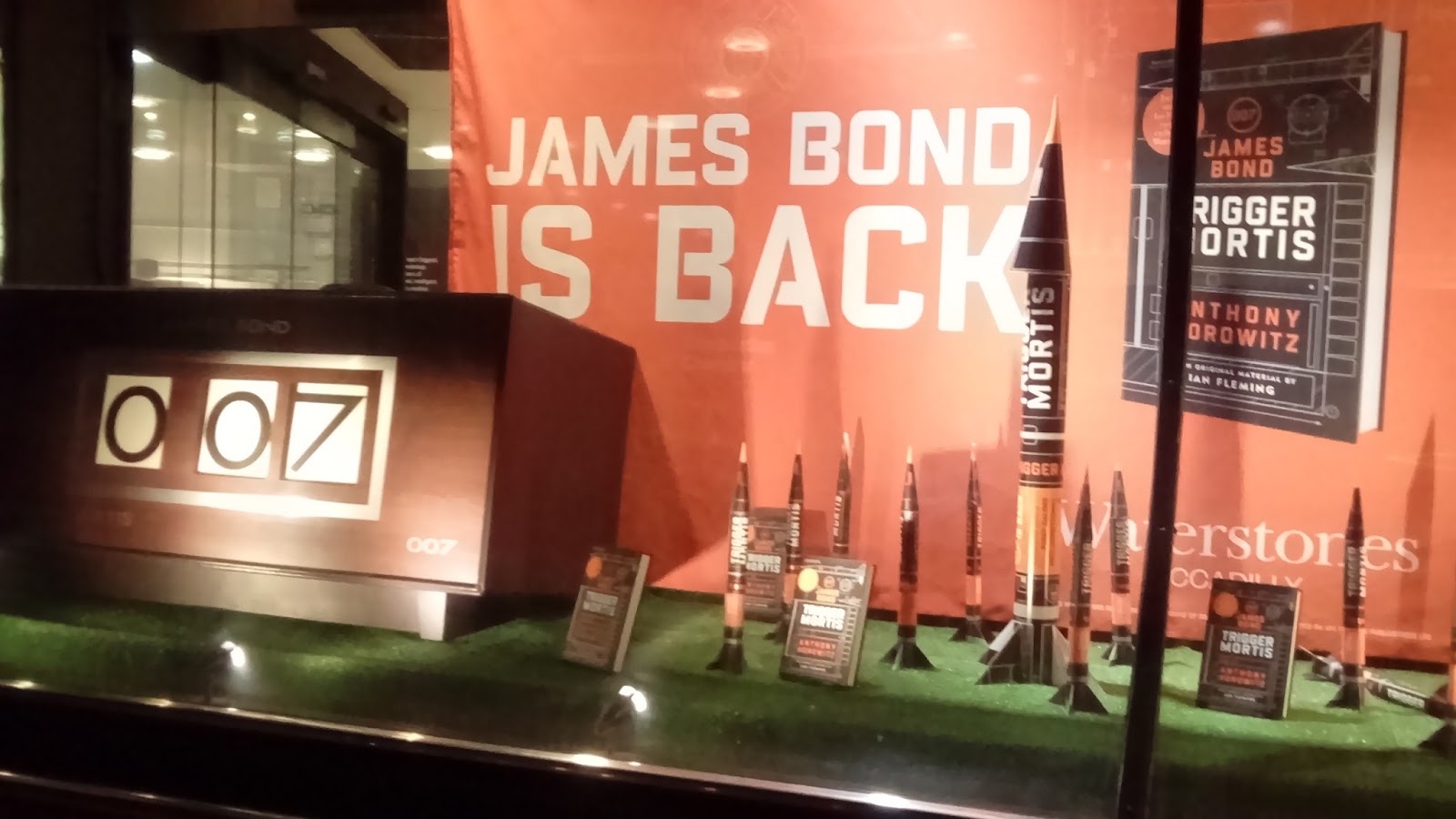
The window display of Waterstones, Piccadilly, where Trigger Mortis was launched
The cover of Devil May Care, Sebastian Faulks' James Bond novel (some might call it an extended pastiche), proclaimed that its author was writing as Ian Fleming. Anthony Horowitz, the author of the latest Bond adventure, Trigger Mortis, has gone one better. In incorporating original material by Ian Fleming, and carefully referencing the touchstones of James Bond's world, Horowitz has delivered the authentic voice of Bond's creator. It is as if the manuscript of a long lost Bond novel had been discovered in the bottom drawer of Fleming's writing desk at Goldeneye.

Trigger Mortis takes the reader back to 1957 and follows immediately from the final events of  Goldfinger. We left that adventure (spoiler alert) on Weathership Charlie off the Canadian coast; Bond, taking Pussy Galore with him, having ditched a Stratocruiser into the ocean, with Goldfinger lying dead on the floor of the plane. Back in London, Bond learns about a SMERSH plot to infiltrate the German Grand Prix and take Lancy Smith (a thinly-disguised Sterling Moss; Smith, like Moss, even drives a Vanwall) out of the race – permanently. This leads to an introduction to the mysterious Jeopardy Lane, the cold and brutal Jason Sin, and a larger, more terrifying plot with the Space Race at its core.

Anthony Horowitz began writing the book, unusually, with Chapter 3, as he weaved 'Murder on Wheels', an unmade television treatment by Ian Fleming, into the story. But it is chapters two and seven which are most infused with the spirit – and the words – of Ian Fleming. Some of the dialogue Fleming gave to Bond and M is repeated verbatim, and readers will have fun trying to identify Fleming's words among those of Horowitz (it's not easy, I can tell you). The seventh chapter, called 'Murder on Wheels', describes the race at the Nürburgring and Bond's attempt to foil SMERSH's plot. What a thrilling piece of writing, and one that rivals, or rather complements, Fleming's descriptions of Bond's other sporting ventures, skiing, scuba diving, driving, and the like.

Any book written today inevitably makes allowances for modern sensibilities, even if set in the past, but I'm glad to report that Bond retains his foibles. He smokes (though is perhaps not quite the seventy-a-day man he once was), drinks Martinis, has opinions about women's bottoms, and hasn't moderated his views about the Germans (to be fair, it is only twelve years since the end of the Second World War).

And naturally Bond remains very particular about his food (for instance distrusting food with French names if not served in France). Continuation authors have tended to make sure that Bond was well fed, and we do know what Bond eats in Trigger Mortis, but the food references this time are not intrusive. At one point Bond breaks the yolk of an egg, but we have no idea how it had been cooked. Horowitz knows when to veer away from the narrative for a Fleming-esque digression, and when get on with the story in order to, as Fleming once put it, “get the reader to turn over the page.”

Apart from Fleming's TV treatment, the novel that has most inspired Horowitz is Goldfinger. It is no secret that Trigger Mortis sees the return of Pussy Galore (lucky Bond's housekeeper, May, is away; I can't imagine her approving of Bond's house-guest), but there are nods to Goldfinger in other ways. Perhaps, though, it is the 1964 film that comes to mind more strongly with some of the episodes in the book, for instance a punishment involving gold paint, the means by which the chief villain, Jason Sin (a Korean, like Oddjob), is killed, and, before that, Jason Sin's asking Bond “Any last witticisms?” The line might have been in the first draft of dialogue given to Gert Frobe's Goldfinger before being redrafted into the classic, “Choose your next witticism carefully, Mr Bond.”

Goldfinger apart, the plot involving rockets obviously recalls the novels of Moonraker and Dr No, and reading the denouement of Trigger Mortis, I was reminded even of the latter part of the film, Octopussy.    

These allusions to the other Bond books (and films) are great fun, of course, and give readers a wonderful sense of Bond's world, but at the same time, I wonder if Anthony Horowitz, like all continuation novelists before him, has played it too safe. Though his novels could well be described as formulaic, Ian Fleming was a great experimenter, and was not averse to playing with the structure of his novels. We can see that most clearly with From Russia, with Love and especially The Spy Who Loved Me. Could a continuation novelist today ever produce a Bond book in which Bond appears in the second or even last third of the book? Probably not (although The Moneypenny Diaries are closest in that vein, and could be considered experimental Bond novels).

This is a very minor point, however, because put simply Trigger Mortis is a triumph. The novel deserves a place alongside Ian Fleming's novels and, containing Fleming's own words and ideas, must be regarded as 'canon'. But the novel can also sit comfortably alongside modern thrillers; I was particularly reminded of Lee Child's Jack Reacher novels in the passages set in American motels and diners as, over endless cups of coffee, Bond and his companion, Jeopardy Lane, piece together clues to the mystery of Jason Sin. 


Anthony Horowitz has achieved what some continuation novelists before him have struggled to do: write a continuation Bond thriller that is, well, thrilling. James Bond – and Ian Fleming – is back!

Friday, 4 September 2015

Where is Royale-les-Eaux?

Ian Fleming set the events of his first novel, Casino Royale, in the fictional coastal town of Royale-les-Eaux in northern France. In chapter 5 of the book, Fleming places the town near the mouth of the River Somme, which puts Royale in the Picardy region, and this is implied by Fleming describing the location as being “before the flat coastline soars up from the beaches of southern Picardy to the Brittany cliffs which run on to Le Havre.”

These cliffs, known as the Alabaster coast, stretch along the Normandy coast between Le Tréport in the north to Le Havre. If we had to mark the approximate location of Royale on a map, then given the geographic references, we'd have to stick the drawing pin somewhere along Côte Picarde, probably on the south side of the Somme estuary.

 
Ian Fleming's northern France (click to enlarge)
 By the time Fleming wrote On Her Majesty's Secret Service, however, Royale-les-Eaux had drifted north. In chapter 2, Bond, motoring north between Abbeville and Montreuil, sees a Michelin signpost which reads: “Montreuil 5, Royale-les-Eaux 10, Le Touquet-Paris-Plage 15”. We can of course use this handy bit of information to an approximate location of Royale by drawing circles of 5km radius around Montreuil, 15km radius around Le Touquet, and circles of 10km radius around various points along the coast south of Le Touquet. Where the circles intersect (more or less) gives us Bond's position, and the centre-point of whichever circle south of Le Touquet fits best is a good indication of where Royale should be. This exercise in fact places Royale roughly at the same location as the seaside resort of Berck immediately north of the bay of the Authie river.

John Griswold has Royale in the same place according to a map in his Annotations and Chronologies for Ian Fleming's Bond Stories (2006), as does David Leigh in an 2004 article exploring James Bond's France. In any case, Fleming confirms that the town is on the stretch of coast south of Le Touquet when he describes Royale in On Her Majesty's Secret Service as “La Reine de la Côte Opale”, the Côte d'Opale being the 120km coastline between the borders of Belgium and Picardy.

What about the inspiration for Royale-les-Eaux? Jon Gilbert in his magnificent Ian Fleming: The Bibliography (2012) states that the town is based on the coastal towns of Deauville, just south of Le Havre, and Le Touquet. However, some of the details of Royale that Fleming provides better fits the description of Trouville, which neighbours Deauville.

As Fleming notes, Trouville, like Royale, was originally a small fishing village and, again like Royale, grew rapidly during the Second French Empire (1852-1870), when the town enjoyed the patronage of artists, the wealthy, and the aristocracy, experienced a degree of urbanisation, and established casinos, hotels, and baths. Trouville's current casino, built in 1912 by Alphonse Durville, perhaps has something of the “Negresco baroque” of Casino Royale about it (presumably Fleming's description refers to Nice's Hotel Negresco); both are decorated with gilt at least.

 
Trouville's casino (Photo: Daniel Villafruela)
Royale-les-Eaux, however, differs from Trouville in one important aspect: Royale is a spa town, whereas Trouville (nor Deauville or Le Touquet, for that matter) is not. Trouville and other coastal towns certainly developed bathing establishments for hydro-therapeutic treatments, but these were based on seawater, not natural spring water believed to have curative properties. As Fleming describes, Royale becomes known as Royale-les-Eaux as fame spreads about the curative powers of the sulphurous spring water flowing through the hills behind the town.

One obvious inspiration for this aspect of Royale-les-Eaux is the spa town of Forges-les-Eaux, which is located inland about 30km south of Abbeville. Visitors came to Forges as early as the 17th century to take 'the cure' deriving from the iron-rich springs around the town, but it wasn't until the 19th century that Forges-les-Eaux developed into a resort to rival those on the coast, establishing a spa and a casino. A history that is not so very different from that of Royale-les-Eaux.

Royale-les-Eaux is something of an amalgam of different towns, but the main inspirations appear to have been Trouville and Forges-les-Eaux. This may explain why Royale appears to have been located in Picardy for its first appearance, before being relocated to Pas-de-Calais subsequently. What is clear is that Ian Fleming was very familiar with the places and geography of northern France, and it is no wonder that his writing is infused with the memes of the region.

Wednesday, 26 August 2015

Jamaica's other Goldeneye

As GoldenEye, the film that introduced Pierce Brosnan as Bond and relaunched the series to great acclaim (and relief) after a six-year enforced hiatus, turns twenty years old, the latest edition of MI6 Confidential celebrates the film's anniversary with an interview with director Martin Campbell, an examination of the essential ingredients of the film, a look at the film's most memorable stunts, and much more.

I'm proud to have contributed to the issue myself: a small article examining the legacy of Goldeneye, Ian Fleming's winter home in Jamaica, where he wrote all the Bond books. While I was researching the article, I made some interesting discoveries about some of Jamaica's other, lesser known Goldeneyes. The article wasn't quite the place to say much about them, so by way of an addendum, here they are.

If one were to ask Jamaicans in the late 1940s, when Ian Fleming built his house, what 'Goldeneye' meant to them, many would have replied that it was something to treat minor ailments of the eyes. The Daily Gleaner was full of adverts for 'Golden Eye' treatments. Sinclair's Drug Department on King Street in Kingston sold the lotion for two shillings per bottle. The lotion was a little more expensive at Williams Drug Store on West Queen Street, selling for 2/6, but it was cheaper that Optrex (3/6), and was alternatively available in ointment form, which was cheaper at one shilling per tube. Meanwhile, Dunker & Company on Harbour Street were offering 'huge savings', selling a dozen tubes of the ointment for eight shillings.

 
An advert in the Gleaner for medicines, including Golden Eye
This was good news for farmers. In an article published in April 1958 in the Farmers Weekly section of the Gleaner, 'Surgeon' recommended the application of Golden Eye lotion for the treatment of 'pink eye', a type of eye infection in cattle.

There was yet another Goldeneye known in Jamaica. In 1950, cinema-goers flocked to the Gaiety cinema, among other venues, and 'country theatres' around Jamaica to see Roland Winters star as Charlie Chan investigating the mystery of why an unprofitable gold mine is suddenly making lots of money. The film, released in 1948, was called The Golden Eye. 


The Golden Eye (1948) on the bill of the Gaiety Cinema
As a footnote, there is a curious link of sorts between the house and the eye treatment. Fleming's house was well known for its stark design and paucity of mod-cons. Friend and neighbour Noël Coward famously referred to the house as 'Goldeneye, nose and throat'. This is a play, of course, on ear, nose and throat departments in British hospitals, but it's possible that Coward had Golden Eye lotion, a product that would have been familiar to Jamaican residents at the time, in his mind too. 

Wednesday, 19 August 2015

Vladimir Putin channels Blofeld - according to the Press

The image was a gift to headline writers: Russian president Vladimir Putin sitting in a mini-submarine preparing to descend into the Black Sea to explore the wreck of a 10th-century Byzantine ship currently under archaeological investigation.

The Metro went with the headline, "From Russia With Love... Putin in '007' submarine stunt", and went on to claim that Putin looked every bit a Bond villain. On its online edition, the paper ran with "Live and let dive: Is Vladimir Putin auditioning for next Bond villain?"


Presumably the paper drew on the association of futuristic submersibles (the underwater vehicles of The Spy Who Loved Me, or Diamonds Are Forever's bath-o-sub, for example) with the James Bond films, as well as the penetrating, somewhat sinister, expression on Putin's face. Perhaps, too, the khaki/beige shirt that Putin was wearing brought to mind the light-coloured Mao-type jackets favoured by Blofeld in You Only Live Twice and Diamonds Are Forever.

The Times made the same connection. “Dive another day: action man Putin (or is he Bond villain?),” ran its headline. “All that’s missing is the sinister white cat sitting on his lap,” it continued, a clear reference to Blofeld. The Daily Mail asked, “Is he trying out for a role as the next Bond villain?”, while Sky News posted a video of Putin with the headline, “Vladimir Putin takes Black Sea adventure in James Bond-esque submarine.” Meanwhile Jonathan Jones in The Independent looked more critically at the event to examine Putin's seemingly underlying nationalist motives, writing: “Think Vladimir Putin looks like a Bond villain? It’s more serious than that.”

These headlines serve to demonstrate the extent to which the 'Bond villain' as an idea or meme is firmly embedded in popular culture. When presented with the 'action man' and controversial (to say the least) Russian president in an adventurous hi-tech activity, it was to the James Bond films, rather than, say, superhero films, that journalists turned. It shows, as well, how closely underwater exploration is associated with James Bond, the sea joining snow-covered mountains and the casino as an essential Bondian environment.

And, with the reference to the white cat, Blofeld remains the archetypal Bond villain. No doubt the upcoming Spectre has brought renewed prominence to the character, but the cultural impact of Blofeld's appearance in the early Bond films, particularly You Only Live Twice, cannot be underestimated.

Thursday, 13 August 2015

In the footsteps of Octopussy's Major Dexter Smythe

Following a recent cycle ride in the Tyrolean mountains, guest writer Radley Biddulph revisits Ian Fleming's 'Octopussy', and considers why the short story remains a fascinating and exciting read.

I recently participated in a cycle race in the Alps. The seven-stage 880-kilometre bike race started in the Bavarian town of Sonthofen, near Munich, and climbed into the mountains via Austria and Switzerland, and finally into Italy with a finish in Arco, near Lake Garda. The route went through Tyrol, and covered 21 mountain passes of seemingly ever-increasing height, and each with an impressive name, such as Hahntennjoch, Flüelapass and Berninapass. The region is simply stunning, with dramatic landscapes, alpine lakes, green pastures, and snow-covered peaks. It was also baking hot. 
A view of the Tyrolean landscape
No surprises then that my thoughts turned to Ian Fleming’s own account of the Tyrolean mountains – and probably my favourite of Ian Fleming’s short stories – 'Octopussy'.

The story tells of Major Dexter Smythe, a member of the Secret Service during the war - now retired to Jamaica – and assigned to a unit called the Miscellaneous Objectives Bureau (MOB), who is tasked with searching in Tyrol for anything of interest – documents, lists of names – in Gestapo and military locations after the collapse of Germany. He discovers papers indicating gold buried in the Kaiser mountains, near Kulfstein, and he engages a local guide, Hannes Oberhauser, to help him show him the route up the slopes. Once the gold is located, Oberhauser is killed. It is the ill-gotten gold that enables Smythe to retire to Jamaica, where soon bored, and with his wife having overdosed on sleeping pills, he is slowly drinking himself to death. 

It is a brilliant read. You get a real sense of Fleming’s intimate knowledge of life in Jamaica. Fleming’s description of life in the small ex-pat British community is vivid, and, like Fleming, Smythe lives on the North Shore of Jamaica, and spends much of his time snorkelling, drinking and smoking excessively. 

The story is also engrained with Fleming’s own experiences of the Second World War with 30 Assault Unit (30AU). Smythe is a former Royal Marine Commando, seconded to Combined Operations and MOB, and Fleming’s own involvement with 30AU, which was tasked with undertaking operations in enemy territory to capture intelligence, meant that he would have had first-hand source material for the story. The story is also reminiscent of other military units at the end of the war, such as T-Force, a unit jointly raised by US and British forces to secure information, documents and equipment, and the Allies’ Monuments, Fine Arts, and Archives section, which was established to safeguard cultural assets and works of art during and after the war, recently depicted in the George Clooney film, The Monuments Men (2014).

But for me, the story comes alive with the description of the climb up the Kaiser mountain. It is arduous, both Smythe and Oberhauser are sweating with their exertions, and their climbing is sending boulders and rubble crashing down the slope. You can really feel the enormous effort needed to reach the summit, or the Peak of Gold, as Smythe refers to it. And for Smythe, this is only the half of it. The more difficult part is to get the gold back down the slope. The box is heavy and he is dragging it clumsily behind him, the sun beating down and his shoulders burning. Finally he succeeds, and with some planning, having found a conduit to exchange the gold, he is able to resign his commission and retire to the West Indies.
The challenging slopes of the Tyrolean mountains
The story is also interesting because, like The Spy Who Loved Me, it is not seen from the viewpoint of James Bond but of another character, in this case, Smythe. In fact, Bond is merely a device; arriving at Smythe’s house to question the former security officer about his wartime record, and in particular his activities in Tyrol, and it is because of Bond’s visit, Smythe looks back on the incident in the mountains and his life with MOB.
Tryol's rocky slopes
As for Bond, he chooses to take on the case because Oberhauser taught Bond to ski before the war and was like a father to him when he needed one. Intriguingly, the forthcoming Bond film, Spectre (2015) stars Christoph Waltz as Franz Oberhauser, a figure in SPECTRE who claims a personal connection with Bond. Whether this personal connection will refer to Bond’s friendship with Hannes Oberhauser remains to be seen but it would be nice to think there is a reference to 'Octopussy', a story very closely linked to Fleming’s own experiences.

Friday, 7 August 2015

Some belated thoughts on the second Spectre trailer

The second trailer for the upcoming Spectre has generated enormous excitement, and it's easy to see why. Jam-packed with thrilling action, intriguing characters, exotic locations, impossible stunts, and witty dialogue, the new Bond film appears to have all the ingredients of a classic Bond film.

One of the most exciting aspects for me in the first trailer was the use of material from Ian Fleming's novels, notably the (blink and you'll miss it) reference in the form of an order of guardianship to Bond's aunt, Charmian Bond, mentioned in Bond's obituary in You Only Live Twice. There's more Fleming in the second trailer. The large table at which Franz Oberhauser, played by Christoph Waltz, sits answers more to the description of the SPECTRE table in Thunderball the novel, at which twenty SPECTRE members sit, than the table (of sorts) in Thunderball the film, at which only ten or so members are present.

The second trailer also looks back to the film series. The use of the main theme music from On Her Majesty's Secret Service is an appropriate and evocative accompaniment to what promises to be significant snow-set action, and reminds us that the original novel provides the inspiration for the character of Franz Oberhauser.

James Bond's white dinner jacket, complete with red carnation, is a nice nod to Goldfinger, in which Connery's Bond wears something similar. Indeed, Daniel Craig's jacket appears to be a close replica of that worn by Connery. Come to think of it, Roger Moore's Bond wears a white dinner jacket in Octopussy, and the garment now joins the back dinner suit and naval outfit as an essential Bond 'uniform'.

Speaking of clothing, Oberhauser gets to wear something equally iconic, a Nehru jacket of a sort first worn by Dr No and then Telly Savalas' Blofeld in On Her Majesty's Secret Service. No doubt the jacket reinforces the connection between Oberhauser and SPECTRE and possibly Blofeld himself (could they be the same person?). The dark shading of Oberhauser's jacket is certainly closer in style to Blofeld's jacket than Dr No's (though even closer, intriguingly, to the Nehru jacket that Bond wears in Dr No).

The second trailer evokes more recent films, too. Mr White, who was introduced in Casino Royale and reappeared in Quantum of Solace, turns up again in Spectre. His chilling line, "He is everywhere," echoes what he tells Bond and M in Quantum of Solace: "The first thing you should know about us, is that we have people everywhere." The similarity of the dialogue perhaps serves to underline a connection between the Quantum organisation and SPECTRE, of which all will presumably be revealed.

Another line of dialogue brought GoldenEye to mind. When Madeleine Swann (Léa Seydoux) asks Bond whether “this is really what you want? Living in the shadows? Hunting, being hunted? Always alone?”, I was reminded of the scene on the Caribbean beach where Natalya Simonova asks Bond, “How can you act like this? How can you be so cold?” Bond replies, “It's what keeps me alive”, to which Natalya responds, “No, it's what keeps you alone.” There have been similar moments of introspection in subsequent films (Paris Carver, for example, asking Bond whether he “still sleeps with a gun under his pillow”), and it seems Bond is still being asked questions about his feelings.

One aspect of the second trailer that I'm less keen on is the allusion to Bond as a rogue agent, as we see him carry out an unauthorised mission in Mexico. Bond-as-rogue-agent has become a standard trope in recent Bond films, and it is something with which I have never been entirely comfortable. After all, the Bond of the books never goes rogue (well, not properly; even his unofficial raid on Piz Gloria has M's approval, and he was brainwashed when he attempted to assassinate M in The Man with the Golden Gun), and would no doubt feel mortified at the thought of letting M down. That said, Bond does have a twinkle in his eye when he tells M he was talking some overdue holiday, and appears relaxed talking to Moneypenny about whether he's finished, so perhaps the consequences of Bond's Mexican jaunt aren't so serious and that he's acting with M's approval soon after the credits roll.

Just as recent films have tended to give us rogue Bond, so too have they made the missions personal to Bond (Quantum of Solace and Skyfall being the most recent examples). Spectre continues the trend. Again I'm not sure I wholly approve, but in the case of Spectre the personal element to the story will at least give us aspects of Fleming's novels not used till now, notably Oberhauser and Charmian Bond, which are very welcome.

Together the two trailers for Spectre promise a spectacular Bond film. October 26th could not come soon enough.

Saturday, 1 August 2015

On the trail of Goldfinger - Mâcon

Ian Fleming's Goldfinger contains one of the most memorable road trips in fiction - James Bond's pursuit of Auric Goldfinger through France and into Switzerland, Bond in an Aston Martin DBIII, Goldfinger in a Rolls Royce Silver Ghost.

It's a journey I've fancied doing myself, preferably in an Aston Martin, but have not had the opportunity. While planning a drive to the south of France for a family holiday, however, I was glad to discover that my route intersected Bond's route at Mâcon, giving me the chance to experience Fleming's great literary journey at one place. Alas, I could not visit Mâcon in an Aston Martin, but at least my Vauxhall Corsa was silver (or, rather, battleship grey, as I try to convince myself).

James Bond approaches Mâcon from the west, and follows Goldfinger on Rue Rambuteau, a major thoroughfare that runs east-west through the city. I came in from the north, exiting the A6 autoroute to enter the city on the E62, which runs alongside the river Saône. I therefore missed Rue Rambuteau, but picked up Bond's route at the old bridge on the west bank of river. Now hot on the heels of Bond and Goldfinger, I crossed the bridge over the river and entered the suburb of St-Laurent-sur-Saône.
View over the bridge from St Laurent

Fleming mentions a butcher's shop with a golden head of a calf hanging over the pavement. I didn't see this (if it indeed existed), and in any case had stopped earlier at a supermarket on the outskirts of Mâcon for the same items. I confess I saved the wine for later; I don't have Bond's ability to consume large quantities of alcohol and stay sober enough to drive.
My Bondian lunch

I left the trail of Bond and Goldfinger at this point. They continue east on the road out of St-Laurent-sur-Saône towards Bourg-en-Bresse and ultimately Geneva. I, on the other hand, headed back over the river and then south to Lyon.
Bond's route out of St Laurent

That wasn't the end of my Bondian experience, however. Going out to for dinner in Lyon, I noticed quenelles de brochet, a mousse-like dumpling of pike, on the menu of a restaurant near the station. Before reaching Mâcon, Bond skirts around Orleans, and as he does so, daydreams about eating quenelles de brochet. He doesn't get the chance, but I took the opportunity to eat the dish on his behalf.

That was the end of my Bondian trail. As short as it was, it demonstrated once again that Ian Fleming wrote with authority about the places Bond visits, and with descriptions based presumably on first-hand knowledge.