Friday, 13 November 2015

Bond memes in Despicable Me and Minions

Another reference to Bond
I have to confess that I did not especially enjoy Despicable Me (2010). I found it a little dull, to be honest. Still, the film does contain aspects that derive from the James Bond films, which is to its credit. These references are obvious enough. The protagonist, Gru (presumably named after the GRU, the Soviet-era military intelligence agency), is a criminal mastermind who plans to steal the moon. He naturally recalls Blofeld, and the link is reinforced by his large workforce of minions, known of course as Minions, whose uniforms and loyalty parody the private armies of Blofeld in You Only Live Twice or Stromberg in The Spy Who Loved Me.

There are more allusions to the Bond films in the sequel, Despicable Me 2 (2013), which I enjoyed more (another case of the sequel being better than the original?). Having turned away villainy and settled down to family life and jam-making, Gru is persuaded by the Anti-Villain League (AVL), headed by M-like character Silas, to join forces with AVL agent Lucy. The powerful substance PX-41 has been stolen and their task is to track down the culprit. Lucy drives an unprepossessing car, but, as one might expect from a spy's car, has its fair share of gadgets. One of these is revealed when the car plunges into the water, the vehicle rapidly transforming into an underwater car. In another sequence, the car becomes a flying car.

The car's submersible and aerial capabilities bring to mind Bond's submersible Lotus Esprit (Wet Nellie) in The Spy Who Loved Me and Scaramanga's flying car in The Man With The Golden Gun. As I discussed in a previous blog post, the idea of a flying and underwater car has an older origin; For example, Robur the Conqueror, the super-villain in Jules Verne's 1904 novel Master of the World, has one. That said, James Bond's vehicles undoubtedly have greater cultural penetration, being the more recent and enjoying frequent exposure on big and small screens everywhere.

Apart from Gru, the film alludes again to Blofeld. Following a lead, Gru and Lucy enter a wig shop. They see the back of a chair in which the proprietor, Floyd Eagle-san is sitting. He rotates his chair to face Gru and Lucy, and on his lap is what we assume is a white cat, but which is then revealed to be a wig. It's a clever nod to Blofeld, particularly his appearance in You Only Live Twice and Diamonds Are Forever.

The association between cats and villainy (not necessarily originating with the Bond films, but boosted by them) is referenced in the third film, Minions (2015), which is a prequel set in the 1960s (the decade itself being an acknowledgement of the period that introduced the Bond films and saw the rise of spy- (as well as Bond-) mania). Minions Stuart, Kevin and Bob hitch a ride with a family, the Nelsons, on their way to Villain Con. The family's young daughter, tells the Minions of her ambition to be a super-villain, picking up and stroking her pet cat as she does so.

Bondian traits make a small but important contribution to the construction of the Despicable Me/Minions films. Interestingly, it's Blofeld, rather than Bond, who provides the principal references. Given that at the time the films were made, Blofeld had not been seen on screen since 1971 (or 1981 with For Your Eyes Only), the films are testament to the character's continued cultural prominence.

Thursday, 5 November 2015

Colonel Sun in Spectre and other Bond films

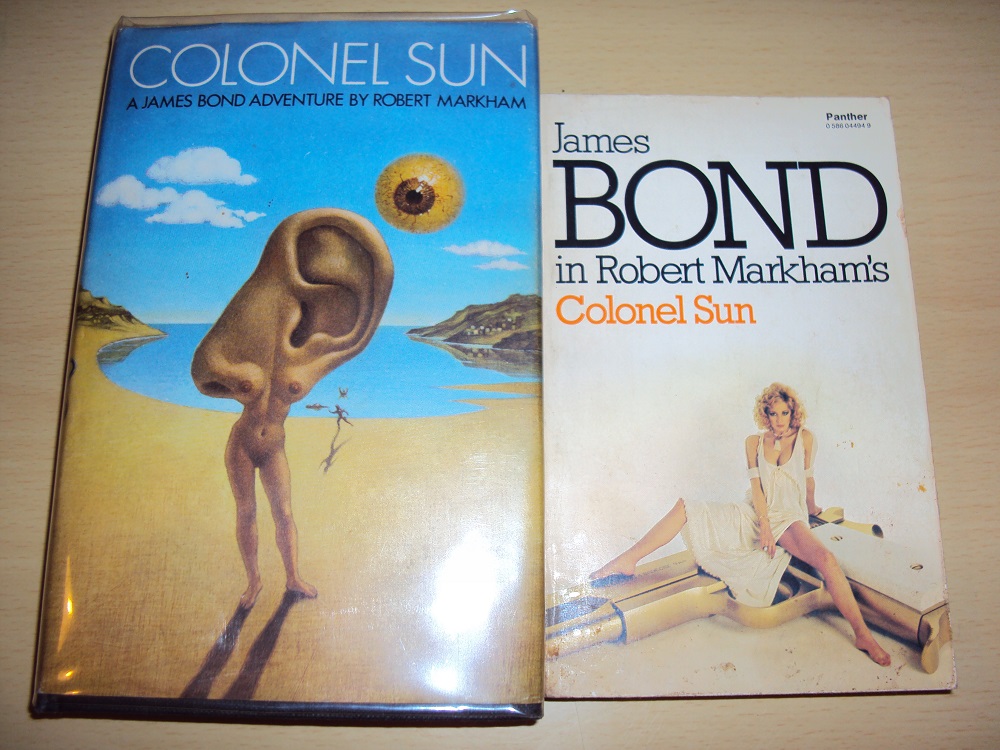
The latest Bond film, Spectre, contains many references to previous films and Ian Fleming's novels, and I listed some of these in my last post. But as Ian Fleming Publications recently revealed, Spectre also incorporates elements from Colonel Sun, the 1968 continuation Bond novel by Kingsley Amis.
 

I've identified the scene below, and while I don't describe it in detail, those who have yet to see the film may wish to look away now.

One of the classic elements of a Bond film is a scene of torture. Casino Royale had one, as did Die Another Day and, before that, The World Is Not Enough. Spectre has one too, and it is this scene, involving thin pointy instruments applied to the head and set in the villain's lair, which is lifted from Colonel Sun.

If there was any doubt that the screenwriters had looked through the pages of Colonel Sun for inspiration, it is confirmed by a line given to the villain – a philosophical thought about what the lack of eyes does to the essence of a man – which is taken almost verbatim from the novel. (I'm not certain, but I think he has another line from the novel, said when he directs Madeleine Swann to a chair.) These references, by the way, are from chapter 19, 'The Theory and Practice of Torture'.

As The Book Bond has pointed out, this may not be the first time Colonel Sun memes have been included in a Bond film. Die Another Day has the character Colonel Tan-Sun Moon, and in The World Is Not Enough (those two films again!), M is kidnapped, just as M is kidnapped in Colonel Sun.

I wonder if there is another reference. On the final page of Colonel Sun, James Bond and Ariadne, the heroine and GRU agent, talk about having to part and return to their duties. Ariadne says, “People think it must be wonderful and free and everything. But we're not free, are we?” Bond replies, “No. We're prisoners. But let's enjoy our captivity when we can.” This reminds me of the final exchange between Camille and Bond in Quantum of Solace (“I wish I could set you free. But your prison is in there”, Camille says, indicating Bond's mind).

Admittedly, this final reference seems less convincing than the others, but given the repeated nods to Colonel Sun in recent films, the writers, chiefly Robert Wade and Neal Purvis, clearly have had Amis' book in mind when coming up with ideas, and it is reasonable to suggest that their films contain other references.

Incidentally, Amis wrote Colonel Sun as Robert Markham, but the new edition of the book, published by Vintage, has dropped the pseudonym altogether. This no doubt improves the book's marketability, but the timing is interesting too. Any new Bond film brings with it glut of Bond-related books and reissues, all hoping to benefit from the film's publicity. But the reissue Colonel Sun has been a while coming; the last UK edition appears to have been published in the mid 1990s. Given that Spectre unambiguously contains elements of the novel, Vintage could almost have published Colonel Sun as a film tie-in.

Returning to Spectre, the references to Colonel Sun are significant, as until now it had been thought that there was reluctance within EON to adapt the continuation novels. Does that mean that we're going to see more of the continuation novels in the Bond films? If so, top of my list for an adaptation is Anthony Horowitz’s excellent Trigger Mortis. I wouldn't mind betting that the motor racing section of the book, which is based on material by Ian Fleming and includes Fleming's own words, will eventually make it to the big screen. Remember, you read it here first!

Tuesday, 27 October 2015

The spectre of defeat or success? A review of Spectre

Warning: This review contains minor spoilers, so if you haven't already done so, you may prefer to watch Spectre before reading on.

When the title and principal cast of Spectre were announced back in December last year, the question on everyone's mind was how would director Sam Mendes top Skyfall. For me, this was not an idle question. The Bond films have a tendency to ratchet up the thrills and spills which each subsequent film to a level of ridiculousness that eventually requires the series to go back to basics. After the massive Skyfall, would Spectre be Daniel Craig's Moonraker or his For Your Eyes Only?

I needn't have worried. In Spectre, Sam Mendes has pulled off the trick of delivering a film that is at least the equal of Skyfall in action, stunts, terrifying villains, yet retaining focus on narrative and characters. The events are as incredible as anything in a Bond film, but we care about what happens to Bond, his colleagues, his loves, and even his enemies.

From its first moments (do not take your eyes off the screen in that first minute or so or you won't fully appreciate what is a superb piece of cinema) in Mexico's Day of the Dead festival, to its near-denouement in the desert of north Africa, Spectre is mesmerising. Considering its long running time, Spectre doesn't drag, although it has its fair share of quieter moments.

Spectre see Bond attempt to get to the bottom, or rather the top, of a mysterious organisation (SPECTRE, naturally). His efforts are unauthorised, and severely test the patience of M, although M has other matters to worry about: a merger of MI6 and MI5 pushed through by a cocky intelligence chief, Max Denbigh. Bond follows a globetrotting trail, on the way meeting Mafia wife Lucia Sciarra, indestructible henchman Mr Hinx, psychologist Dr Madeleine Swann, and head of SPECTRE, Franz Oberhauser, whose connection with Bond we learn is personal, as well as professional.

Traditional Bond is back with a vengeance. Bond does what he does best, powering through any obstacle, human or otherwise, to get to the truth, using any vehicle, object or person he can lay his hands on, all the while delivering the best one-liners since the days of Roger Moore. Nevertheless, reflecting current concerns about technology, the level of surveillance in society, the control of information, and, as heard around the SPECTRE meeting room, people trafficking, Spectre is by no means old-fashioned or nostalgic.

Part of the fun of watching a Bond film is spotting the nods and references to previous films and Ian Fleming's stories. And Spectre is filled with them. The novel of Thunderball has inspired much of the organisational set-up of SPECTRE, while the short story of 'Octopussy' is alluded to in a scene that sees the return of Mr White and, more fundamentally, in the character of Oberhauser. Bond's now famous white jacket is taken from Goldfinger, while a scene featuring Q and a cable car is redolent of Moonraker and For Your Eyes Only.

The Hoffler Klinik in the Austrian mountains brings to mind Piz Gloria, but I wonder too if there isn't a reference here to Ian Fleming's early experiences in Austria when he was sent to the Forbes Dennises at their villa in Kitzbühl to further his education. One of the subjects he studied was psychoanalysis, the very discipline that Dr Swann practises. Bond's close encounter with a health drink may also hark back to Shrublands.

Then there's the film of You Only Live Twice. To list the references would be to give too much away, but the allusions are clever and thrilling.

No film is perfect, and Spectre does have its faults. The film doesn't stay in one country for very long, giving us little time to settle down and enjoy the sights. Bond doesn't even have time to get his skis out in Austria. Perhaps the film has one ending too many, and the villain, like Silva before him, is implausibly omniscient.

But these are minor points. Spectre is, well, SPECTacular, and looks sumptuous as well. (If cinematographer Hoyte Van Hoytema isn't rewarded with an Academy Award nomination, there's no justice.) I have just two requests for EON when starting on the next Bond film. Can we have a story that isn't personal for Bond? And can we have Bond go through the adventure without going rogue?

Friday, 23 October 2015

The Man with the Golden Typewriter: some thoughts about the letters of Ian Fleming

I've just finished reading The Man with the Golden Typewriter, the volume of Ian Fleming's James Bond-related letters edited by his nephew, Fergus Fleming, and published by Bloomsbury. It's a wonderful read, and no fan of the Bond novels should be without a copy.

The volume includes correspondence that is likely to be familiar to aficionados, for example the exchanges between Ian Fleming and gun-enthusiast Geoffrey Boothroyd about Bond's armoury, and Fleming's letters to the wife of the real James Bond, the ornithologist whose name Fleming borrowed. Even these, however, include previously unseen material.

Much of the volume is taken up with Fleming's responses to the comments of his readers at Jonathan Cape – principally William Plomer, Daniel George and Michael Howard (Howard was initially lukewarm about publishing Casino Royale, but became a devotee of Bond's adventures) – which followed Fleming's submissions of the first drafts of his novels. Then there are Fleming's good-natured (and at times weary) replies to members of the public, who'd write triumphantly about errors they'd spotted.

Three aspects in the book fascinated me in particular. One concerns Fleming's celebrated writing style, which, as the letters reveal, developed over a number of novels with the help of Cape's readers. For example, in one letter to Fleming about the manuscript of From Russia, with Love, Daniel George pointed out the number of sentences beginning 'there was' or 'there were', and reminded Fleming of the excessive ands and buts and other conjunctions that resulted in long sentences. Comments such as these helped to tighten Fleming's writing and hone his style.

Another intriguing aspect were the ideas mentioned in correspondence that would eventually appear in some form in the Bond books. For example, in a letter written in 1954 to Somerset Maugham in which Fleming describes out-sized posters featuring Maugham as part of a Sunday Times promotion, Fleming imagined Maugham emerging from the lips of Maugham's own image. Fleming remembered and used the idea when he came to write From Russia, with Love (1957).

Similarly, in one of his letters to Fleming written in 1956, Geoffrey Boothroyd happened to mention some experience of archery. Fleming was intrigued, and asked Boothroyd who he (Fleming) might be able to approach for advice about technical aspects of archery. In the short story 'For Your Eyes Only', published in book form in 1960, the heroine Judy Havelock's weapon of choice is a crossbow.

Finally, something I hadn't appreciated before reading Fergus Fleming's volume was that Ian Fleming was responsible for writing the blurb that adorned the dustjackets of his novels. I had assumed it was someone on the staff of Jonathan Cape who wrote the text, but as the letters make clear, the blurb was usually Fleming's own words. For instance, evidently asked to amend his blurb for Thunderball, Fleming wrote to Michael Howard to say he didn't think his re-write was a great improvement. And in a letter to Anthony Colwell, also at Cape, Fleming admitted a spelling mistake in his blurb for The Spy who Loved Me.

The fact that Fleming wrote the blurb for his novels means that the Cape – and the Book Club editions, which carried the same blurb – have slightly more of Fleming's writing than any subsequent editions.

Fergus Fleming's The Man with the Golden Typewriter is a superb collection that complements Mark Amory's volume of Ann Fleming's letters, and joins Jon Gilbert's Ian Fleming: The Bibliography and Andrew Lycett's Fleming biography as an essential work of Fleming reference. The only question is, why have we had to wait so long for it?

Friday, 16 October 2015

A diamond a day - the 1971 Diamonds Are Forever competition

What are the essential ingredients of a James Bond film? The jaw-dropping stunts? The exotic locations? The thrilling action? In 1971, readers of the Daily Express were invited to rank what they considered to be the most important qualities out of twelve put forward by the paper as part of a competition to coincide with the release of Diamonds Are Forever. The list reveals that some forty years later, those defining characteristics of a Bond film have little changed.

The 'Diamond-A-Day' competition was run over ten days up to Christmas Eve. Readers had to select eight essential qualities and place them in order of importance. Entries were judged by a panel of experts (the identities of those experts were not given), and the winning entry – one for each day of the competition – was that considered to be the most 'meritorious'.

 
The Diamond-A-Day entry form
To improve their chances, readers could make up to six selections in a single entry, and in the event of a tie, readers' answers to a tie-breaker were taken into account; readers were given a photograph of a Bond girl and had to name the actress and the film in which she appeared. If that still didn't resolve matters, then competitors were invited 'to take part in a simple eliminating contest to decide the outright winner'. (The  nature of this contest isn't described, but the slightly sinister text does rather conjure up images of a gypsy girl fight or perhaps something involving piranhas.)

However competitors were eliminated to leave only one (for each day), it was worth the prize: a diamond. But there was more for the winner who was judged to have had the best entry across the entire competition: a cruise on P&O Canberra, the ship on which some scenes for Diamonds Are Forever were filmed.


So what were those essential qualities? They were:

  • Prolonged excitement
  • Fantastic gadgets
  • Good direction
  • Sean Connery as James Bond
  • Fabulous and exotic locations
  • Theme music
  • Excellent casting for supporting roles
  • Tense script
  • Romantic interest
  • Ian Fleming's original stories
  • Subtle humour
  • Abundance of gorgeous girls

We might want to modify some of the terminology (the last item is of its time somewhat), but overall, few would argue that those qualities are not still important ingredients in a Bond film. That said, the inclusion of 'romantic interest' may have been influenced by the previous film, On Her Majesty's Secret Service (1969), in which the romance between Bond and Tracy is a significant plot point. Otherwise, romances do not seem to play an important role, at least not until Casino Royale (2006), which charts Bond's relationship with Vesper Lynd.

We must naturally replace Sean Connery with the latest incumbent, but the characteristic nevertheless holds true – whoever plays Bond is important. There are some Bond fans who have been drawn into the series by Daniel Craig's portrayal, and others who don't admit the existence of any other Bond except Connery's. And of course, prospective candidates for the role continue to earn many column inches in the press and generate huge debate on social media.

Even the quality of 'Ian Fleming's original stories' continues to have relevance, possibly more so today than it did in 1971, as the scriptwriters of recent films, not least Spectre, take inspiration from Fleming's novels and short stories.

While the Bond films have seen many changes through its 50-year history, judging by the 'Diamond-A-Day' list published in the Express in 1971, the essential qualities of Bond films remain much the same, testament to how the creative team has remained faithful, both deliberately and subconsciously, to the earlier entries.

Saturday, 10 October 2015

The parallel lives of Peter and Ian Fleming

He was a journalist and best-selling author, he devised ingenious deceptions while working in intelligence during the Second World War, he travelled to parts of the world tourists don't normally see, and he was in awe of his brother. I could be describing Ian Fleming, but it's his older brother, Peter, who I have in mind. 


I've just finished reading Duff Hart-Davis' brilliant 1974 biography of Peter Fleming, and was struck by just how closely Ian's life mirrored Peter's. Of course, being brothers growing up together, one would expect their childhoods to be near-identical, but even in adulthood, their paths followed remarkably similar trajectories.

Both Ian and Peter developed an interest in writing from a young age and began their literary careers in journalism. Ian joined Reuters in 1931, while, in the same year, Peter started at The Spectator as assistant literary editor. The following year, Peter was preparing for an expedition to Brazil, ostensibly to search for the explorer Colonel Fawcett, who had gone missing some years before, and was approached by The Times to become its Special Correspondent and report on the mission. Ian was also a Special Correspondent for The Times, but in 1939, when he covered a British trade mission to Moscow (by then Peter was full-time on the staff of the paper).

Throughout their journalistic careers, Ian and Peter's output was to some extent similar. In 1937, The Times sent Peter on a tour of European cities: Paris, Rome, Prague, Vienna, Berlin and Moscow. Some twenty years later, Ian took his own tour of European cities, though on behalf of the The Sunday Times, visiting Hamburg, Berlin, Vienna, Geneva, Naples and Monte Carlo. After the war, Peter returned to The Times as a writer of fourth leaders, which were generally light-hearted takes on the news of the day, while at The Spectator, he wrote humorous and idiosyncratic pieces under the pen-name Strix. Ian's Atticus column for The Sunday Times, written between 1953 and 1955, shared something of form and function of Peter's work. And curiously, both Ian and Peter managed to write articles about shaving, Peter's article being published in 1946, Ian's appearing in 1960.

 
Two of Peter Fleming's books in one volume
Peter Fleming is best known for his hugely successful travel books, among them Brazilian Adventure (1933), One's Company (1934), and News from Tartary (1936). One of his earliest forays into fiction was written during the early stages of the Second World War, when Britain was threatened by German invasion. The Flying Visit (1941) imagined a Britain in which the German plan had succeeded. Peter wrote it in bed while recovering from, ironically, German measles, and though the story was not a children's book, he dedicated it to his young son, Nicholas. Ian Fleming would similarly write a book – Chitty Chitty Bang Bang (1964) – on his sick bed for his young son.

As for the Second World War, both Peter and Ian had what might be considered 'a good war'. Both worked in intelligence, which kept them away of frontline operations (although Peter would contrive, often unofficially, to be sent where the action was). Ian worked as assistant to the director of the Naval Intelligence Division (NID), while Peter, after a variety of roles, spent much of the war in the Far East running a unit known as GSI(d), which devised and executed methods of deception.

One of Peter's ruses was to take a corpse, provide it with the equipment of a British agent, including codes and a radio, and drop it into occupied Burma in the hope that the Japanese would find the body and start using the radio, which would transmit material back to British HQ in Delhi. If the plan seems familiar, then it may be because it was inspired by Operation Mincemeat, in which a body carrying disinformation was floated onto the Spanish coast for the Nazis to pick up. It's uncertain whether Peter was aware of it at the time, but he might have been amused to learn that the idea for that operation was Ian's.

Another wartime activity undertaken by both Ian and Peter was the setting up of commando units. Ian had his 'Red Indians', the 30 Assault Unit that would raid enemy territory to gather documents and other secret material. Peter, meanwhile, organised a commando unit in Greece on behalf of the SOE, and before that the XII Corps Observation Unit or Auxiliary Unit, which was a resistance force to counter a successful German invasion.

 
Ian Fleming alluded to Peter's wartime work in this collection
Among Peter's creations were underground hideouts, which were dug in woodland and concealed by vegetation and accessed by means of a trapdoor and rope ladder. The hideouts of course never saw hostile action, but Peter described them in his unpublished novel, The Sett, and they are likely to have provided the inspiration for the Soviet agents' underground bunker in Ian's short story, 'From a View to a Kill'. Indeed, Ian alludes to his brother's work in the story. Remarking on the sophistication of the Russian hideout, Bond considers that it was “far more brilliant than anything England had prepared to operate in the wake of a successful German invasion.”

After the war, Peter settled more comfortably into his estate in Nettlebed in Oxfordshire, while Ian built Goldeneye, his house in Jamaica. Goldeneye was designed by Ian to admit as much of the outside – the breeze, the sounds, the smells, and occasionally the creatures – into the house as possible by means of large, spartan rooms and enormous unglazed windows. Merrimoles, Peter's house on the Nettlebed estate, was built in 1938/9 with much the same principles in mind. Peter wanted plenty of doors and french windows and, as a friend suggested, the inside of the house to be like the outside. 

More generally, Peter and Ian had a similar outlook on life. Both were fatalistic and essentially irreligious and had been immensely affected by the events and acts of heroism they witnessed in the Second World War. They believed that the war showed Britain at its best, and expressed disappointment with values of the post-war generation. As for how they regarded each other, Ian felt that he was in Peter's shadow and considered Peter a hero, while Peter looked up to Ian (quite literally, too – Ian was taller).

That's not to say that Ian and Peter saw eye-to-eye on everything. Peter was not fond of the Caribbean, while Ian detested shooting, unlike his brother, who shot throughout his life, and in fact died of a heart attack in 1971 while out shooting in Scotland.

The lives of Ian and Peter Fleming were different in a number of respects, yet both enjoyed similar careers and successes, and had a lasting cultural impact on the lives of many others. Parallel lives, indeed.

References:

Hart-Davis, D, 1987 Peter Fleming: a biography, Oxford University Press, Oxford
Lycett, A, 1995 Ian Fleming: the man behind James Bond, Turner Publishing, Atlanta

Thursday, 1 October 2015

Stepping into James Bond's shoes

The shoemakers Crockett & Jones recently announced that they have been responsible for keeping James Bond appropriately shod in the upcoming film, Spectre. The Northampton-based company has supplied several models of 'Goodyear-welted' footwear, among them three styles of boots (Camberley and Radnor in black calf leather, and Northcote in black wax calf), and three styles of shoes (Alex in black calf, Norwich in black calf, and Swansea in brown suede).

As attractive as this footwear is (and, yes, I have entered the company's Spectre competition for the chance to win a collection of Bond's shoes worth over £200), there is at least one style of shoe missing: the slip-on. The literary Bond “abhorred shoe-laces” (OHMSS, chapter 2) and, when not sporting sandals or golf shoes, wears black casual shoes or well-polished black moccasins (for example in Moonraker, chapter 3). Admittedly the Camberley boot has no laces, but it is fastened by straps, which might still cause Bond to think twice before putting them on.

Then again, Daniel Craig's Bond is pretty used to lace-ups. In Casino Royale (2006), we see him crouch down to fix his shoelaces (or pretend to) in front of a Bahamian hotel.


Curiously, it was another Northampton-based company (at least for correspondence; the company was founded in Norwich) that was among the earliest shoemakers to use James Bond to promote their range. In March 1965, the Norvic Shoe Company ran an advert alongside the first part of the serialisation in the Daily Express of The Man with the Golden Gun. The advert (“Norvic 007 shoes show the kind of man you are”) featured a style of shoe (M11) within the 'Norvic 007' range, which comprised ten styles, all branded with the 'James Bond signature' and '007 golden tag of quality'. It's difficult to tell from the picture, but to me the M11 style is a slip-on. The literary Bond would be pleased.
Advert for Norvic 007 shoes, Daily Express, March 1965
Norvic's advert reminds us that companies have been eager to associate their products with the perceived traits or memes of James Bond – in this case a man-of-the-world character and an appreciation of quality and style – for the past 50 years (longer, in fact, when one considers the 1961 adverts for a range of Bond-inspired clothing by Courtelle). The Norvic advert also reveals that the publication of the latest Ian Fleming novel was greeted with something of the fanfare that accompanies the release of every Bond film.