While the James Bond of the cinema is rarely seen carrying a book (a volume on heraldry in On Her Majesty's Secret Service is a rare example), the literary Bond is, well, more literary. You can find a general discussion of the books on Bond's bookshelf here, but in this post I want to focus on one particular volume – Profiles in Courage by John F Kennedy and published in 1956.

Profiles in Courage appears in Ian Fleming's final full-length novel, The Man with the Golden Gun (1965). Bond is in Jamaica on the trail of professional hitman Francisco Scaramanga. In chapter 7, Bond arrives at his hotel, settles into his room, calls room-service, and reads Profiles in Courage as he sips an ice-cold bourbon.
Fleming undoubtedly knew the book well. The chapter to which Bond turns, which is an account of US senator Edmund G Ross, who at the impeachment of President Andrew Johnson in 1868 saved the president from conviction, is indeed subtitled, 'As I looked into my open grave'. This is chapter 6 out of 11; the book also includes profiles on president John Quincy Adams, 19th-century senators Daniel Webster, Thomas Hart Benton, Sam Houston, Lucius Lamar, and George Norris, and 20th-century senator Robert A Taft.
By referencing Kennedy's book, Fleming returned the compliment that Kennedy paid him when in 1961 he included From Russia, with Love in a list of his top ten books. Fleming's reference was also something of a tribute to Kennedy, who had been assassinated in November 1963. Earlier that year, Fleming had dined with Kennedy, and the two had got on enormously well, especially when Fleming suggested some innovative ways of dealing with Fidel Castro. It is notable that in the reference in his novel, Fleming uses the more familiar 'Jack Kennedy', rather than 'John F Kennedy'.
The edition shown here is a 1961 paperback. We don't know what edition Bond reads, but no doubt Bond would have found a paperback convenient for travelling, being easily packed in his suitcase.
Reference:
Lycett, A, 1995 Ian Fleming: The Man Behind James Bond, Turner
 Charles Helfenstein has done it again. After astounding the Bond-fan community with his exhaustive account of the making of On Her Majesty's Secret Service, the author has returned with another extraordinary behind-the-scenes look at a Bond film. Why Helfenstein settled on The Living Daylights is not explained, but like On Her Majesty's Secret Service, Timothy Dalton's first Bond film represents something of a milestone for the series, heralding a more serious Bond firmly rooted in Fleming, which continues to resonate today in the era of Daniel Craig.
Helfenstein's examination of the film begins with Ian Fleming's short story of the same name. The origins of the story lay in the murky landscape of 1960s' Berlin, the front line of the Cold War where defection, assassination, clandestine meetings, shady deals and acts of notorious individuals were a near-daily occurrence. As usual, Fleming distilled a tremendous amount of research into the story, having for example visited important locations, read up on the latest sports rifles, and perused catalogues of classical recordings for the perfect music to defect to. Fleming also took a personal interest in the illustration to accompany the story's publication in the Sunday Times Magazine. The image, a heart pierced by an arrow, had originally been considered for the dustjacket of The Spy Who Loved Me, and recalled the bleeding hearts motif of the Casino Royale first-edition cover art. Unfortunately for Fleming, the design was rejected for a second time.
Most of the Helfenstein's book, though, is naturally concerned with the film adaptation. After Roger Moore resigned from Bond duty in 1985, early drafts of the Bond film to follow A View to a Kill presented an origins story for Bond, taking him back to his time as an officer in the Royal Navy and his early brushes with British intelligence. Bond is introduced to the key personnel – M, Q and Moneypenny – and, 26 years before Skyfall, is returned to his ancestral home in Scotland. The ideas of Skyfall may seem radical, but their seeds were planted long before.
The treatment, however, was rejected, and screenwriters Richard Maibaum and Michael G Wilson began work on what would become The Living Daylights. Helfenstein dispels the myth that screenplay was written with Roger Moore in mind, although it is notable that the film's story boards show a Bond that looks remarkably like (a youthful) Roger Moore.
But with Roger Moore hanging up his Walther PPK, who was going to play Bond? That Pierce Brosnan had actually been awarded the role before his commitments to the TV show Remington Steele pulled him away is well known, but there were a host of other candidates in the running. There were, as well, many more names mentioned by the press, which has served to confuse the history of the casting. While Helfenstein is correct to name Mark Greenstreet as one of the actors who auditioned for the role, I am not certain that his information on Trevor Eve is so accurate. Though the author, citing John Glen, names him as an official candidate, Trevor Eve, in response to my enquiries, told me that he was never screen-tested, though he did have an informal meeting with Barbara Broccoli.
Ultimately, the prize of playing Bond went to Timothy Dalton. Reading Helfenstein's book, one is reminded of just how committed Dalton was to the role. He read and analysed the Bond books for clues to his portrayal, and was quoted as saying that he approached the role with a responsibility to Fleming's writing. Dalton was keen to perform as much stuntwork as he could (“I was terrified”, said second-unit director Arthur Wooster), while director of photography, Alec Mills, remembered Dalton's intensity: “You really believed he was going to kill him [Koskov]”.
For director John Glen, filming in Austria reacquainted him with the locations of The Third Man, on which he was assistant editor, and these, along with the shared themes of subterfuge and intrigue, allowed Glen to repeat some of the tricks of The Third Man and in places give The Living Daylights the look of a classic film-noir.
The Living Daylights opened to very healthy ticket sales and a generally favourable reaction. Helfenstein has assembled a collection of reviews, both positive and negative, that remarkably could have been written today in response to any of Daniel Craig's films. Variety thought the film a “cut above the series norm of super-hero fantasy”, while Time suggested that “the film forfeits sniggering humor [sic] to accentuate action and character.” Some of the negative reviews focused on the villains, who were thought not sufficiently larger than life or deadly enough, and pointed to the film's relative lack of humour. “Fight scenes are conducted in grim silence and in the most swift and expedient fashion”, wrote the BBC's Tom Coates.
Charles Helfenstein's book, lavishly illustrated, is a superb achievement, and deserves to be read by every Bond aficionado. In light of Daniel Craig's portrayal, the book also reminds us that, while Timothy Dalton's Bond was not necessarily ahead of its time – The Living Daylights packed cinemas and Dalton's tenure was assured into the 1990s – the direction in which Craig's films have been taken was a path first trodden back in 1986/87 (and indeed intermittently through the Pierce Brosnan era).
Sebastian Faulks, author of the continuation James Bond novel, Devil May Care, is to turn his attention to another English literary institution and continue the adventures of PG Wodehouse's best-known characters. Invited by the Wodehouse estate to revisit the world of Bertie Wooster and his valet, Jeeves, Faulks' novel, Jeeves and the Wedding Bells, will be published in November.
Just as with Bond, Faulks encountered Jeeves and Wooster from an early age, reading his first Jeeves story by the age of 12 (he first read Fleming aged 13). And both Bond and Wooster have been victim to Faulks' ingenious literary parodies, initially written for the BBC radio quiz, The Write Stuff, and subsequently published in the 2006 volume, Pistache. In his Fleming parody, Faulks imagined Bond shopping in a supermarket. For Wodehouse, Faulks gave Wooster the voice of Raymond Chandler's hard-boiled detective, Philip Marlowe.
Beyond these rather loose connections, the worlds of Wodehouse and Fleming have only fleetingly coincided. When we are introduced to Donovan 'Red' Grant in Fleming's From Russia, with Love, we learn that Grant is reading, or at least carries for form's sake, a copy of Wodehouse's 1913 novel, The Little Nugget. As far as I can tell, Wodehouse doesn't appear to have returned the compliment by having one of his characters read a Bond novel, but there are suggestions in his novels written after the release of the film of Dr No in 1962 that Wodehouse responded to the success of the Bond films.
Frozen Assets, published in 1964 (the year Goldfinger was released and a year after the release of From Russia With Love) features a sub-plot in which one of the main characters, Christopher Biffen, or Biff, is persuaded to take who he thinks is a Russian spy to a club to get him drunk and reveal his secrets. But “aren't international spies inclined to be on the cagey side?”, Biff wonders. In Do Butlers Burgle Banks, Wodehouse's novel published in 1968 (a year after the release of You Only Live Twice and Bond spoof Casino Royale), burglar Horace Appleby, having been away, asks one of his gang-members, Ferdie the Fly how he occupied himself during Appleby's absence. “Went to the pictures...one of those spy things”, is the response. And in The Girl in Blue, published in 1970, we learn that Crispin Scrope, owner and resident of Mellingham Hall had not acquired the taste for any book with spies or a couple of good murders.
Well, as George Baker's Sir Hilary Bray says in On Her Majesty's Secret Service, “It's not the sort of thing we rely on”, but it is possible that these references to spies reflect an awareness of the Bond films (and novels) and growing 'Bondmania', just as a passage in Aunts Aren't Gentlemen (published in 1974) in which Bertie Wooster encounters a protest march in London, reflects a period of protest against the government and the Vietnam War, among other issues.
In any case, there is one more certain connection between Fleming and Wodehouse – a dislike of a particular way of serving boiled eggs. In Live and Let Die, when Bond and Solitaire eat at a diner in Jacksonville (chapter 12), Bond complains of the American habit of serving boiled eggs mixed up in a teacup. Galahad Threepwood has the same complaint in Wodehouse's Galahad at Blandings (1965). “When you ask for a boiled egg, they bring it to you mashed up in a glass”, he complains.
After 60 years, James Bond is proving to be as immortal a character as Sherlock Holmes. Bond's longevity owes much, of course, to Ian Fleming's writing and the success of the films. But there are other aspects that help keep James Bond current in popular culture. One small aspect is the titles of Fleming's novels. Whether they play on common expressions (Live and Let Die), use the intriguing-sounding names of characters (Dr No or Goldfinger), or derive from official phrases (On Her Majesty's Secret Service), the titles are certainly memorable. And being memorable is a hugely important factor, along with adaptability, that has allowed some of the titles to become successful memes in their own right, being used in a range of different contexts away from the books or films.
One area in which the titles have had life beyond Fleming and the films is other books, as a search through Amazon reveals. Take From Russia, With Love. There are dozens of variations: From Greece with Love, From Manhattan with Love, From Hell with Love, From Baghdad with Love, From Russia with Tough Love, From London with Love, From Notting Hill with Love...Actually, From Somalia With Love. The list goes on, and is potentially endless, thanks to Fleming's use of the word Russia, which can be replaced with any other place name, making his title highly adaptable, usually in this case for travel books or accounts of journeys.
If From Russia, With Love, is the top title for adaptability, The Spy Who Loved Me comes a close second. Here, the word spy has given the title variability. So there is The Viscount Who Loved Me, The Dragon Who Loved Me, The Wolf Who Loved Me, The Vampire Who Loved Me, The Droid Who Loved Me, The Nerd Who Loved Me, and The Saint Who Loved Me, among many others. Most of these books are novels, and it may have amused Fleming to know that a good proportion of those fall under the category of erotic fiction.
Authors of erotic fiction have also looked, perhaps inevitably, to For Your Eyes Only for inspiration. For His Eyes Only and For Her Eyes Only are two examples. But the title, which itself derives from a phrase used in intelligence circles, has been used less salaciously for non-fiction, such as For the President's Eyes Only, which is an account of US Intelligence through successive presidents. In a similar vein, the title In the President's Secret Service, a history of the US Secret Service, may have derived from Fleming's On Her Majesty's Secret Service. If this is arguable, then there is surely less dispute about At Her Majesty's Secret Service, Sherlock Holmes on Her Majesty's Secret Service, Her Majesty's Secret Service, or On His Majesty's Secret Service.
As noted, Fleming turned to a well-worn phrase, 'live and let live', when naming his second novel, and it could be argued that Live and Let Shop and Live and Let Love are further variations of the original expression, rather than adaptations of Fleming's title. However, the titles Liver Let's Die, Live and Let Spy and Live and Let Dive, must derive from Fleming, as the choice of words to rhyme with 'die' indicates. Fleming again thought of a common expression for his penultimate full-length novel, 'you only live once' becoming You Only Live Twice. Other authors have in turn been inspired by Fleming, as is clear by the use the word 'twice' in, for example, You Only Die Twice and You Only Love Twice.
When Fleming arrived at The Man with the Golden Gun, he may have been inspired by The Man with the Golden Arm, a 1955 film starring Frank Sinatra. As Fleming shows, the final word in the original title makes it reasonably adaptable, and other authors have provided alternatives: The Man with the Golden Torc, The Man with the Golden Plow, The Man with the Golden Flute, The Man with the Golden Cuffs, The Man with the Golden Handshake, and the Man with the Golden Touch. The final two are certainly derived from Fleming. The Man with the Golden Touch is Sinclair McKay's excellent account of the rise of the Bond phenomenon, while The Man with the Golden Handshake, a collection of cartoon strips featuring the character Alex, references the gunbarrel sequence on its cover.
When Ian Fleming settled on some of the titles for his Bond novels, he devised titles that were memorable and variable, qualities which have allowed them to replicate, spread and evolve as entities separate from the world of James Bond.
“No one has ever stirred a Martini. That's not how you make a Martini.” When Seth MacFarlane, in a commercial for the 2013 Oscars, berates Pierce Brosnan's James Bond for suggesting that a Martini could be stirred (assuming that MacFarlane didn't mean to say 'shaken'), he joined a long-running debate about how James Bond's favourite tipple (at least in the films) is prepared. The argument is at least as old as the film series itself, and to an extent is perpetuated by a confusion about different types of Martinis.
One of the earliest references to Bond's Martini outside the Bond books can be found in Booth's Handbook of Cocktails and Mixed Drinks, by John Doxat and published in 1966. Doxat writes, “I don't know if he was the first, but James Bond Esquire caused some consternation in the world of the Dry Martini when he asked for a 'Dry Martini – shaken, not stirred.'” He continues that the opinion of all but a fringe group maintains that a dry Martini must be stirred. Brusque shaking “bruises the gin”, although interestingly Doxat dismisses this view as an affectation.
 But by 1966 Bond had ordered more than dry Martinis (that is, a Martini made with gin). The film of Dr No (1962) saw Bond take a vodka Martini, while Bond consumes a dry Martini in From Russia With Love (1963) and Goldfinger (1964). Both types of Martini, though, were 'shaken, not stirred'. In the books, the frequency of gin and vodka Martinis is more evenly divided though the series, though crucially in Dr No (1958), which introduces the phrase 'shaken, not stirred', his Martini is made with vodka.
The difference between Martinis is critical. While a conventional dry Martini tends to be stirred, it is generally acceptable to shake a vodka Martini. This distinction is made in more recent cocktail guides. James Bond is referenced in Mittie Hellmich's Ultimate Bar Book (2006), but only under 'Vodka Martini'. The guide recommends that the cocktail is shaken. The section dealing with dry Martinis makes no mention of Bond, and also specifies that the drink is stirred. Similarly, in Jeremy Harwood's Cocktails, a Collins Gem guide published in 2004, James Bond is credited with popularising the vodka Martini. Those making the drink are told to remember the essential precept: 'shaken, not stirred'.
So although Bond is 'correct' to order his vodka Martini 'shaken, not stirred', he goes against the bar-tending community by extending the instruction to dry Martinis. He has, of course, Ian Fleming to thank for that. As David Leigh reminds us in his Complete Guide to the Drinks of James Bond, Fleming wrote an article containing instructions on how to order a Martini in a pub, stipulating that the ingredients (including gin) be shaken vigorously.
The view that Bond is wrong to order his Martini 'shaken, not stirred' is a 50-year old meme that shows no sign of abating. But it is a debate, along with repetition of the order through the film series, which has helped to ensure that Martinis of whatever type are closely associated with James Bond. The Martini section of any book of cocktails is likely to include a reference to Bond, while the word 'Martini' itself instantly conjures up an image of James Bond in many minds.
Indeed, the association is older than the film series. The advertisement below for fashion by Courtelle, modelled in the advert by James Bond, was published in the Daily Express in May 1961. It asks readers, “How do you see James Bond? Sipping vodka Martini – ice-cold, stirred, not shaken (sic) – on the fronded terrace on a distant sea-girt Government House?” The advertisement shows that not only were Bond and the Martini synonymous by 1961, but that the phrase 'shaken, not stirred' had escaped the pages of the novels as a meme and began to have resonance in popular culture before Dr No hit the screens.
There were mixed fortunes for Skyfall at the 2013 Academy Awards. Of the film's five nominations, two brought home the Oscar – Best Song, won by Paul Epworth and Adele, and Best Sound Editing, won by Per Hallberg and Karen Baker Landers. There was, however, disappointment for Roger Deakins, who lost out to Life of Pi in the best cinematography category, Scott Millan, Greg Russell and Stuart Wilson, who saw Les Misérables take the honours for Best Sound Mixing, and Thomas Newman, who lost to Life of Pi for Best Original Score.
Unfortunately, my predictions for Oscar success made in a recent post proved more accurate than I had hoped. Looking at previous winners in the categories in question, I suggested that Skyfall's best chance for an Oscar was in the sound editing category. I thought the award for sound mixing would go to either Les Misérables or Lincoln, and that Argo or Life of Pi would win the Oscar for its score. However, while I suggested that Skyfall would lose out in cinematography, I looked to Lincoln or Anna Karenina, rather than Life of Pi, which was a somewhat controversial winner in the category. For best song, I thought that Life of Pi or Ted might have the best chance, given the history of past winners.
Naturally I hoped that Skyfall would win in all categories, although I don't mind admitting some satisfaction with the methods and results of my statistical analysis, which highlighted a number of trends in certain categories across the history of the Academy Awards.
Although on the night Skyfall didn't come away with all five Oscars for which it was nominated, to win two is nevertheless a tremendous achievement for the film. The Oscars (along with the other nominations) represent the first Academy recognition for the Bond series since Cubby Broccoli's Irving G Thalberg award in 1982, and the first winners since John Stears' award for his visual effects work for Thunderball in 1965.
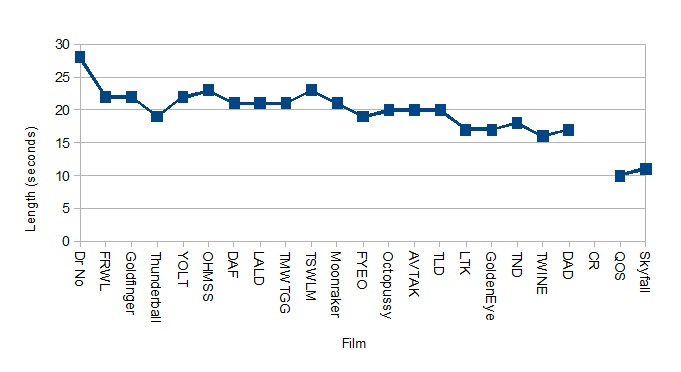
In an earlier post, I traced the evolution of the gunbarrel sequence, identifying some of the changes that have occurred through the series. I suggested that for style each sequence generally followed those that immediately preceded it (for instance, a gunbarrel sequence from a later Roger Moore film is closer in style to an earlier Roger Moore sequence than it is to a gunbarrel sequence from a Sean Connery film). I also noted that the sequence was becoming shorter over time; excluding that from Dr No (28 seconds) as an outlier, the sequence in From Russia With Love (1963) was 22 seconds, while that from Die Another Day (2002) was 17 seconds. Between these points, a reasonably steady decrease in length is evident.
While the gunbarrel sequence for Daniel Craig's first Bond film, Casino Royale (2006) was incorporated into the narrative of the film, that for Quantum of Solace (2008) was more traditional in style, although it had been moved to the end of the film. It was also the shortest of the series at just 10 seconds. I thought this anomalous, and predicted that the gunbarrel sequence for Skyfall would be about 15 or 16 seconds long in line with the trend ending with Die Another Day. I should, however, have looked again at the pattern of evolution that I outlined.
Against much expectation (and not a little disappointment), Skyfall's gunbarrel sequence was again placed at the end of the film. Director Sam Mendes has said that he attempted to restore the sequence to the beginning of the film, but found that it didn't work next to the opening scene of Bond walking towards the camera. However, there is a musical nod to the sequence at this point, as the opening bars of the James Bond theme are heard when Bond appears and turns a corner to begin his walk towards the camera. Although the reasons for keeping the sequence at the end of the film are undoubtedly different from those for Quantum of Solace, the placement of the sequence in Skyfall nevertheless owes something to the previous film. Quantum of Solace set the precedent, which in turn was allowed by the radical treatment of the gunbarrel sequence in Casino Royale.
Skyfall's gunbarrel sequence also matches that of Quantum of Solace in length, lasting just 10.6 seconds. Far from being anomalous, then, the Quantum of Solace sequence appears to fit the trend for ever shorter sequences, which is continued in Skyfall. (Incidentally, the gunbarrel sequence which introduces the documentary, Everything or Nothing (2012), and features all six official Bond actors, who appear one after the other, is 15 seconds long, shorter even than the sequences of Pierce Brosnan's films. It seems that this sequence, too, fits the apparent trend.)
 The sequences of Quantum of Solace and Skyfall share other traits. In contrast to the earlier gunbarrel sequences, they lack the wobble of the barrel to represent Bond's would-be assassin falling to the floor after Bond has fired. And in both, Bond wears a lounge or business suit, rather than a dinner suit that had been seen in all gunbarrel sequences from The Spy Who Loved Me onwards.
The gunbarrel sequence of Skyfall follows a standard pattern. Just as the sequence of Die Another Day shares more attributes with the sequences of Pierce Brosnan's earlier films than it does with those of, say, Sean Connery's films, Skyfall's sequence is closest in style and length to that of Daniel Craig's preceding film, Quantum of Solace. It seems, then, that a new gunbarrel sequence is more likely to inherit the traits or memes of the films that immediately preceded it, and not of those made much earlier (although, of course, particular elements have survived and been passed on through the series). While factors such as long breaks between films and a new Bond actor are sufficiently isolating from earlier films to allow significant changes to the style of the sequence, the gunbarrel sequence in general continues to respond to a selection pressure to become ever shorter.