Showing posts with label ian fleming. Show all posts

Saturday, 5 September 2020

Ian Fleming's early literary appearances

Some of the works containing appearances by Ian Fleming

When he came to write the James Bond books, Ian Fleming frequently named his characters after his friends and acquaintances, and sometimes even gave the people he knew walk-on parts. In On Her Majesty's Secret Service (1963), for example, Irma Bunt points out to Bond the presence, in Piz Gloria's restaurant, of Lady Daphne Straight, an old girlfriend of Fleming's, and her husband Whitney, as well as Ursula Andress, fresh from her appearance in the film of Dr No (1962). Ian Fleming was not alone in this habit, and, even before the birth of Bond, had had the same treatment, appearing as a character in fiction and other literary works.

Ian Fleming's first literary cameo was in Public Faces, a 1932 novel by Harold Nicholson. The story, set a few years in the future, follows the tribulations of government ministers and their staff as they deal with a developing crisis and the threat of world war. (The nature of the crisis is somewhat different from the circumstances of the Second World War, but, with the story taking place in 1939, the novel was in many ways prophetic.) Ian Fleming appears towards the end of the novel as himself - a journalist at Reuters ("What's his name? Hemming? Oh, yes, I know, young Fleming") - and has a small, if unseen, role in ensuring world peace.

Alaric Jacob, a colleague of Ian Fleming's at Reuters, gave Fleming his second walk-on part. Scenes from a Bourgeois Life, published in 1949, is Jacob's part-fictionalised autobiography and a polemic on post-war Britain (he bemoans the growth of the suburbs and the rise of the nouveau riche, among other things). His account of his time at Reuters, or Telenews, as it is called in the book, includes a portrait of Fleming, who, in the book is goes by the name of Hugo Dropmore. In his recently published Ian Fleming: the Notes, John Pearson comments on the quotability of Jacob's character study. He's not wrong: it's full of zingers: 

"Hugo Dropmore was a cross between Mr Darcy and the hero of a book by Stephen McKenna" (a novelist whose characters tended to come from upper-class circles); 
"He looked like a young actor who has never toured, but started right in the West End"; 
"He seemed to know something about everything; but if a subject arose on which he was not informed, he would own it at once, and it no longer seemed to matter;" 
"His good taste was such that you never observed what he was up to until it was too late." 

I could go on. These have more than the ring of truth, but I can't imagine Ian Fleming being particularly displeased with the characterisation. The choice of pseudonym is interesting. Dropmore Press was the name of a small publishing house owned by newspaper baron James Kemsley. Ian Fleming was involved with Dropmore from 1949. I don't know whether or not Alaric Jacob based the name Hugo Dropmore on this, but the coincidence is striking.

Over the years, Ian Fleming developed a deep friendship with writer Noël Coward. Fleming had leased a beachside home at St Margaret's Bay in Kent from Coward, and the playwright was an early guest at Fleming's Jamaican home, Goldeneye, famously labelling it 'Goldeneye, Nose and Throat' on account of its resemblance to a hospital (ironically, a leading brand of eye medicine in Jamaica at the time was Golden Eye Lotion). The two became neighbours of sorts when Coward himself came to live in Jamaica. As Fleming discovered, the only problem with being friends with a playwright is that one can end up as a character in a play. This is precisely what happened to Fleming - twice.

Volcano, written in 1957, is a play set in the fictional South Sea island of Samolo, standing in for Jamaica. It focuses on six individuals, whose relationships are tested by marriage breakdowns and infidelities during the eruption of the local volcano. Early on, we discover that Adela Shelley, a widow and resident of the island, had had an affair with Guy Littleton, who has flown in from London with his wife Melissa. Coward based Adela on Blanche Blackwell, a neighbour of Coward's in Jamaica, while Guy and Melissa were a thinly disguised Ian and Ann Fleming. The play, while set far away from Jamaica, painted a picture that Ian and others would have recognised, fictionalising the real-life affair between Blanche and Ian and giving voice to the sort of feelings that Ann had expressed about Blanche, Ian and Jamaica itself. 

Goldeneye is also alluded to in the play. Guy and Melissa are staying at 'Le Tellier's beach house'. Melissa tells Adela: 

"Guy loves it because of the lagoon and the reef; he spends most of the day under water spearing those unfortunate fish...Mr Le Tellier must be a rather Spartan type, the furniture is so unforgiving. He built the house by himself, didn't he?"
Perhaps fortunately for Ian and Ann, the play was never publicly performed until 2000, although it did have a rehearsed reading in 1989, with Judi Dench in the role of Adela and her husband, Michael Williams, in the role of Guy. The play was performed again in 2012, with Judi's daughter Finty taking a role.  

Reading the play, I was reminded of 'Quantum of Solace', Ian Fleming's short story, published in 1960, which deals with the breakdown of a relationship. Though the tale was inspired most directly by 'His Excellency', a short story by Somerset Maugham, its themes could easily have been drawn from Coward's play. 

Noël Coward returned to the subject of love and lust in Samolo in his 1960 novel Pomp and Circumstance, a comical tale set against the backdrop of an impending royal visit. Ian Fleming once again proved inspirational, spawning a character called Bunny Colville, whose roving eye leads to all sorts of complications among Samolan high society. Bunny's tropical house, incidentally, has the hallmarks of Goldeneye: an uncomfortable house that overlooks a coral beach (accessed via concrete steps), a large living room, and the general appearance of an austere and over-masculine barrack. 

Since his death, Ian Fleming has made further appearances in novels, for instance in William Boyd's Any Human Heart. But it is worth returning to his earliest appearances - written by people who knew him best. 

References:

Coward, N, 1960 Pomp and Circumstance, Heinemann

Coward, N, 2018 Collected Plays: Nine (introduced by Barry Day), Bloomsbury

Jacob, A, 1949 Scenes from a Bourgeois Life, Secker and Warburg

Lycett, A, 1995 Ian Fleming: The Man Behind James Bond, Turner

Nicolson, H, 1944 Public Faces, Penguin

Saturday, 30 May 2020

Ian Fleming: The Notes - some questions

May saw the publication by Queen Anne Press of John Pearson's Ian Fleming - The Notes, literally a volume of the notes that John Pearson wrote up after his interviews while preparing his biography of Ian Fleming, published in 1966. John Pearson has called it a book about writing a book, but it is more than that. Packed with candid reflections by those who knew Ian Fleming that didn't necessarily appear in the biography, as well as John Pearson's initial thoughts and queries, the book is, in essence, the reading between the lines. 

The book is a perfect companion to the 1966 biography, adding detail and putting people, events, and places into better context. There are aspects, too, notably Fleming's wartime experiences, that evidently could not be properly addressed by John Pearson, but have since been examined more fully by subsequent accounts by Andrew Lycett, Nicholas Rankin, Henry Hemming and others. The book also alluded to other points of interest, mainly relating to Ian Fleming's writing, that don't appear to have been followed up in John Pearson's or subsequent biographies, but are nevertheless very intriguing. If anyone can supply any answers to my questions raised by these matters, I'd be extremely grateful.

001. Ian Fleming had once said to fellow author Eric Ambler that he (Fleming) had written some 250 television scripts while in the US. Presumably Ambler meant television treatments, of which we know of ten or so, some of which were recycled by Fleming for short stories or have now seen the light of day in Anthony Horowitz's continuation Bond novels. I'm assuming that 250 scripts is a gross exaggeration or that the number was misremembered by Ambler. But is there a chance that Fleming wrote many more than those we know about?

002. Hugh Vivian-Smith told John Pearson that, while at City stockbrokers Rowe & Pitman, Ian Fleming contributed to the firm's newsletters. Do these newsletters exist still in the company's archives? Can they be accessed?

003. John Pearson makes a note to himself that among the items of Fleming's writing to dig out is an adaption of One Arabian Night, a television script by Sydney Carroll for Cary Grant. Does this piece of writing exist? If so, what form of adaptation does it take - a novel, a short story?

004. Al Hart, Ian Fleming's editor at the publishers Macmillans, recounted a story that Ian Fleming had told Princess Margaret. The story was about a traveller that had arrived at a castle. He is welcomed in by the owner and stays the night. While in bed, the traveller is visited by a beautiful woman who sleeps with him. In the morning, the guest says to his host that he's sorry he didn't meant the host's wife. His host tells him that, to his great sorrow, his wife is a leper. This story sounds remarkably like 'The Visitor', a short story by Roald Dahl that was published in Playboy in 1965. In his interview with John Pearson, Roald Dahl said that Fleming came up with several story ideas, but the only one that Dahl took was 'Lamb to the Slaughter'. Might there in fact have been more, 'The Visitor' being one, or did Fleming take the story from Dahl before it was published?

005. Finally, the volume reminded me that John Pearson assisted Ian Fleming with his 'Atticus' column at the Sunday Times and on occasion wrote some of the copy. The dates of Fleming's tenure as Atticus remains a little fuzzy, and it's not always clear which entries he was responsible for. To the powers that be, would it be possible to have an edited volume of Ian Fleming's 'Atticus' containing a selection of his best or most interesting pieces (like this or this) and a precise chronology? 

Whatever the answers to these questions, Ian Fleming - The Notes is fascinating read and an essential addition to the Fleming scholar's library. 

Sunday, 24 May 2020

No Time To Die in the Gleaner

Back in 2013, during the 40th anniversary of the release of Live and Let Die (1973), I trawled through the archives of the Gleaner, probably Jamaica's best-known newspaper which James Bond reads from time to time in the novels, to find out how the newspaper covered the filming of Roger Moore's first Bond film, much of which was set on the island. 

The previous year, I delved into the Gleaner's archives to find out how the paper covered the filming of Sean Connery's first outing as Bond, Dr No (1962).  

Last year, Eon Productions returned to Jamaica to begin filming on Daniel Craig's final Bond effort (probably), No Time To Die. How did the coverage compare with that for Live and Let Die and Dr No? Did the presence of the film crew generate as much interest? Did James Bond still have a place in Jamaica's cultural environment? Once again, I took a look through the archives. 

The day after Eon's press conference to at Ian Fleming's former winter home, Goldeneye, James Bond was on the front page of the Gleaner on 26th April 2019. '007 comes home', ran the headline, with the article beginning with the familiar phrase: 'We've been expecting you, Mr Bond.' There was more inside the paper, with the item about the event taking up almost half a page. Apart from reporting what was revealed at the press conference, the article focused on the impact that the filming would have on the local economy; it was expected, the paper reported, that the filming would be mean employment for nearly a thousand Jamaicans, gaining work as extras, film crew and in support services, such as accommodation and transportation.

The Gleaner, 26th April 2019
The following day, the Gleaner published another photo of the launch event, this time of Daniel Craig, Naomi Harris and director Cary Joji Fukunaga being interviewed. 

In its entertainment pages on 15th May 2019, the Gleaner reported that Daniel Craig had been injured during filming in Portland at the eastern end of the island. The paper's coveraged remained positive, however, stating that such injuries are par for the course. The article also spoke to Jamaican radio celebrity Nikki Z, who, it was reported, might share some screentime with Daniel Craig in the film. Recounting her experience filming on set, she praised the way that the film had represented African-Americans: 'It wasn't something where you saw a lot of us "Europeaned" out.' Nikki Z continued: 'You saw so much culture from what I was involved in, it made me feel proud.'

The Gleaner returned to Bond on 26th June 2019. Kimberley Small reported on the release of a behind-the-scenes look at the filming in Jamaica. Though not a trailer, the video, accompanied by a 'groovy dancehall rhythm', was hugely welcomed, especially coming after a string of negative events, including news of a peeping tom in the women's toilets at Pinewood, and an explosion at the studio. The article also highlighted the incongruous appearance of Heineken, rather than Red Stripe beer in the Jamaican scenes. However, the article concluded that fans will nevertheless be getting 'giddy with excitement, to see their beloved MI5 (sic) agent having a romp on the Caribbean shoreline.'  

The Gleaner, 26th June 2019
An article on 25th July 2019 reported on the resurgence of the Jamaican film industry, thanks in part to the presence of the 'Bond 25' crew in the country. The article stated that the film had resulted in 400 jobs for Jamaicans. 

On 5th January, the Gleaner ran through the list of big cinema releases expected in 2020. Accompanied by a photo of Daniel Craig, the piece noted that Bond 25, now called No Time To Die, was scheduled for release in April. Since then, of course, Covid-19 arrived. January's piece won't be the end of the Gleaner's coverage, but for now everything is on hold. 

Comparing the coverage in 2019 with that for Dr No and Live and Let Die, it is striking how similar it is. For all three films, the Gleaner reflected interest in the jobs that the filming would generate, and the duration and location of the filming. Ian Fleming, who created James Bond at Goldeneye, was not forgotten either. 

What is different, though, is the more critical look at how Jamaica is being represented in No Time To Die. When the film crew touched down in April, they arrived in a very different country to that in 1962, when Jamaica had just become independent, and to a lesser extent in 1972, when the legacy of colonial rule (which never fully disappears) still cast a long shadow. One thing is certain, however: James Bond retains the power to generate headlines in Jamaica. 

Sunday, 12 April 2020

From The Property of a Lady to Octopussy: Snowman's Art of Carl Fabergé

This Easter, my thoughts turn to one man - James Bond and the part that a 'suberb green-gold Imperial Easter egg by Carl Fabergé' played in the film of Octopussy (1983). The egg and the auction in which it (or, rather, a fake) is sold are, of course, taken from Ian Fleming's short story, 'The Property of a Lady'.

Writing the story, Fleming turned to Kenneth Snowman's The Art of Carl Fabergé for inspiration and information. The 'Property of a Lady' of the story is a 'terrestrial globe designed in 1917 by Carl Fabergé'. This fictional piece is based on two separate works. One of them is an Easter egg in the form of a clock, which was never produced, but exists as a watercolour design. This was reproduced in Snowman's volume and also accompanied Fleming's story in The Ivory Hammer, Sotherby's yearbook in which the story was first published. The other is a miniature terrestrial globe, an early work that Fleming mentions in his story and is described in Snowman's volume (which Fleming also references).

Perhaps to acknowledge Kenneth Snowman's help in Fleming's research, the art expert himself appears as a character in the story. 


Kenneth Snowman's volume was also a sourcebook for the film's screenwriters (Richard Maibaum and George MacDonald Fraser) and prop-makers. 

During his briefing with M, with art expert Jim Fanning in attendance, James Bond is handed an auction catalogue, turned to the page in which egg, known as 'The Property of a Lady', is described. One can just about make out the text, which begins: '[Imperial] Easter Egg, known as the Coronation Egg, by Carl Fabergé. Presented to Her Imperial Highness the Tsarina Feodorovna by the Tsar Nicholas II in the year 1897.' The prop egg is indeed based on the real Coronation Egg (right down to the model of the imperial state coach), and the introductory words in the catalogue are taken almost verbatim from the entry for the Coronation Egg in Kenneth Snowman's volume: 'Coronation Egg. Presented to Alexandra Feodorovna by Nicholas II. Dated 1897.'


Much of the remaining part of the catalogue entry is based on Kenneth Snowman's text, but his description is also used in the film's dialogue. At the auction, the auctioneer describes the egg as: 'A superb green-gold lmperial Easter egg by Carl Fabergé. Enamelled in translucent green, enclosed by gold laurel-leaf trellis. Set with blue sapphires and four petalled gold flowers with diamonds.' Compare this to Kenneth Snowman's text: 'This superb red gold Egg, enamelled translucent lime yellow on an engraved field, is enclosed by a green gold laurel leaf trellis work cage.' 

In its adaptation of Ian Fleming's 'The Property of a Lady', Octopussy is remarkably faithful, not only to the short story itself, but also to its source material.  

Monday, 23 March 2020

Le Touquet: The final model for Royale-les-Eaux

Back in 2015, I explored the possible inspirations for the fictional seaside resort of Royale-les-Eaux, introduced in the first James Bond novel, Casino Royale (1953) and revisited in On Her Majesty's Secret Service (1963). I noted that the location had shifted between novels, being first on the Côte Picarde on the south side of the Somme estuary before moving north to the Côte d'Opale in Pas-de-Calais.

A trip last year to explore the French locations in Goldfinger (1959) took me first to Le Touquet, from where James Bond begins his pursuit of the gold-obsessed villain. The idea that Royale-les-Eaux is based, at least in part, on Le Touquet is not new. Jon Gilbert, for example, suggests as much in his 2012 volume, Ian Fleming: The Bibliography. However, a few days on Le Touquet's beach brought home to me just how closely some aspects of the fictional town, as described in On Her Majesty's Secret Service, were modelled on the French resort. 

Take the swimming pool mentioned by Ian Fleming in the opening chapter of the novel: 'Music, one of those lilting accordion waltzes, blared from the loudspeakers around the Olympic-sized piscine.' Le Touquet's beach-side piscine was certainly large enough to qualify as 'Olympic-sized' and could well have been what Fleming (a frequent visitor to the resort) had in mind as he wrote those words. 

The swimming pool, Le Touquet-Paris-Plage, in 1965

Ian Fleming then descibes three childrens' play areas on the beach of Royale-les-Eaux: Joie de Vivre, Helio and Azur. Today, there are six children's play areas on Paris-Plage, among them Joie de Vivre and Helio Plage. Whether these existed in Fleming's day, I can't be certain, but clearly Fleming had not conjured up the names purely from his own imagination.

Then there is the length of the promenade at Royale-les-Eaux: a full five miles, which is pretty much the length of the beach of Le Touquet-Paris Plage. 

While Ian Fleming did not base Royale-les-Eaux entirely on Le Touquet (Trouville and Forges-les-Eaux, I think, were equally important sources of inspiration), the descriptions of the fictional town, in its later incarnation, owed much to the resort. If you were to look at images of Le Touquet in the 1960s, then you could well be looking at how Ian Fleming pictured his creation and the opening scenes of one his finest novels.     

Sunday, 8 March 2020

Ian Fleming, the conservationist

Ian Fleming seems an unlikely champion of animal rights, but the evidence is there in his writing. That he was an animal-lover is clear from his heartfelt descriptions of animals, particularly birds and fish, in his James Bond novels. Scotland's red deer were also close to his heart. 
Red deer hind (image: Charles J Sharp / CC BY-SA (https://creativecommons.org/licenses/by-sa/4.0))
In his 'Atticus' column, published in the Sunday Times on 7th November 1954, Ian Fleming lamented the cruel and unnecessary killing of deer during the winter months, when the onset of snows forced the animals to lower pastures. There, Fleming told his readers, the stags and hinds made easy targets for farmers and poachers, 'who slaughter and wound them with whatever weapons they can muster.'

Fleming went on to refer to a parliamentary White Paper on the issue, which, while setting out the sad facts, had evidently failed to put a halt to the annual dispatch of deer. 'Eight months of cruelty to these beautiful animals has once again set in,' he concluded.

Unlike his brother Peter, Ian Fleming was no country-sports enthusiast. Once, as a boy, Ian was taken grouse-shooting near Glencoe in Scotland by his father Valentine, but he didn't enjoy the experience. On another occasion, at Black Mount also near Glencoe, Ian (aged 16) shot a stag, but he never made a habit of it, preferring to listen to records than going 'out of doors killing something.' 

Given Ian Fleming's concern for red deer, the depiction of a stag (itself presumably a nod to the stag shown on the Fleming family crest) on top of the gateway to James Bond's Scottish home in Skyfall (2012) seems entirely fitting. 

Tuesday, 18 February 2020

Interviews about James Bond – a review of two recent books


Books in which the authors talk to people about James Bond are like buses. You wait ages for one, then two show up at once. The first to arrive, slightly ahead of the second, is The Many Lives of James Bond: How the Creators of 007 Have Decoded the Superspy, by Mark Edlitz. The second is Nobody Does it Better: The Complete, Uncensored, Unauthorized Oral History of James Bond, by Mark A Altman and Edward Gross.


Mark Edlitz’s book is the slimmer of the two, but is no less interesting or insightful. The book contains interviews conducted by the author with individuals who in one way or another have created incarnations of James Bond or otherwise interpreted the character. In the book, you’ll find interviews with film directors (such as Martin Campbell), writers of Bond stories (Anthony Horowitz and Mike Grell), illustrators (among them John McLusky and Dan Goozee), computer game designers (Glen A Schofield), and, in a series of particularly absorbing interviews, people who have actually been Bond in some way, including Corey Burton (James Bond Jr), Dietmar Wunder (the German voice of Daniel Craig) and Simon Vance (audiobook reader). 

These are fascinating interviews. We get a wonderful sense of the craft required to create aspects of James Bond and the professionalism of the individuals concerned. Take the author’s interview with Jany Temime, for example. We learn that the clothes worn by Daniel Craig’s Bond when he arrives at Skyfall in the film of the same name were designed to evoke the gentleman farmer, as befitting the owner of a country pile, while Bond’s scarf was based on that worn by Field Marshal Montgomery. I’ll never look at the costumes in the films in quite the same way again.

And we get the definitive answer to a question that until now as never been fully resolved: are the lyrics to Thunderball about James Bond or the villain? Lyricist Don Black is unequivocal: James Bond. (I still feel, though, that they suit the villain better. I’d also like to add that the word ‘thunderball’ isn’t entirely meaningless, as is usually implied – it refers to the mushroom cloud created by an atomic bomb.)

Returning to the book, what is less successful, I feel, is the author’s attempt to gain insight through these interviews about the character of James Bond himself and find out what makes Bond tick. Questions about what motivates Bond (which Bond? There have been so many), whether Bond would still be Bond were he not a spy and other, similar questions, though philosophically interesting to an extent, seem tacked-on, while the answers are somewhat unconvincing.

Nevertheless, the book is a page-turner and deserves a place in every Bond fan’s bookshelf.

Altman and Gross’s effort is a somewhat different beast. Within the sizable tome (over 700 pages), the authors have assembled a comprehensive selection of quotations from many of the people connected with the James Bond films. Much of the content is based on interviews conducted by the authors, but the book includes material taken from other sources.


Arranged by film, including the two non-EON productions, the book takes a look the scriptwriting, casting, filming, publicity and reception of each release through the eyes of the people who were involved – directors, producers, actors, screenwriters and so on. The authors also talk to critics and popular culture commentators, who place the films in context and offer views on the impact that the films have had on them and society more generally in subsequent years.

The authors provide some linking text, but most passages are without any introduction or commentary. While this certainly gives readers a sense of that the views expressed are uncensored and ‘from the horse’s mouth’, the approach taken does present some difficulties. The historian, for example, might bemoan the lack of dates and sources. Which passages are taken from original interviews and which are reproduced second-hand? What are the dates of the quotations? Are they contemporary with the events being described or were they said years later? If the latter, might there be an issue with reliability? Sometimes we are presented with contradictory statements and, even after reading the various passages, remain none-the-wiser about the truth. (Were George Lazenby and Peter Hunt on speaking terms during the filming of On Her Majesty’s Secret Service or not? It seems we will never know.)


More serious is the absence of editorial intervention where what has been said is just plain wrong. Terence Young’s assertion that Ian Fleming died during a swim, hinting heavily that he committed suicide, is factually incorrect and should have been challenged by the authors, at least by way of a footnote. 

All that said, the book is an invaluable sourcebook of views and facts from the people who were closest to the production of the Bond films. The authors are to be congratulated for assembling such a useful resource. This is a book designed to be savoured, to dip in and out of, ideally with a vodka martini by one’s side.

Tuesday, 26 November 2019

Our Man in New York - a review


Hear the words ‘America First’, ‘fake news’ and ‘agents of influence’, we would probably think of Donald Trump’s presidential campaign slogan, the pernicious spread of disinformation via traditional news outlets and social media, and Russian interference in the US presidential election. To Ian Fleming, these phrases would have meant one thing – the British campaign, led by William Stephenson, to bring the United States into the Second World. In his new book, Henry Hemming reveals the full story of MI6’s head of station in New York and his audacious campaign, which till now has only partially been told.  

By June 1940, Britain was in trouble. France had fallen to the German forces as thousands of allied soldiers were evacuated from the beaches of Dunkirk. Merchant shipping, carrying vital supplies to the country across the Atlantic, faced constant threat from U-boat attack, and a German invasion of Britain seemed imminent. Winston Churchill knew that Britain would not win the war without America’s help. President Roosevelt was sympathetic to the cause, but his hands were tied; America was officially neutral and its population heavily anti-interventionist. Britain somehow had to overcome public opinion and break down powerful lobby groups. One man, MI6’s agent in New York, recognised that it had to be done by any means necessary. 

William Stephenson, a Canadian businessman and unlikely-looking spymaster, having brought himself to the attention of ‘C’, the head of MI6, was appointed to run an influence campaign in America. The work began uncertainly, but soon Stephenson knew what he had to do and in time built up an organisation – eventually given the cover name ‘British Security Coordination’ – that occupied an entire floor of New York’s Rockefeller Center. 

Henry Hemming has trawled through the archives and examined recently declassified files to reveal the full extent of Stephenson’s racket. The organisation run by Stephenson began rumours to discredit individuals sympathetic to Germany, devised opinion polls so that the results would appear more favourable, fed propaganda (and entirely false) stories to newspapers and radio stations, infiltrated campaign groups, set honey-traps and faked plans that seemed to put the Nazi threat on America’s doorstep. Stephenson himself cultivated a friendship with people close to the president, most importantly William Donovan, who would head-up the forerunner to the CIA.

As personal assistant to the Director of the Naval Intelligence, Ian Fleming weaves in and out of the narrative. Fleming’s part in the creation of what would become the CIA can be overplayed, and though Fleming was a key player, Hemming duly sets the record straight.
Hemming has not forgotten the Bond connection either. One of the two kills that earn James Bond his double-O status takes place at the Rockefeller Center. It’s worth noting, too, that William Stephenson would often meet people at the St Regis Hotel; James Bond stays there in the novel of Live and Let Die (1954).


There’s room, too, for other individuals who in time would leave a mark on James Bond lore. Ivar Bryce, Fleming’s friend and financial backer of the early attempts to bring Bond to the big screen, used his South American expertise during his time with BSC to fake a map that was almost decisive in bringing America into the war. (Interestingly, the same map is described as genuine in Room 3603, an earlier account of William Stephenson and the BSC. It’s fascinating to consider that Ian Fleming wrote a foreword to a book that he knew was far from the full story, as had been claimed on the dustjacket.) Roald Dahl, responsible for the screenplays of You Only Live Twice and Chitty Chitty Bang Bang, also worked for the BSC. I would like to have read more about Roald Dahl’s knack for digging out scandal that could be used to Britain’s advantage, as well the adventures he and Fleming enjoyed during their time together in New York and Washington away from the office, but perhaps that’s another story.

Our Man in New York is a fascinating read as thrilling as any work of fiction. There aren’t many history books that you’ll want to read in one sitting, but this is one of them. Henry Hemming has written a superb book that deserves a place on every Fleming aficionado’s bookshelf. 

Our Man in New York by Henry Hemming is published by Quercus in the UK and in the US (as Agents of Influence) by PublicAffairs.

Friday, 22 November 2019

On the trail of Goldfinger


During the summer, I went on an epic road-trip and retraced James Bond’s route in pursuit of Goldfinger from Le Touquet on the north coast of France to Geneva in Switzerland, as described in Ian Fleming’s 1959 novel. 

For just a few days I became Bond as I followed the same roads, drove through the same towns and villages, stopped at the same hotels and ate the same food mentioned in the novel. Along the way, I re-discovered a France before the construction of the motorway network and sights and places away from the usual tourist routes. 

An article about my journey has just been published in issue 53 of MI6 Confidential. Click here to find out more

I’ve also put together a short video, accompanied by a rocking soundtrack, that shows the route that Bond takes. Check it out! 

Thursday, 7 November 2019

Atticus and Bond: the inspiration for Rosa Klebb?

Atticus and Bond: the most beautiful money in the world


Sunday, 13 October 2019

James Bond in Biarritz?

During the summer, I took a road-trip from Le Touquet on the north French coast to Coppet in Switzerland, just north of Geneva, following the route that James Bond takes in the novel of Goldfinger (1959). At various points, James Bond consults a Michelin guide, and so to give me further insight into Bond's journey, I acquired a copy of a vintage edition of the guide, specifically the 1958 edition, the year in which Fleming wrote the novel.

When I returned to England, I watched On Her Majesty's Secret Service (1969), having also visited Piz Gloria while in Switzerland. It was then that I noticed for the first time that the book that Bond (George Lazenby) has on the passenger seat of his Aston Martin at the beginning of the film is the Michelin guide to France. Presumably, the edition used in the film is a more recent edition than mine, but it was nevertheless instantly recognisable. 

The Michelin guide, as seen on On Her Majesty's Secret Service

Sharp-eyed viewers will notice that the guide is open at a town plan that extends across two pages. Obviously, the map could not be of Estoril in Portugal, where the hotel scenes were shot and where Bond was presumably heading to in the film. Nor is the map that of Le Touquet or any other coastal town on the north French coast that inspired the fictional seaside resort of Royale-les-Eaux that appears in Casino Royale and On Her Majesty's Secret Service. So, what place does the map show?

After consulting my Michelin, carefully studying the maps that cover two facing pages and comparing them with a screenshot of the Aston's passenger seat, I can reveal that the map is of... Biarritz, the fashionable resort on France's south-western coast that has long been popular with the international jet-set. 

The plan of Biarritz, from the 1958 edition of the Michelin guide

While Biarritz the sort of place where James Bond would feel at home, it's unlikely that he's making his way there in the film. That said, Biarritz is not without a Bondian connection. In his biography of Ian Fleming, Andrew Lycett records that during a holiday there in the 1950s, Fleming decided to write a piece about casinos. The resulting article, 'How to win at roulette with only £10' was published in various forms, appearing, for example, along with references to James Bond, within the Monte Carlo chapter of Thrilling Cities.

Returning to OHMSS, I imagine that the set dressers simply required a town plan - any plan would do - that covered two pages and had relatively little text. They chose well. It's impossible to make out the name of the town on the screen and none of the other text is legible. And though film viewers can see that the book is open at a plan, the shot is gone in a blink of an eye. Details can only be made out after pausing the film.

Whether intentional or not, the appearance of the Michelin guide in the film provides a nice link to the literary 007, serving as a nod to James Bond's adventures in France in the novels. 

Wednesday, 14 November 2018

On location: a visit to the College of Arms

Last week, I was privileged to visit the College of Arms in London. The principal roles of this world-famous institution are to grant coats of arms, investigate rights to existing ones, and undertake genealogical research. However, to Bond fans, it is best known as a location in both the book and the film of On Her Majesty’s Secret Service. James Bond visits the college to learn about Blofeld’s request for its services to support his claim to the title of Count Balthazar de Bleuchamp (or Comte Balthazar de Bleuville, as it is in the book). Naturally, I took the opportunity to investigate the some of the spaces that inspired Fleming’s writing and the college scenes in the film.
 
The College of Arms
In the film, we are introduced to the college by means of an exterior shot of the front of the building, which is on Queen Victoria Street; Bond arrives in his Aston Martin and parks in the courtyard. This scene was shot on location and the building today is little changed.
 

The film cuts to an interior view of a hall, where Bond meets a porter in a cherry-red uniform (still worn today, a real-life porter at the college told me), who takes him through a side door to Sable Basilisk’s office. The hall is in fact the Earl Marshal’s Court, which may still, in theory, sit in order to hear and resolve heraldic disputes. The court in the film is a studio recreation, but apart from being larger and having more doors (through the long walls), it is a fair depiction of the real thing. The throne, enclosing rail, wall panelling, portraits, and flags present in the actual court are all represented on screen. The attention to detail is such that the screen court even depicts the crests and other devices above the doors and the radiators along the wall.
 
The court room in the College of Arms (top) and as depicted in OHMSS (below)
In the novel, Fleming describes the hall as gloomy, with ‘dark panelling…lined with musty portraits of proud-looking gentlemen in ruffs and lace’, and flags of the Commonwealth hanging from the cornice. Clearly, Fleming had visited the college himself.
 

During my visit, I got talking to one of the officers of the college, the York Herald. We chatted about the film, and he revealed that part of what would become the rooftop chase scene that was later deleted was filmed inside the college. A smaller room off the hall has a door in the corner. In the missing scene, Bond goes through this door ultimately to reach the roof.
 
Bond goes through this door on his way to the roof
The York Herald also pointed out that a few pages of the original script are on display in the corner of the court under a window. I eagerly went over to have a look and found that they featured dialogue from the deleted scene. (Photography of these pages is, incidentally strictly forbidden.)


Returning to the film, the porter leads Bond through a corridor to the door of Sable Basilisk. It is an ornate door, with an even more ornate name plate to the side. As I discovered as I explored some of the corridors after answering a call of nature, all the heralds’ office doors are rather elaborate. The office of Portcullis, for example, has a golden portcullis within a carved rosette-type device above the door. In the novel, Fleming describes the decoration above Sable Basilisk’s ‘heavy door’ as a nightmare black monster with a vicious beak, accompanied by a name plate in gold.
 
Doors of the heralds' offices
Today, the College of Arms is open to public enquiries, and I’m told that tours are occasionally given. The Bond connection is very much alive. Apart from the script, Bond-related books are on display on a table in the court room and available to purchase from the receptionist. The York Herald also told me that the college receives regular enquiries from Bond fans.

Sunday, 7 October 2018

Casino Royale - before Casino Royale?

Picture the scene: a high-stakes baccarat game at the casino. At the table sits our hero, who has come to the gambling resort to ruin his arch-enemy, who now faces him. The game is observed by the hero’s female companion, with whom he has fallen in love and to whom he has explains the rules of the game. The game proceeds, during which our hero wins several coups and his enemy limps off, a little wounded, after losing a lot of money and declining the challenge of our hero’s substantial bank.
 

Sound familiar? I could, of course, be describing events in the novel of Casino Royale (1953), but in fact this comes from the E Phillips Oppenheim novel, Prodigals of Monte Carlo, published in 1926. Monte Carlo provides the casino (obviously), Sir Hargrave Wendever is the protagonist, Violet is his beautiful companion, and his arch-enemy is called Andrea Trentino (or ‘Trentino – Andrea Trentino’, as Wendever tells Violet). As for their characters, we read that ‘Hargrave, if he lacked the other’s almost flamboyant insouciance, was nevertheless in his way emotionless.’


The novel itself is more romance than thriller, but it shares some of its elements – the contest across the baccarat table, the sophisticated location, the impassive hero, the captivating woman – with Ian Fleming’s first James Bond novel. Oppenheim was among the authors whom Fleming admired and credited as providing inspiration for his Bond books.
 

The similarity of the gambling scene may be coincidental, but it provides a connection between the two books and, it could be argued, places Casino Royale at a point of transition in the evolution of the thriller, being a novel that is set in the world of Oppenheim and others, but one whose outlook and style, shaped by Fleming’s wartime experiences, was distinctly modern.

Thursday, 27 September 2018

Who matches up with Bond?

Being a fan of Lee Child's Jack Reacher books, I was recently given a copy of Match Up, an anthology of short stories that pair up well-established characters from thrillers and crime fiction. The volume is edited by Lee Child, and naturally Jack Reacher makes an appearance, teaming up with Kathy Reichs' forensic anthropologist, Dr Temperance Brennan.


The idea of character crossovers is nothing new, though is largely restricted to television, films and comics, especially of the superhero kind (though I remember a somewhat bizarre episode of Murder She Wrote in which amateur sleuth Jessica Fletcher joins forces with Magnum PI). Characters from different novels rarely share the page together.

Unsurprisingly, Match Up got me thinking about James Bond and which other character he could join in an adventure. There are plenty to choose from – the many rivals in 1960s spy fiction for Bond's crown, for example – but there are two characters I'd put on my shortlist: Philip Marlowe and Jules Maigret. Their respective authors, Raymond Chandler and Georges Simenon, both have a connection to Ian Fleming. Fleming certainly admired their work. He knew Chandler well and had met and conversed with Simenon about their respective books. 

I would also like to find out the answer of an intriguing question. Raymond Chandler was once asked who would win if they found themselves up against each other, Bond or Marlowe? With a story featuring both characters, we might have a chance of finding out.

Actually, come to think of it, there is already a ‘match up’ of sorts – Clive Cussler’s Night Probe, featuring marine adventurer Dirk Pitt and a British agent called Brian Shaw. Clive Cussler based Shaw on Bond and indeed is reported to have intended the character to be Bond but was prevented by legalities.


There was another aspect about Match Up that interested me. In Lee Child and Kathy Reichs' story, Brennan is framed for the murder of a journalist, who had been investigating the suicide of an air force officer, one Calder Massee. It was believed that journalist had evidence that supported claims that Massee had in fact been murdered and that Brennan was part of the cover-up. But Reacher knows that it was a case of suicide and joins Brennan to get to the bottom of the conspiracy. 

How does Reacher know? The air force officer had been exposed as a spy, having passed secrets to the Russians (the back story is set during the 1980s at the tail end of the Cold War). As an officer in the military police, Reacher is sent to confront and arrest Massee. When they meet, they talk. Reacher later recounts, 'I laid out the situation. He begged me to let him shoot himself. He wanted to spare his family the disgrace.' 

Suicide to avoid dishonour is a familiar trope in fiction, but I couldn't help thinking of Ian Fleming's Octopussy, in which James Bond, investigating the theft of gold and the death of a mountain guide in Austria at the end of the war, catches up with the perpetrator, Major Dexter Smythe, and offers him the chance to put his affairs in order and commit suicide, thus sparing Smythe the disgrace of a trial.

Thursday, 7 June 2018

Reflections on Forever and a Day

This piece contains spoilers. If you haven’t read the book, do so now!

I’ve just finished reading the latest James Bond novel, Forever and a Day, and thoroughly enjoyed it. Author Anthony Horowitz knows his Bond and his own love for the character comes through on every page. Anthony Horowitz has given us an exciting, fast-paced thriller that conjures up the world of Fleming’s Bond in rich detail. Original material by Ian Fleming helps, and for this novel, Horowitz has incorporated a treatment of a story called 'Russian Roulette', set in the casino of Monte Carlo. Such is the skill of Horowitz that without reference to Fleming’s text, it is almost impossible to tell where Horowitz’s words stop and those of Fleming begin.


As was announced before publication, the novel is a prequel, taking us to events before Casino Royale. We find out how James Bond earned his licence to kill and was inducted into the double-0 section and learn about the origin of some of the traits for which he has become familiar. Bond’s principal mission is to investigate the death of his predecessor, from whom Bond has assumed the 007 code. Bond’s investigation takes him to the French Riviera and the criminal underbelly of Marseille. There he meets Jean-Paul Scipio, an enormous, corpulent gangster, the mysterious Madame Sixtine, an expert blackjack player with ambiguous loyalties, Reade Griffith, a CIA agent (not Felix Leiter), and a wealthy American businessman called Irwin Wolfe, who is used to getting what he wants.

The basis of the plot is heroin, and this is good solid Fleming territory. He did like his crime-based plots, and he had an involvement in the film The Poppy Is Also A Flower, which revolves around opium smuggling. 

The book is a page-turner. Perhaps in places it Is too rapid a read. Some of the tight spots in which Bond finds himself (the chapter 'The Acid Test' is a nail-biter) are resolved quickly. I would also have welcomed more Fleming-style digressions. 

Anthony Horowitz gives Bond fans several Easter eggs, and it is fun to spot these. And some of the cultural nods appear to go beyond Bond. In the chapter ‘Bad Medicine’, Sixtine bleeds Bond to remove the heroin from his blood. ‘All she wanted was the contents of one arm’; a reference, perhaps, to the classic Hancock’s Half Hour episode, ‘The Blood Donor’ (‘A pint? That’s very nearly an armful!’)? The villains’ plot itself could be viewed as one massive Easter egg. Wolfe explains:
‘What I am providing might be called the greatest loss-leader of all time. Although I have paid Scipio a fair market price for his product [heroin], I am going to pretty much give it away… I intend to create a nation [in this case the USA] of heroin-addicts, Mr Bond, a million future customers for Mr Scipio. ’
Reading this, it’s inevitable that those familiar with the films will think of Live and Let Die. The plot is more or less identical to Mr Big’s. Come to think of it, Forever and a Day has a literal Mr Big in the character of Scipio. 

There’s one aspect that bothers me. Throughout the book, James Bond is referred to as an assassin or is described in terms that equate to the role of an assassin. As I’ve argued before, I think this is a misreading of the character. Bond’s licence to kill doesn’t make him an assassin; it is a recognition that he has had to kill in cold blood in the course of his duties. A subtle difference, perhaps, but a difference nonetheless. Killing isn’t Bond’s primary role. In any case, we're told in Goldfinger that Bond doesn't like killing people, but when he has to do it, he does so out of duty and his sense of professionalism. Not quite the ideal candidate for the role of assassin. At M’s briefings, Bond isn’t given a photograph of a target and told to kill him or her. True, in the short story, ‘For Your Eyes Only’, M sends Bond effectively on a private mission to kill the killers of the Havelocks, friends of M. This is a difficult decision for M, and he doesn’t like making it, which underlines the rarity of such an order. It’s a little disturbing, then, returning to Forever and a Day, M appears to have few scruples when he sanctions a kill at the end of the book (the denouement is terrific, incidentally).

I won’t say much about how Bond discovers Morland cigarettes or martinis shaken, not stirred, but I’m not entirely convinced by the explanations, and would have preferred these to have already been established. After all, the debate about whether martinis should be shaken, not stirred is one that has been raging at least since 1948. It's more plausible that Bond would have been aware of the debate and formed an opinion of his own.

I love the descriptions of the food in the novel. Anthony Horowitz strikes the perfect balance. Readers expect Bond to consume copious amounts of eggs, among other things, but it can be overdone, pushing the descriptions into pastiche. Horowitz, however, has got it right. That said, I would question the unsalted butter, and where was the bouillabaisse, the regional speciality mentioned in On Her Majesty’s Secret Service?

But I’m being pedantic. Forever and a Day is a wonderful Bond novel and, along with its predecessor, Trigger Mortis, the closest thing we have to a new Ian Fleming book. With three more Fleming treatments left, I really hope Anthony Horowitz is asked to pick up his fountain pen again and go for the hat-trick. Where else can Bond go? My suggestion, for what it’s worth, is to look at the allusions to adventures in the novels that have never been expanded – the missions between the missions. Or how about a war-time adventure? Anthony, over to you!

Wednesday, 23 May 2018

Bond at Bletchley Park - a report

Inside Hut 12 at Bletchley Park
I was lucky enough to have been at Bletchley Park yesterday to attend a special press view of the new exhibition of artwork inspired by the James Bond novels: 'Bond at Bletchley Park: Illustrations and Inspirations'. The exhibition, which also explores Ian Fleming's connection to the World War Two codebreaking centre, was opened by Anthony Horowitz, who spoke about his introduction to James Bond, his interest in the wartime work at Bletchley, and his latest Bond novel, Forever and a Day

Click here to read my report on the event on the James Bond Dossier website.

Monday, 21 May 2018

Does James Bond eat Jell-O? Historical menu collection provides food for thought

Can the James Bond novels be used as historical documents, a reliable source of information on people, places, and events? Almost certainly, given Ian Fleming’s journalistic background and his determination to get factual details right. Take the food represented in the novels as an example. I was recently alerted to the existence of ‘What’s on the Menu’, an online collection of historical menus, largely of American restaurants, hosted by the New York Public Library (NYPL). One can search by restaurant, meal or food type, and decade or year, and even download the entire dataset. Browsing through the vast collection, it’s clear that the meals Bond eats or considers during his American adventures accurately reflect what was served and consumed at the time.
 
Cover of 1958 menu from Voisin. Image: NYPL 'What's on the Menu' collection

For instance, in Diamonds are Forever (1956), we read that Bond has a meal of two vodka martinis, Oeufs Benedict and strawberries at Voisin’s in New York. One of the menus available in the NYPL collection is a lunchtime menu from Voisin’s (closed Mondays) dating to 1958. The menu doesn’t offer eggs Benedict as such, but it does list Oeuf Poché à la Reine (priced at $2.50). Berries in season with cream (presumably including strawberries if available) are also listed and would have cost Bond $1.75. The menu doesn’t show drinks, but a martini from the Hotel Astor (where Bond stays in Diamonds are Forever) cost 90 cents. 

I’ve tended to think of Bond’s choice of camembert, which Bond orders on the train to Jacksonville in Live and Let Die (1954), as being somewhat incongruous. However, browsing through contemporary menus, it’s clear that the cheese was a standard option in American restaurants. Bond regards domestic camembert as ‘one of the most welcome surprises on American menus.’ It was a surprise to me too: from low-price diners to fancy restaurants, it seems that there aren’t many restaurants where it wasn’t available. 

Another curiosity for me is the fact that the only meals for which prices are given in the Bond books are chicken dinners. At Sugar Ray’s in New York in Live and Let Die, Bond notes that the special fried chicken dinner cost $3.75. In an eatery near his hotel in Saratoga Springs in Diamonds are Forever, Bond orders a chicken dinner for $2.80. Looking through the menus, the prices are pretty accurate, although Sugar Ray’s appears to be on the pricier side. Perhaps its special was something very special.  

For contemporary British readers, a chicken dinner would have conjured up images of roast chicken served with roast potatoes, stuffing and vegetables and smothered in gravy, and was what people could win at village fetes and association raffles. Something approaching an English-style roast dinner was of course available in America. A menu dated to 1958 from Chickland, a chicken restaurant based in Massachusetts, lists among its many items a ‘roast turkey dinner’, comprising turkey, stuffing, mashed potatoes, vegetables and gravy. But, as we know from Sugar Ray’s, a chicken dinner could also involve fried chicken. Chickland naturally also served several fried chicken specials, such as the ‘General Lee Special’, comprising southern fried chicken, French fired potatoes and, to follow, ice-cream and coffee, all for $2.50. The celebrated Knotts Berry Farm restaurant in California offered a fried chicken dinner with mashed potatoes and gravy, as well as a pudding and drink, for $2.25 in 1956 [menu not in the collection].
 
Cover of 1958 menu from Chickland restaurant. Image: NYPL 'What's on the Menu' collection

Interestingly, Bond declines another opportunity to have fried chicken. He rejects the chicken ‘French fried to a golden brown, served disjointed’, listed on the menu on the train to Jacksonville, as ‘eyewash’.

Puddings served with chicken dinners, incidentally, could include fruit pie, ice-cream, a hot biscuit or Jell-O. I wonder which one Bond had with his chicken dinner in Saratoga Springs. (My bet’s on ice-cream.)   

The NYPL’s ‘What’s on the Menu’ collection is a treasure trove of information on dining and food culture mainly in the US from the 19th century to the present day. For the Bond aficionado, the resource provides useful background and context to Bond’s American adventures. The collection isn’t comprehensive; so far, the collection does not include many restaurants and hotels that Bond frequents and even fewer menus from those establishments that date to the year of publication. However, there is more than enough information from contemporaneous menus to show that Bond’s food choices (probably based on Fleming’s own experiences) accurately reflect the cultural environment around him. Time to go back to the online resource for a second helping!

Wednesday, 9 May 2018

Casino Royale's lookalikes

I’m enjoying Dynamite’s version of Casino Royale, adapted from Ian Fleming’s novel by Van Jensen and Dennis Calero. The story is, of course, familiar, but so too are some of the faces. As Bond aficionado Mark Ashby pointed out in a Facebook post, Felix Leiter appears to be based on Jack Lord, the actor who played Leiter in Dr No, as this image demonstrates:

Jack Lord                        Felix Leiter

The artist seems to have used other well-known faces as reference material, especially for some of the minor characters, and so, in the spirit of a running feature in the satirical magazine, Private Eye, here are some of the other Bondian ‘lookalikes’ that I’ve spotted.

James Bond’s opponents on the Baccarat table include a star of the silver screen and acquaintances from his cinematic adventures. Appropriately enough, Carmel Delane, an American film star, seems to be modelled on Grace Kelly.

Grace Kelly                  Carmel Delane

Monsieur Sixte, the wealthy Belgian, has more than a passing resemblance to Kristatos, as played by Julian Glover in For Your Eyes Only.
 
Kristatos                     Monsieur Sixte
Meanwhile, the Greek, owner of a profitable shipping line, has a similarity to Columbo, as played by Topol in the same film.

 
Columbo                   The Greek

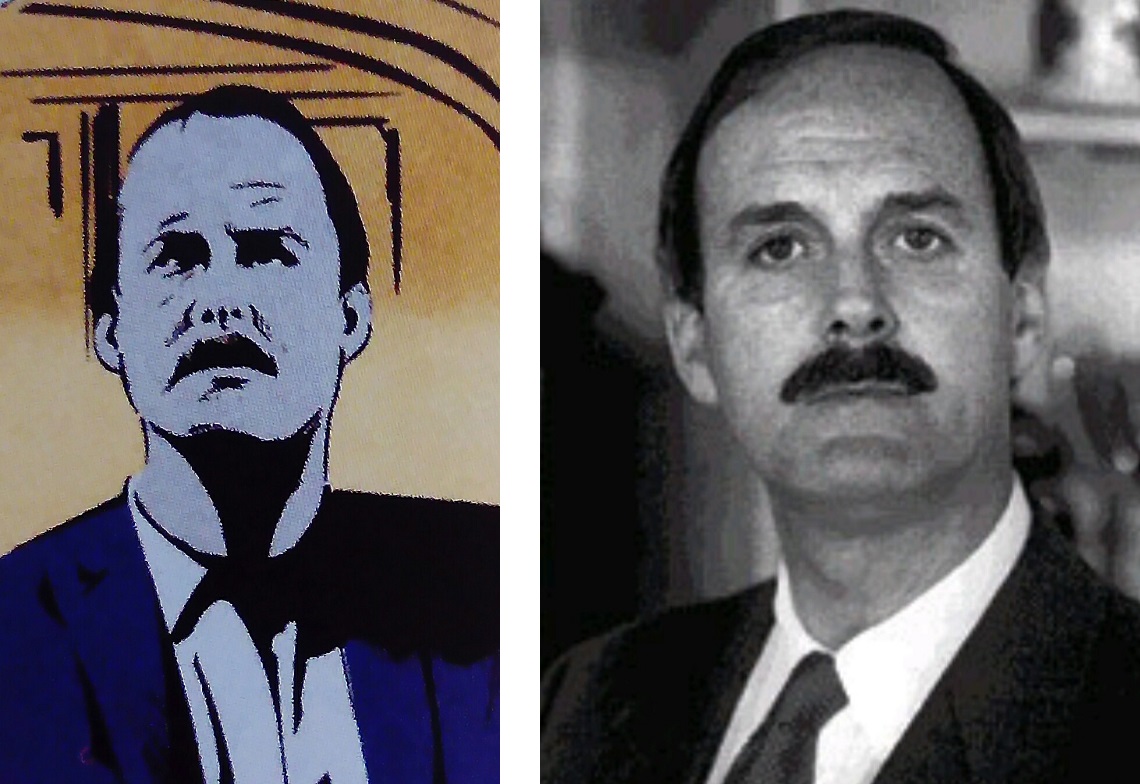
John Cleese has already appeared in two Bond films, and here he makes his debut in the artwork of Casino Royale, this time as the croupier.
 
John Cleese                   The Croupier

Finally, as Ian Fleming’s first Bond heroine, it is fitting that Vesper Lynd has some of the appearance of the most significant woman in Fleming’s life, Ann Fleming. Vesper’s facial features are a little different, but the hairstyle is a very close match.
 
Ann Fleming                Vesper Lynd

The appearance of famous faces in Casino Royale, presumably intended as Easter eggs for the reader, provides added excitement to what is a thrilling read. Does that mean that we can call Grace Kelly a Bond girl?