Showing posts with label william boyd. Show all posts

Saturday, 5 September 2020

Ian Fleming's early literary appearances

Some of the works containing appearances by Ian Fleming

When he came to write the James Bond books, Ian Fleming frequently named his characters after his friends and acquaintances, and sometimes even gave the people he knew walk-on parts. In On Her Majesty's Secret Service (1963), for example, Irma Bunt points out to Bond the presence, in Piz Gloria's restaurant, of Lady Daphne Straight, an old girlfriend of Fleming's, and her husband Whitney, as well as Ursula Andress, fresh from her appearance in the film of Dr No (1962). Ian Fleming was not alone in this habit, and, even before the birth of Bond, had had the same treatment, appearing as a character in fiction and other literary works.

Ian Fleming's first literary cameo was in Public Faces, a 1932 novel by Harold Nicholson. The story, set a few years in the future, follows the tribulations of government ministers and their staff as they deal with a developing crisis and the threat of world war. (The nature of the crisis is somewhat different from the circumstances of the Second World War, but, with the story taking place in 1939, the novel was in many ways prophetic.) Ian Fleming appears towards the end of the novel as himself - a journalist at Reuters ("What's his name? Hemming? Oh, yes, I know, young Fleming") - and has a small, if unseen, role in ensuring world peace.

Alaric Jacob, a colleague of Ian Fleming's at Reuters, gave Fleming his second walk-on part. Scenes from a Bourgeois Life, published in 1949, is Jacob's part-fictionalised autobiography and a polemic on post-war Britain (he bemoans the growth of the suburbs and the rise of the nouveau riche, among other things). His account of his time at Reuters, or Telenews, as it is called in the book, includes a portrait of Fleming, who, in the book is goes by the name of Hugo Dropmore. In his recently published Ian Fleming: the Notes, John Pearson comments on the quotability of Jacob's character study. He's not wrong: it's full of zingers: 

"Hugo Dropmore was a cross between Mr Darcy and the hero of a book by Stephen McKenna" (a novelist whose characters tended to come from upper-class circles); 
"He looked like a young actor who has never toured, but started right in the West End"; 
"He seemed to know something about everything; but if a subject arose on which he was not informed, he would own it at once, and it no longer seemed to matter;" 
"His good taste was such that you never observed what he was up to until it was too late." 

I could go on. These have more than the ring of truth, but I can't imagine Ian Fleming being particularly displeased with the characterisation. The choice of pseudonym is interesting. Dropmore Press was the name of a small publishing house owned by newspaper baron James Kemsley. Ian Fleming was involved with Dropmore from 1949. I don't know whether or not Alaric Jacob based the name Hugo Dropmore on this, but the coincidence is striking.

Over the years, Ian Fleming developed a deep friendship with writer Noël Coward. Fleming had leased a beachside home at St Margaret's Bay in Kent from Coward, and the playwright was an early guest at Fleming's Jamaican home, Goldeneye, famously labelling it 'Goldeneye, Nose and Throat' on account of its resemblance to a hospital (ironically, a leading brand of eye medicine in Jamaica at the time was Golden Eye Lotion). The two became neighbours of sorts when Coward himself came to live in Jamaica. As Fleming discovered, the only problem with being friends with a playwright is that one can end up as a character in a play. This is precisely what happened to Fleming - twice.

Volcano, written in 1957, is a play set in the fictional South Sea island of Samolo, standing in for Jamaica. It focuses on six individuals, whose relationships are tested by marriage breakdowns and infidelities during the eruption of the local volcano. Early on, we discover that Adela Shelley, a widow and resident of the island, had had an affair with Guy Littleton, who has flown in from London with his wife Melissa. Coward based Adela on Blanche Blackwell, a neighbour of Coward's in Jamaica, while Guy and Melissa were a thinly disguised Ian and Ann Fleming. The play, while set far away from Jamaica, painted a picture that Ian and others would have recognised, fictionalising the real-life affair between Blanche and Ian and giving voice to the sort of feelings that Ann had expressed about Blanche, Ian and Jamaica itself. 

Goldeneye is also alluded to in the play. Guy and Melissa are staying at 'Le Tellier's beach house'. Melissa tells Adela: 

"Guy loves it because of the lagoon and the reef; he spends most of the day under water spearing those unfortunate fish...Mr Le Tellier must be a rather Spartan type, the furniture is so unforgiving. He built the house by himself, didn't he?"
Perhaps fortunately for Ian and Ann, the play was never publicly performed until 2000, although it did have a rehearsed reading in 1989, with Judi Dench in the role of Adela and her husband, Michael Williams, in the role of Guy. The play was performed again in 2012, with Judi's daughter Finty taking a role.  

Reading the play, I was reminded of 'Quantum of Solace', Ian Fleming's short story, published in 1960, which deals with the breakdown of a relationship. Though the tale was inspired most directly by 'His Excellency', a short story by Somerset Maugham, its themes could easily have been drawn from Coward's play. 

Noël Coward returned to the subject of love and lust in Samolo in his 1960 novel Pomp and Circumstance, a comical tale set against the backdrop of an impending royal visit. Ian Fleming once again proved inspirational, spawning a character called Bunny Colville, whose roving eye leads to all sorts of complications among Samolan high society. Bunny's tropical house, incidentally, has the hallmarks of Goldeneye: an uncomfortable house that overlooks a coral beach (accessed via concrete steps), a large living room, and the general appearance of an austere and over-masculine barrack. 

Since his death, Ian Fleming has made further appearances in novels, for instance in William Boyd's Any Human Heart. But it is worth returning to his earliest appearances - written by people who knew him best. 

References:

Coward, N, 1960 Pomp and Circumstance, Heinemann

Coward, N, 2018 Collected Plays: Nine (introduced by Barry Day), Bloomsbury

Jacob, A, 1949 Scenes from a Bourgeois Life, Secker and Warburg

Lycett, A, 1995 Ian Fleming: The Man Behind James Bond, Turner

Nicolson, H, 1944 Public Faces, Penguin

Sunday, 1 December 2013

Breakfast with Bond

Me about to tuck into my 'Solo' breakfast
Throughout October and November, London's Dorchester Hotel was offering guests a 'Solo' breakfast in celebration of the publication of William Boyd's James Bond novel, Solo. The book begins with Bond eating breakfast at the hotel. I left it to the last minute, but on the final morning of the special breakfast, I managed to make it to the Dorchester to enjoy my own breakfast with Bond.

Sitting down in the ornately-decorated breakfast room, I was handed a complimentary copy of Solo and a facsimile of a breakfast menu dating to 1969, the year in which the book is set (more about the menu in a separate post). As much as I was tempted by the kedgeree, grilled chop or stewed prunes, I was here to have what Bond had, and that was helpfully described on the back of the menu: “...four eggs, scrambled with pepper sprinkled on top, half a dozen rashers of unsmoked bacon, well done, on the side and a long draught of strong black coffee.”

James Bond's breakfast choices, as described in the original novels, are more varied, and I was able to supplement the breakfast Boyd gives Bond with items mentioned by Fleming. I ordered orange juice (which Bond orders for breakfast in New York in Live and Let Die), and had my eye on a pot of marmalade on the table (Bond takes toast and marmalade during the same New York breakfast, and marmalade is mentioned again in From Russia, with Love).

As for the scrambled eggs and bacon, I can only say that they were cooked to perfection. The eggs were perhaps not as runny (baveuse) as Fleming – and presumably Bond – would like, but they were moist and delicious (and peppered as Boyd described), and nicely balanced by the crisp bacon. The meal was accompanied by a pot of coffee, which I initially drank black as Bond would have done, although I confess I added sugar, which would have received Bond's disapproval. I duly had some toast and marmalade, and selected a few items from a basket of pastries, breads and croissants that had also been placed on the table. The basket is not as un-Bondian as it seems. Bond breakfasts on café complet – which typically includes croissants and bread – at Orleans' Hotel de Gare in Goldfinger.

If the Solo breakfast wasn't the best breakfast I have ever had, it was certainly close, and for a Bondian experience it was unforgettable. I must also mention the staff. As you'd expect from the Dorchester, the staff were more than excellent. They were attentive and sensitive, and no request was a problem. It was no trouble, for example, that my three-year old daughter went off-menu and wanted boiled eggs (we weren't charged for them either). Incidentally, I didn't mind my daughter's preference for boiled eggs. After all, James Bond likes a boiled egg too.

Monday, 25 November 2013

Are James Bond novels getting longer?

In an interview by Sathnam Sanghera for the Times Magazine in September, William Boyd said that he thought his James Bond book, Solo, “might be the longest Bond novel at 336 pages” ('...pretending he doesn't know this for a fact', Sathnam Sanghera commented). Boyd admitted at the 'Boyd on Bond' event at the Southbank that he hadn't read any continuation Bond novels except Kingsley Amis' Colonel Sun and Sebastian Faulks' Devil May Care, and so we can excuse the inaccuracy. In fact, the longest Bond novel is Jeffery Deaver's Carte Blanche, which at 432 pages is almost 100 pages longer than Solo.

Boyd's claim notwithstanding, his comment perhaps reflects a wider view that, certainly by modern standards, Ian Fleming's novels are rather on the short side, possibly even too short to be taken very seriously. Indeed, in his preview of the Designing Bond exhibition in London in July 2012, design critic Stephen Bayley, writing in the Times (2nd July 2012), dismissed the original novels as novellas. But is this fair? Are Fleming's books really so short? Are Bond books increasing in length over time? Let's have a look at some numbers.

I collected data for all of Fleming's books, except Octopussy (a statistical outlier), and all continuation novels, except the novelisations of Pierce Brosnan's Bond films. I chose to ignore several variables that might affect book length, such as font size, pages size, margins and spacing, simply taking instead the number of the last page in the UK first edition hardback. This gave me a dataset of 39 books.

Here are some basic statistics. As stated, the longest Bond book is Carte Blanche. The shortest is John Gardner's Nobody Lives Forever (1986), which is 192 pages long. In fairness to William Boyd, Solo is the second longest book (actually 322 pages). The longest Fleming novel is Goldfinger (1959) at 318 pages, only four fewer than Solo. The shortest Fleming novel is Casino Royale (1953) at 218 pages. Sebastian Faulks' Devil May Care (2008) is within the top quarter with 294 pages, while Kingsley Amis' effort (1968) is roughly in the middle with 255 pages. Raymond Benson's novels are generally on the higher end, his longest being The Man with the Red Tattoo (2002), Doubleshot (2000) and Never Dream of Dying (2001), all being 320 pages in length. The longest Gardner novel is The Man from Barborossa (1991) at 303 pages. The overall mean across the dataset is 262 pages.

The sequence of books produced by Fleming, Gardner and Benson allows some interesting comparison. The mean length of Fleming's novels is 253 pages. This is slightly more than the mean for Gardner's books (241 pages) but somewhat smaller than the value (301 pages) for Raymond Benson's novels. The standard deviations for the books of Fleming and Gardner are also quite similar (27 and 29 pages respectively), but more than that for Benson (25 pages). This suggests that Benson's novels are more consistent in terms of page length, while the books of Fleming and Gardner varied rather more. This is confirmed by the overall range (that of Fleming is 100 pages, compared with 61 for Benson), and the coefficient of variation (standard deviation divided by mean), which standardises groups of data of different size. That for Fleming and Gardner is 0.12, while that for Benson is 0.08.

These values suggested to me that Gardner's novels are practically the same sort of length as Ian Fleming's, but that Raymond Benson's are different; judging by the means, Benson's books are consistently longer. I tested this by first combining into a single list Fleming's and Gardner's books and ranking the books in size order. I could see that the novels were fairly evenly mixed. There was a Gardner, then a Fleming, then two Gardners, followed by two Flemings, four Gardners then a single Fleming, and so on, as if randomly intermixed. When I compared Fleming and Benson, again combining the lists and ranking the books by page length, most of Benson's books were at high end of the list. There were eleven Flemings (out of 13) ranked below the shortest Benson. Evidently Benson's books were generally longer than Fleming's (and no doubt Gardner's too), and a Mann-Whitney test confirmed there there was a significant statistical difference between the lengths of Fleming's and Benson's books.

So while there has been no steady rise during the time that Fleming and Gardner were writing (1953-1996) (it could even be suggested that Gardner deliberately copied the length of the original novels for greater authenticity – his Herbie Kruger novels, for example, are much longer than his Bonds), the continuation novels of Raymond Benson and subsequent authors have been generally longer than earlier novels.

Much of the explanation for this is likely to be cultural, with authors (Gardner excepted) matching, to some extent unwittingly, the length of their Bond books with that of their other works or other contemporary fiction. It is probably true to say that when Fleming was writing, contemporary novels were the same sort of length as his own. Raymond Chandler's Philip Marlowe books averaged about 250 pages per book. William Boyd's novels are more consistently over 300 pages long. In other words, book length has been driven upwards over time, and authors conform to that trend. Nevertheless, does it really matter? After all, it's not the size of the book that counts, but what's inside it.

Friday, 4 October 2013

A review of William Boyd's Solo

Ian Fleming said that the recipe for a bestseller was to “get the reader to turn over the page”. Early book sales notwithstanding, on this basis, William Boyd's own James Bond novel, Solo, has succeeded. It is a fast-paced adventure, by turns exciting, surprising, reassuring, and sobering, that at times takes Bond, and the reader well out of their comfort zones.

The story begins at the Dorchester hotel in London. Bond is in reflective mood as he celebrates his 45th birthday alone and recalls a dream which explores his wartime service (an ingenious nod to Bond's creator). Later returning to the office, M briefs him on the civil war in the fictional West African country of Zanzarim, sending Bond there with the vague mission to end the conflict. In Zanzarim, Bond meets his contact, the beautiful Blessing, and encounters the horribly disfigured and very dangerous mercenary, Kobus Breed. Events ultimately lead him to Washington on a solo mission of revenge. There he meets with an old friend as he pursues his unauthorised mission and attempts to make sense of events.

James Bond is his familiar self, and Boyd has peppered the books with the usual Bondian traits and foibles. Bond consumes scrambled eggs, wears shoes without laces, refuses offers of tea, smokes incessantly, and is always in reach of a drink. To be honest, the 'Bondisms' become a little distracting, as the narrative pauses yet again to describe Bond's latest meal or the clothes he wears. Certainly, Fleming indulged in such descriptions, but Bond's traits emerged gradually over the course of twelve novels. Not even Fleming described every meal of Bond's in detail. It is a trap that is evidently all too easy for continuation novelists to fall into, but a degree of restraint is important, and makes the difference between classic Bond and pastiche.

Still, this is of minor concern, as William Boyd impresses in other areas, in particular his convincing descriptions of Zanzarim. Boyd's knowledge and affection for West Africa is evident, and his portrait of the fictional landscape will have readers almost reaching for the atlas. The late 1960s is also effectively evoked with references to the moon landing, the Vietnam war, mini skirts and cinema releases. And with Solo being his fourth espionage novel, Boyd knows his spy lore. Readers might recognise Bond's rule that “if it looks like a coincidence then it probably isn't” from Boyd's earlier work (Restless, if memory serves).

We can trace some tropes or memes further back. Boyd lifts the idea that one vomits after being struck on the head from Fleming ('Risico'), who in turn borrowed it from Raymond Chandler. And despite Boyd's assurance, given at the recent Boyd on Bond event at the Southbank Centre, that Solo contained no traces of the cinematic Bond, inevitably elements of the film series have crept in – a quip or two that could have been uttered by Sean Connery's Bond (or even Roger Moore's), Bond's relationship with Moneypenny, and a Q-like character, for example.

Solo is shaped by all the essential Bondian ingredients, and still allows Boyd to assert his own voice. But even with the exotic African location, the familiar faces, and Bond doing what he does best, my thoughts kept returning to Bond's role in the Second World War. Boyd's writing here is at its most Fleming-esque, and I wanted to read more. Is there scope for a full-length wartime-set Bond adventure? I really hope so. Indeed, any author tackling it might find it a more rewarding proposition than penning a straight continuation novel, being less constrained by the habits and peculiarities of the older, weary 007. The adventures of Young(er) Bond? I'd definitely read those.

Sunday, 29 September 2013

Boyd on Bond - a report

To mark the publication of the new James Bond adventure, Solo, author William Boyd was in conversation with GQ literary editor, Olivia Cole, at Queen Elizabeth Hall in London's Southbank Centre on 26th September. I was lucky enough to be in the audience and hear William Boyd speak about his growing up with James Bond, his views on Ian Fleming, and his approach to writing his Bond novel. I've written a report on the event, and this is available on the MI6: The Home of James Bond 007 website. Click here to read the article.

Wednesday, 21 August 2013

An open letter to the chefs of the Dorchester hotel, London

Dear chefs,

I read with great interest on the Ian Fleming Publications website that the Dorchester will be serving a special 'James Bond breakfast' between 28th September and 30th November in celebration of the publication of William Boyd's James Bond novel, Solo. I understand that the novel opens at the Dorchester with Bond treating himself to a plate of his favourite food, scrambled eggs.

According to the publicity for this event, the breakfast William Boyd describes comprises scrambled eggs made with four eggs per person, half a dozen rashers of unsmoked bacon and strong black coffee. Given that Bond avidly consumes the dish throughout his adventures, we are able to reconstruct how Bond likes his eggs in quite some detail. So, to ensure that the scrambled eggs served at the Dorchester are as authentic as possible, may I respectfully suggest that the following points are borne in mind by your kitchen staff?

001 I don't think Bond would object too much to the four eggs, but when he orders room service in a New York hotel (Live and Let Die), he asks for three eggs lightly scrambled. His preference for three eggs is reiterated in the recipe for scrambled eggs given in the short story '007 in New York' (the recipe is for four 'individualists' and 12 eggs are required).

002 The eggs should be laid by Marans hens. We know that when at home, his boiled eggs are made with such eggs (From Russia, with Love), and presumably his eggs for scrambling come from the same source. In any case, avoid white-shelled eggs.

003 The eggs should be served moist. This reflects Ian Fleming's own preference for runny scrambled eggs (a letter from Ann Fleming mentions that Fleming liked the eggs 'très baveuse').

004 Milk should not be added to the eggs. In Live and Let Die, while dining in Jacksonville, Florida, Bond disdainfully observes that milk will be added to the scrambled eggs, and the 'no milk' rule is confirmed by the recipe noted above.

005 Customers will no doubt have their own preferences with regard to the bread used for the toast, but ensure that wholewheat (From Russia, with Love) or rye (Diamonds Are Forever) bread are available for the Bond purist.

006 I expect Bond does eat unsmoked bacon from time to time, but he also likes smoked bacon, preferably hickory-smoked. Will customers get a choice?

007 I have nothing to add about the coffee. It should be strong, black and unsweetened. If anyone asks for tea, tell them you don't serve cups of mud (Goldfinger).

Follow these tips, and you will create the perfect Bondian breakfast. And if you'd like more information on Bond breakfasts, or if you're thinking of expanding your menu to include Bond lunch and dinner items, then I invite you to read my James Bond cookbook, Licence to Cook: Recipes Inspired by Ian Fleming's James Bond. Good luck!

Kind regards,
Edward Biddulph


Photo of scrambled eggs by Clare McIntyre

Thursday, 1 August 2013

Cover art for William Boyd's Solo

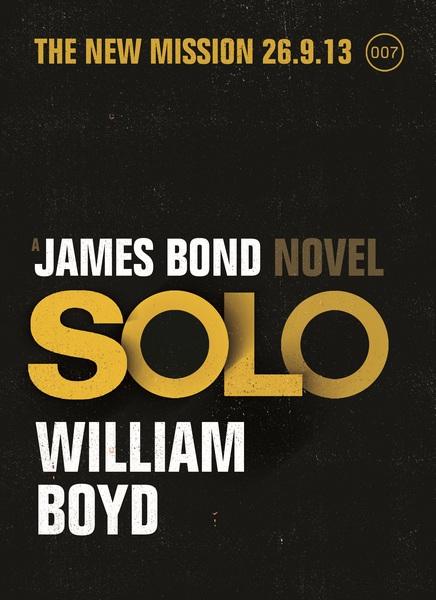
Ian Fleming Publications have published details of the cover of Solo, the forthcoming James Bond adventure by William Boyd. The design is stylish and dramatic, hinting at danger, intrigue and exotic locations. On the front of the dustjacket is the title Solo; the final O appears to be open, allowing us to peek through to the dramatic red colour of the boards beneath. The back of the dustjacket is emblazoned with the 007 motif, and this time the hardcover is seen through one of the zeros. The hardcover itself is decorated with representations of bullet holes and a gecko, which alludes to the novel’s African location.

Suzanne Dean, the designer, said that she didn’t “just want to depict a cinematic image”, and that she was influenced by designers such as Saul Bass (read her full statement here), but inevitably the bullet holes on the hardcover and the arrangement of the title and Bond’s code number on the dustjacket recall the gunbarrel sequence that opens (or closes) the James Bond films. The use of shadow and open elements on the dustjacket also give, to my mind, the design a trompe l’oeil appearance, perhaps in keeping with the famous Richard Chopping covers of Fleming’s novels.

I wonder, also, whether the gecko offers clues to the African location. I’m certainly no expert on geckos, but the shape of the one depicted is not too dissimilar from that of the West African forest gecko. In previous posts, I’ve speculated on the basis of Boyd’s previous work and experiences, the events of 1969, and the clues that he’s provided that Boyd would send Bond to West Africa, possibly Nigeria. Of course, the image might simply represent a generic gecko not specific to any location, but such animals do vary in shape and size, and the gecko depicted does not appear to be inconsistent with the West African species.

Monday, 15 April 2013

James Bond on a solo mission

The title of William Boyd's James Bond novel, due to be published in the UK on 26th September, was announced at the London Book Fair. The book will be called 'Solo'. As the HMSS Editors point out, Solo recalls the 1960s TV series, The Man From UNCLE, and specifically the character Napoleon Solo, which Ian Fleming had a hand in creating. A Mr Solo of the Unione Siciliano was also a character in the novel Goldfinger (chapter 17, Hoods' Congress). It seems unlikely that these references were in William Boyd's mind when he settled on the title, although a villain with a Napoleon complex might count as a nod to Fleming's role in The Man From UNCLE!

More seriously, the official press release includes a statement by William Boyd, which provides a strong indication as to the significance of the title. In the novel, Bond will "go solo" on a "self-appointed mission of his own, unannounced and without any authorization." What's more, Boyd has confirmed that the book will be set partly in Africa. Given Boyd's interest in the continent, there had been speculation that he'd send Bond there, and in an earlier post, I suggested that Bond would visit West Africa, possibly Nigeria (perhaps relating to the events of the Biafran War). However, 1969 proved to be momentous year for many reasons, and I also reflected on the events that Boyd might allude to in the novel, if not directly involve Bond.

For more information and discussion about William Boyd's Solo, I also recommend The Book Bond, The James Bond Dossier, and the novel's official website

Saturday, 26 January 2013

William Boyd's Waiting for Sunrise - the Bond connection

In the course of researching and writing his novel, Waiting for Sunrise, William Boyd acquired a library of some 200 books. These provided Boyd with the necessary facts about the places, people and events that formed the backdrop to the novel's narrative, or otherwise inspired him. Among the books were Frederic Manning's First World War novel, Her Privates We, and AJP Taylor's history, The First World War. Then there were the spy classics The Spy Who Came In From The Cold, by John le Carré, Ashenden, by Somerset Maugham, and William Boyd's favourite Bond novel, From Russia, With Love. Reading Waiting for Sunrise, it's hard to find aspects of From Russia, With Love, but there are certainly passages which wouldn't be out of place in a Bond novel.
 
The events of Waiting for Sunrise begin in Vienna in 1913, as stage actor Lysander Rief seeks the advice of a renowned psychiatrist. In the doctor's waiting room he meets a beguiling woman, Hettie Bull, and they soon begin an affair that ends with Rief arrested on a charge instigated by Hettie Bull's (other) lover. With help from two intelligence officers, Munro and Fyfe-Miller, Rief escapes to Britain. But he soon finds himself caught up with the start of the Great War, and an encounter with Munro and Fyfe-Miller leads him to assume a false identity in Switzerland as a spy seeking a key to intercepted coded messages. Back in London, Rief turns his attention to a traitor leaking information on ordnance and field positions, as indicated by the deciphered codes, and learns that the truth might be uncomfortably close to home.

William Boyd said that From Russia, With Love captured “some of the paranoia of the Cold War”. One could suggest, too, that Fleming's novel, with its Istanbul-set sequences, inspired some of the mood of the events in Austria and Switzerland, both novels conveying, for instance, the essence of a tourist city's murky underbelly. I also thought of Bond's gripping journey on the Orient Express when I read the description of Lysander Rief's escape from Switzerland to France on an express steamer around Lake Geneva. Boarding the steamer doesn't stop Rief feelings of suspicion and danger, just as similar threats accompany Bond's journey.

There was one other aspect in Waiting for Sunrise that I thought particularly Fleming-esque: detailed descriptions of meals. For instance, before he's about to leave for the front line in northern France to begin his mission, he lunches with Munro and has an excellent coq au vin, a carafe of Beaujolais, a selection of cheeses, a tarte tatin, and a Calvados. Later, in a café in Geneva, Rief dines on the menu de jour, comprising a clear soup, blanquette de veal, cheese and an apple tart. The wine, we learn, was rough and on the sour side. Back in England, at a hotel in Hythe on the Kent coast, Rief notes the evening menu – classic English fare of a saddle of lamb, devilled kidneys, and Dover sole. James Bond would no doubt approve.

As in the Bond books, the descriptions of food in Waiting for Sunrise add detail to the settings, juxtapose the everyday with the extraordinary, and, in Fleming's view, stimulate the readers' senses. William Boyd's own James Bond novel will be published in September 2013. Judging by a previous novel of his, Any Human Heart (in which Fleming makes an appearance), and now Waiting for Sunrise, Boyd is well prepared for the task of bringing life to James Bond's world.

Sunday, 10 June 2012

Ian Fleming in Any Human Heart

When Ian Fleming Publications announced that author William Boyd was to write the next James Bond adventure, many of the media reports drew attention to the fact that not only was Boyd a self-confessed fan of the Bond novels – with From Russia, with Love being his favourite – but he had also written Fleming into his 2002 novel, Any Human Heart. A more complete read of the novel provides further connections with the world of Ian Fleming.


Any Human Heart takes the form of a set of journals by the protagonist, Logan Mountstuart. Beginning in 1923, the journals reveal the story of his life from his time at a minor public school to his final days in France in the early 1990s. In between, the journals encompass Mountstuart's years at Oxford University, his early period as a writer, his journalism covering the Spanish Civil War, his experiences in naval intelligence during the Second World War, his career as a New York art dealer, and his time living in London and West Africa. Throughout, he meets people of note, including fellow writers, artists, royalty, and, of course, Ian Fleming.

Fleming makes several appearances. We first encounter him in August 1935 in Scotland on a golf course. Fleming is introduced to Mountstuart by a mutual friend and tells Mountstuart that he is travelling to Kitzbühel. In reality, Fleming did visit Kitzbühel in August, and indeed went there most summers before the Second World War. But his visit in 1935 was especially meaningful for Fleming. While he was there, he met Muriel Wright, who would become his lover for nine years until she was killed in an air raid in London.

Then, in October 1935, Mountstuart plays golf with Fleming at Huntercombe, near Henley-on-Thames, before lunching with him at the Savoy Grill. The course had been a regular Fleming haunt since childhood. Amusingly, William Boyd appears to make Mountstuart responsible for turning Fleming to writing. We learn in the same journal entry that Fleming asked Mountstuart about his writing after revealing, as was indeed the case, that he was unhappy being a stockbroker.

Mountstuart's recruitment into the Naval Intelligence Division (NID) is described later in the novel in a journal entry dating to July 1939. Fleming invites Mountstuart to lunch at the Carlton Grill, within the Carlton Hotel, and tells him how impressed he was with Mountstuart's reports from the Spanish Civil War, and hints at a role for him at the Admiralty. On the way out, they meet Admiral Godfrey, director of the NID. Boyd tells us that Mountstuart began his career in the NID as a lieutenant in the Special Branch of the Royal Navy Volunteer Reserve. Mountstuart's recruitment matches that of Fleming's very closely. Fleming joined the NID after lunching with Admiral Godfrey at the Carlton Grill, and he was appointed to the rank of lieutenant (Special Branch) of the Royal Navy Volunteer Reserve. Later, Mountstuart is promoted to the rank of commander, just was Fleming was.

The final reference to Fleming dates to October 3, 1955. Mountstuart has read Live and Let Die, which had been published the year earlier, and writes that he cannot suspend his disbelief, as he sees Fleming as a very strong presence in it.

Other literary luminaries who cross paths with Logan Mountstuart to lesser or greater extents formed part of Ian Fleming's world. At Oxford Mountstuart meets Peter Quennell. Quennell was a close friend of Ann Fleming, and came to know Ian Fleming well. Then we learn that, after Oxford during his early period as writer in London, Mountstuart lives close to Cyril Connolly. Connolly was a friend of Ian Fleming's and wrote the James Bond parody, 'Bond Strikes Camp'. Later Mountstuart meets Evelyn Waugh at a party. After the Second World War, Evelyn Waugh and Ann Fleming became firm friends. Mention is also made by Mountstuart of William Plomer, Ian Fleming's editor at Jonathan Cape.

William Boyd's Any Human Heart provides much interest for the Fleming and Bond aficionado. It gives us insight into Boyd's style and the potential direction of his Bond novel, but his references to Fleming and others reveal a detailed knowledge and fascination with Ian Fleming, which can only point to his Bond adventure being a worthy tribute to Fleming and James Bond.

Sunday, 6 May 2012

James Bond in 1969 - an update

In a recent post, I speculated about the events William Boyd might refer to in his forthcoming James Bond novel in order to root the narrative to 1969, the year in which the novel will be set. I wonder whether the author's 2002 novel, Any Human Heart, provides a little more insight.

The novel takes the form of a journal, which is written intermittently by the protagonist Logan Mountstuart between the early 1920s and the early 1990s. The journal covers, among other episodes, Mountstuart's school days, his time at Oxford University, his early career as a writer, his experience in naval intelligence during the second world war (having been recruited by Ian Fleming - more on that in a later post), and his time in New York running an art gallery. 

In 1969, Mountstuart is teaching English in Nigeria. Through Mountstuart's journal, William Boyd refers to the Moon landing (something I thought might be mentioned in the Bond novel), and places Mountstuart in the centre of the Nigerian civil war (also known as the Biafran War), which lasted from July 1967 to January 1970. 

Given Boyd's knowledge of the region (he grew up in Nigeria and set a novel in West Africa), it is possible that he might turn again to Africa, and we might at least see a reference to Nigeria and the Biafran War in his awaited Bond novel.  

Monday, 16 April 2012

James Bond in 1969

On 11th April, Ian Fleming Publications announced that William Boyd will write the next James Bond novel. Many of the details are under wraps, but William Boyd has said that he will take Bond back to the 1960s, setting the adventure in 1969.

The book will expand the chronology of Bond's activities in the 1960s. According to John Griswold, Fleming left Bond in February 1964. The events of Devil May Care, by Sebastian Faulks, were set after The Man with the Golden Gun, apparently around 1967. If so, then presumably Faulks disregarded Kingsley Amis' Colonel Sun, which is set in the year that Amis wrote it, 1967/8.

One of the ways in which authors evoke a past period is to refer to contemporaneous events. In Kate Westbrook's first volume of The Moneypenny Diaries (2006), for example, the narrative weaves around the Cuban Missile Crisis of 1962. Modern-set novels (that is, contemporary with the period of writing) tend to lack references to newsworthy events, possibly because the significance of recent events is not clear at the time of writing, or that reading about those events a year later when the book is published can make the book seem dated. In the words of Elvis Costello, yesterday's news is tomorrow's fish and chip paper. There are exceptions, of course, among them The Man with the Golden Gun, in which Fleming referred to Charles de Gaulle's recognition of Communist China in 1964, and Raymond Benson's Zero Minus Ten (1997) in which the British handover of Hong Kong to China in 1997 provided the novel's background.

So to what events might William Boyd refer in his forthcoming Bond novel to root the narrative to 1969? January was a rather momentous month. Given the ongoing furore surrounding the behaviour of the British Press (phone hacking, intrusion, etc.) and the fortunes of Rupert Murdoch's media empire, we could see a reference to Murdoch's purchase of the News of the World in that month. Also in January, Richard Nixon was elected US president, and the Beatles gave their final live performance on the roof of Apple Records.

The Harrier jump-jet entering service in March of 1969 may get a mention, as it's a fondly-remembered plane that was controversially axed in 2010. Or there may be a reference to British troops going into Northern Ireland in April. Charles de Gaulle resigned as president of France in April, and a reference to this would be a nod to Fleming's reference to de Gaulle.

May 1969 provides another Beatles reference – it was the month that John Lennon and Yoko Ono had their Bed-In in Montreal. Inevitably, it has been argued that the current situation in Afghanistan finds an echo in the Vietnam War, and a reference to the first US troop withdrawals from Vietnam in July 1969 may be difficult to resist. Also in July, the Apollo 11 mission landed on the Moon and Neil Armstrong stepped onto its surface. Surely no book set in 1969 can avoid a reference to this momentous event.

A smaller event, at the end of July, is the removal from British legal tender of the halfpenny. One can imagine that being another bee in M's bonnet, and Bond might have some views about a new commercial aircraft, the Boeing 747, which entered service in December. Finally, I wonder whether Bond will walk past a cinema in December, glance up to see what's showing and note that there's another film about that sophisticated and tough secret agent. 'Complete fantasy. Nothing like real intelligence work', Bond might reflect with an almost imperceptible shake of the head.