Showing posts with label casino royale. Show all posts

Wednesday, 9 May 2018

Casino Royale's lookalikes

I’m enjoying Dynamite’s version of Casino Royale, adapted from Ian Fleming’s novel by Van Jensen and Dennis Calero. The story is, of course, familiar, but so too are some of the faces. As Bond aficionado Mark Ashby pointed out in a Facebook post, Felix Leiter appears to be based on Jack Lord, the actor who played Leiter in Dr No, as this image demonstrates:

Jack Lord                        Felix Leiter

The artist seems to have used other well-known faces as reference material, especially for some of the minor characters, and so, in the spirit of a running feature in the satirical magazine, Private Eye, here are some of the other Bondian ‘lookalikes’ that I’ve spotted.

James Bond’s opponents on the Baccarat table include a star of the silver screen and acquaintances from his cinematic adventures. Appropriately enough, Carmel Delane, an American film star, seems to be modelled on Grace Kelly.

Grace Kelly                  Carmel Delane

Monsieur Sixte, the wealthy Belgian, has more than a passing resemblance to Kristatos, as played by Julian Glover in For Your Eyes Only.
 
Kristatos                     Monsieur Sixte
Meanwhile, the Greek, owner of a profitable shipping line, has a similarity to Columbo, as played by Topol in the same film.

 
Columbo                   The Greek

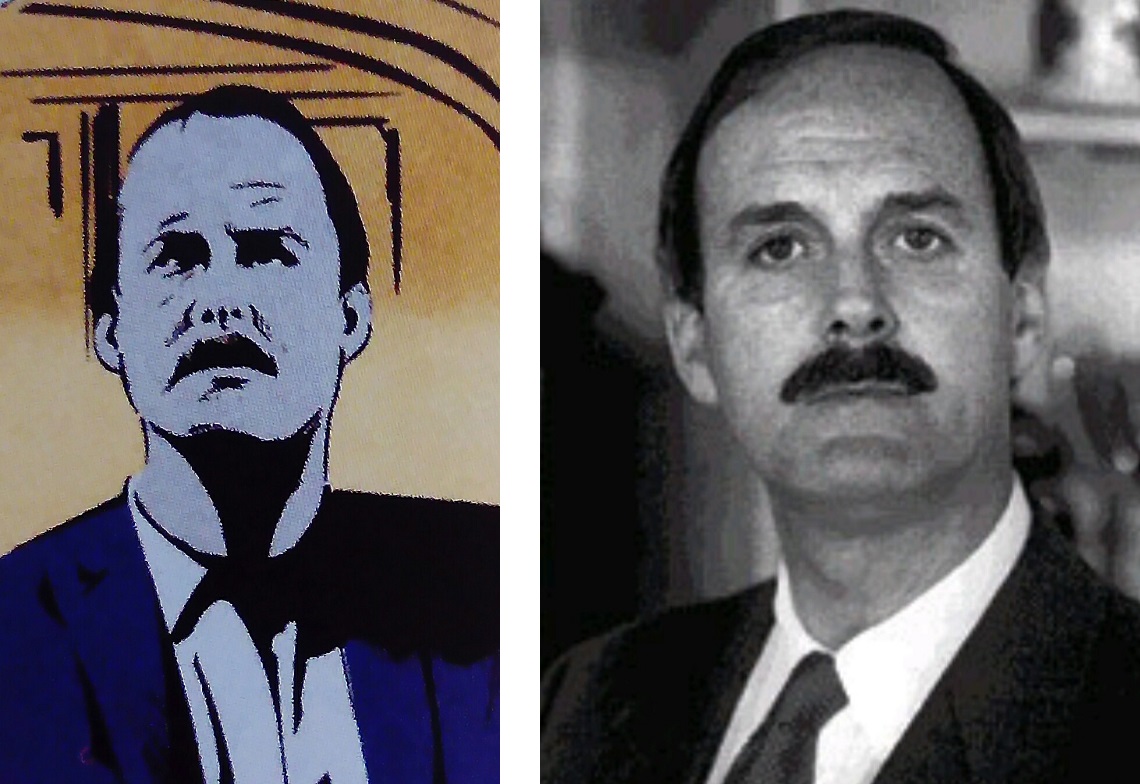
John Cleese has already appeared in two Bond films, and here he makes his debut in the artwork of Casino Royale, this time as the croupier.
 
John Cleese                   The Croupier

Finally, as Ian Fleming’s first Bond heroine, it is fitting that Vesper Lynd has some of the appearance of the most significant woman in Fleming’s life, Ann Fleming. Vesper’s facial features are a little different, but the hairstyle is a very close match.
 
Ann Fleming                Vesper Lynd

The appearance of famous faces in Casino Royale, presumably intended as Easter eggs for the reader, provides added excitement to what is a thrilling read. Does that mean that we can call Grace Kelly a Bond girl?

Tuesday, 13 February 2018

What can we expect in Forever and a Day

The title of Anthony Horowitz’s second James Bond novel, due to be published in May by Jonathan Cape, was announced last week. The book, Forever and a Day, is set before the events of Casino Royale and sees James Bond earn his licence to kill and develop into the man we know from Ian Fleming’s novels. What else can we learn from the tantalising hints offered by the official press release?  

Anyone familiar with the novel of Casino Royale will remember that James Bond earned his double-O status during the Second World War by killing a Norwegian agent in Stockholm who was doubling for the Germans, and a Japanese cipher expert operating out of the RCA Building in the Rockefeller Centre in New York. Presumably the episodes will be referenced in the new novel, but the latter is especially interesting, as the Rockefeller Centre was also the headquarters of the British Security Coordination (BSC) headed by William Stephenson. The BSC represented British intelligence in the US during the war and was concerned with intelligence gathering, counter-espionage and special operations. If Horowitz’s novel describes or alludes to the killing of the cipher expert, will it link Bond more explicitly to the BSC? 

Probably not, judging by the synopsis: 
‘007 floats in the waters of Marseille, killed by an unknown hand. It’s time for a new agent to step up. Time for a new weapon in the war against organised crime. It’s time for James Bond to earn his licence to kill. This is the story of the birth of a legend, in the brutal underworld of the French Riviera.’ 
This appears to be a different narrative to that presented in Casino Royale, and it will be interesting to see how the two origins are reconciled.

In any case, the Marseille setting and mention of the underworld of the French Riviera are intriguing. We know from On Her Majesty’s Secret Service that this is Union Corse territory. Are the members of that criminal organisation involved in the death of 007? Will we be introduced to Bond’s future father-in-law, Marc-Ange Draco? There is no suggestion in OHMSS that Bond knew Draco before the events of that novel, so it seems unlikely that Bond and Draco would meet in Forever and a Day, but Draco could certainly be in the background.

It’s worth bearing in mind, too, that Marseille was home in the early 1950s to Jacques-Yves Cousteau’s operation to excavate two ancient wrecks. Ian Fleming reported on the underwater excavation for the Sunday Times and even attempted to dive to the site. It’s possible that this will inform Horowitz’s novel to some extent (just as it informed Fleming’s Live and Let Die), and indeed the author confirmed in a tweet that the book involves ‘lots of water.’ 

And will Bond eat one of the regional specialities? In OHMSS, Bond asks a Marseille taxi-driver whether the bouillabaisse (ideally made with rascasse or scorpion fish) chez Guido is always as good. Bond is clearly familiar with the dish and the local restaurants, and it might be in Horowitz’s adventure that he is introduced to them. 

One thing we do know is that the novel will, like Anthony Horowitz’s first Bond adventure, Trigger Mortis, contain original material by Ian Fleming. How it will contribute to Forever and a Day has not been revealed, but it makes the novel an even more mouth-watering prospect.

Sunday, 25 June 2017

Kiss Kiss Bang Bang and spy fiction of the 1950s, '60s and '70s

I've thoroughly enjoyed reading Kiss Kiss Bang Bang (Harper Collins, 2017), Mike Ripley's examination of the golden age of British thrillers. It's a period that began, the author contends, with Ian Fleming's Casino Royale, published in 1953, and ended in the late 1970s with tough heroics of Jack Higgins' novels and the methodical thrillers of Frederick Forsyth. In between, there were Fleming wannabes, the realistic spy thrillers of Len Deighton and John le Carré, and a whole host of bestselling books by authors who remain hugely popular still, such as Alistair MacLean, or are now long out of print and largely forgotten.


The identification of this period as a golden age is contentious – others would argue that that period belonged to the likes of John Buchan, Sapper, Peter Cheyney, and E Phillips Oppenheim – but there's no denying that the twenty year period saw an explosion of British thriller writers (many influenced by Ian Fleming or more generally the success of James Bond) who would dominate the thriller market across the world.

For me, the book gave me a sense of nostalgia. Not that I read any of these books at the time. Being born in the 1970s, I was too young, but some of the books that Mike Ripley mentions were on the bookshelves at home, among them Eric Ambler's The Levanter, John le Carré's Tinker, Tailor, Soldier, Spy (or was it Smiley's People?), and When Eight Bells Toil by Alistair MacLean. Such thrillers seeped into my consciousness at an early age.

Later, I began collecting thrillers, mainly published in the mid/late 1960s, that attempted to fill the void left by Ian Fleming, their heroes often being described on the back cover as the new James Bond or even better than James Bond (as if that were possible). Many of these are discussed by Mike Ripley too, such as DIECAST by John Michael Brett, Sergeant Death by James Mayo, and Where the Spies Are by James Leasor.

 
Some of Bond's many rivals
Since reading Mike Ripley's book, I've been inspired to catch up on the many thrillers that I've missed. I decided, fairly randomly, to begin with a novel by Desmond Bagley, the author of some sixteen adventures and spy novels which invariably featured rugged locations, even more rugged heroes, and Land Rovers. Bagley wrote between 1963 and 1983, the book I chose, Running Blind, being published in 1970.


Running Blind is a Cold War thriller than falls somewhere between the realistic environment of George Smiley and the more fantastic world of James Bond. In the novel, former British agent Alan Stewart makes a routine visit to Iceland, where his girlfriend lives, but is met by another agent, who persuades him to deliver a package. When an attempt is made on his life, he realises he's been set up, forcing him to go on the run across Iceland's volcanic terrain, pursued by Russian, British, and American agents.  

It's an exciting read, and while it's rather different to the James Bond books (except, maybe, John Gardner's Nobody Lives for Ever), the influence of Ian Fleming, or indeed the James Bond films, is not far away. There's a moment when Alan Stewart enters the room of Slade, a British agent whom Stewart suspects of having gone over to the Russians. Stewart looks out for a trick of the trade – hairs dabbed with saliva and stuck across the doors of the wardrobe that would be dislodged if the doors were opened.

A device of a similar nature is described in Casino Royale. When James Bond returns to his hotel room at Royale-les-Eaux, he inspects the hairs lodged in the drawer of the writing desk to make sure the drawer hadn't been opened. It's possible, though, that Desmond Bagley had been thinking of the film version of Dr No, in which Bond dabs a hair with saliva and sticks it across the doors of his wardrobe.

 
James Bond takes precautions
At another point, when Stewart confronts Slade, Slade tells him that he's 'been reading too much Fleming'. Then, as Stewart turns out the contents of Slade's wallet, he observes wryly that he found no plans for the latest guided missile or laser death ray that a master spy might have been expected to carry. A nod perhaps, at least with regard to the laser, to the film of Goldfinger

I expect that Running Blind will be the first of many thrillers from the 'golden age' that I'll discover and rediscover thanks to Mike Ripley's Kiss Kiss Bang Bang, and along the way be reminded (as if I needed reminding) of the enormous influence that Ian Fleming's work has had on thriller and spy fiction. As Mike Ripley notes, Casino Royale wasn't so much the spy novel that ended all spy novels, but the novel that launched many more.

Thursday, 8 June 2017

James Bond references in The Simpsons, Family Guy and American Dad

The animated shows Family Guy, American Dad and The Simpsons are well known for their pop-culture references, typically those relating to TV, films and music. The James Bond films have not been forgotten, and have provided the inspiration for episode plots, as well as for incidental gags.

For example, 'You Only Move Twice', an episode of The Simpsons, is a complete Bond parody, featuring a James Bond character that resembles Sean Connery and allusions to the films of Goldfinger and You Only Live Twice (and possibly the book of You Only Live Twice – Lisa finds that she is allergic to all the plants in the grounds of the community of Cypress Creek, owned by the evil Globex Corporation, a nod, perhaps, to Blofeld's Garden of Death). The episode even includes a Bondian song that could have been sung by Shirley Bassey.

In other episodes, the Bond references have been more incidental. I've always thought the Bond-related joke in the 'Bart Carny' episode - after Cooder and his son Spud, both carnival folk, ingratiate themselves into the Simpson's home, Cooder puts on Homer's clothes, and Spud says, 'Wow, Dad. You look like James Bond' - to be rather clever.

Given that its main character, Stan, is a CIA agent, it's inevitable that American Dad should have its own Bond parody. 'Tearjerker' features Stan as the James Bond character, Francine as a Bond girl called Sexpun T'Come, Steve as the Q character, here named 'S', and Roger as the eponymous villain. There is a sequel called 'For Black Eyes Only'.

There are plenty of Bond references to be found in Family Guy too. In the episode 'Mr and Mrs Stewie', Stewie meets Penelope, who shares his own psychopathic tendencies. When Stewie refuses to kill Brian for her, Penelope decides to do it herself, but is prevented from doing so by Stewie. They have a fight on the top of a train, when Penelope uses her Rosa Klebb-style shoes with blades in the toes. It's interesting to note that Penelope is voiced by Cate Blanchett, who also appears as Soviet agent Irina Spalko in Indiana Jones and the Kingdom of the Crystal Skull. Cate Blanchett has stated in interviews that her portrayal was inspired by Lotte Lenya's portrayal of Rosa Klebb in From Russia With Love.

I'm not intending to list all the Bond references found in these shows – there are websites dedicated to the shows that do that – but it is probably fair to say that most of the references draw on the older films and classic moments – Sean Connery, From Russia With Love, Goldfinger and so on. However, two allusions to Bond in American Dad and Family Guy show that the more recent films, Casino Royale in particular, are also making an impact on the scriptwriters.

We can see as much in 'Phantom of the Telethon', an episode of American Dad in which Stan hosts a telethon to raise money for the CIA torture programme. At one point, we see a blooper reel of comedy moments in the torture chamber. In one of these moments, a man holding a rope with a ball at the end stands by a naked man tied to a seat-less chair, which is obviously a nod to the torture scene in Casino Royale. (If I remember aright, the blooper occurs when the torturer accidentally hits himself with the rope.)

 
The Casino Royale moment from American Dad
Coincidentally (although maybe not, considering that Seth MacFarlane is responsible for both shows), the torture scene is also referenced in Family Guy. In 'The Peter Principal', Peter is appointed principal of James Woods High, and begins meting out punishments to the bullies. The punishments get progressively more severe, and at one point Peter places a seat-less chair in the school hall and swings a knotted rope.

 
The Casino Royale moment from Family Guy
Animated shows like The Simpsons and Family Guy play an important role in keeping the classic elements and traits or memes of the Bond films, such as Rosa Klebb's shoes, current in popular culture. Each subsequent film creates new memes, and a sign of how successful they are in the cultural environment (that is, their longevity and the extent to which they are replicated and disseminated) is that they're referenced in shows like Family Guy. On that basis, Casino Royale is well on the way to being every bit as classic as Goldfinger and From Russia With Love.

Thursday, 1 June 2017

Fiction mirrors fiction - James Bond and Eric Ambler's The Mask of Dimitrios


One of the numerous volumes on James Bond's bookshelf (there are more than you think) is Eric Ambler's The Mask of Dimitrios. Bond reads the novel, published in 1939, on the plane en route to Istanbul in From Russia, with Love (1957).

The novel concerns a writer of detective mysteries called Charles Latimer. In Istanbul, he's introduced to Colonel Haki, the head of the secret police, who, interested in Latimer's profession, tells him about a real murder. A man called Dimitrios, by all accounts a nasty piece of work, has washed up dead, having been stabbed. As far as Haki is concerned, the case is closed, but out of professional curiosity, Latimer begins to look into the life of this criminal. Following a trail from Turkey to Greece, Bulgaria, and Paris, he discovers that the truth about Dimitrios isn't so clear cut, as events take a sinister and dangerous turn.
 

What Bond thought of the book is unrecorded, but he may have returned to the book from time to time and wondered whether there were certain echoes of the book in his own adventures. 

For instance, according to the records of the Greek authorities, Dimitrios is 182 centimetres tall. Bond may have raised an eyebrow at that – Bond himself is only one centimetre taller, as mentioned in From Russia, with Love, and indeed, we subsequently find out that Dimitrios is a little taller still.

Then there's the description of the nature of spy work. At one point of the novel, Latimer meets a polish spy named Grodek, who Latimer discovers recruited Dimitrios as an agent. In a subsequent letter recounting his meeting, Latimer wonders whether 'governments of adult men and women behave like children playing Red Indians'. The phrase would have been familiar to Bond. In Casino Royale, Le Chiffre, while torturing Bond with a carpet beater, tells Bond that 'the game of Red Indians is over, quite over', and later Bond admits to himself that he 'had been playing Red Indians through the years.' It's unlikely that Ian Fleming, perhaps having read The Mask of Dimitrios before he wrote Casino Royale, borrowed the phrase from Ambler, as, during the Second World War, he called his commando unit, 30AU, his Red Indians, but the coincidence is interesting all the same.

In another part of the book, Latimer discovers that Dimitrios was also a drug pedlar, and learns about the drug trade from a former associate of Dimitrios, a Mr Peters. Latimer finds out, for instance, that drugs are smuggled into Europe from Istanbul on the Orient Express, with the help of a bribed sleeping car attendant. Bond, of course, travels on the Orient Express in From Russia, with Love, but the train is mentioned again in the short story 'Risico', which is about the drugs trade. Fleming describes how opium is smuggled onto the train in Istanbul and hidden in false upholstery in the carriages, with the help of bribed train cleaners. As he set off to Rome to tackle Colombo, and then Kristatos, Bond must have been pleased about having had something of a grounding in drug smuggling from Eric Ambler.

What about the nature of good and evil? James Bond wrestles with this question as he recuperates from injuries sustained by the carpet beater in Casino Royale. Bond tells Mathis that 'in order to tell the difference between good and evil, we have manufactured two images representing the extremes – and we call them God and the Devil'. Latimer also reflects on the nature of good and evil, and considers that traditional concepts are not sufficient: 'It was useless trying to explain [Dimitrios] in terms of good and evil. They were no more than baroque abstractions. Good business and bad business were the elements of the new theology.' 

It's hard to say whether Ian Fleming had The Mask of Dimitrios in mind as he wrote Casino Royale and 'Risico', or that the book was especially influential in the writing of From Russia, with Love, but as Bond finds himself in the same murky environments as Eric Ambler's hero, it's unsurprising that there would be there be some aspects in common between Ambler's and Fleming's work.

Thursday, 5 January 2017

When James Bond dreamt of Edgar Allan Poe

Edgar Allan Poe seems an unlikely influence on Ian Fleming's writing, but the 19th-century poet, story-teller, and master of the macabre nevertheless made his mark in the James Bond novels.

Ian Fleming mentions Poe three times in the Bond novels. There is one reference in Moonraker (1955); Fleming compares the ominous ticking inside the Moonraker rocket before launch to “the beating heart in Poe's story” (probably 'The Tell-Tale Heart' (1843), in which “the beating of the old man's heart...increased my fury, as the beating of the drum stimulates the soldier into courage”).

 
An illustration from 'Tell-Tale Heart'
Fleming himself had a fondness for the macabre, and it is appropriate that his most macabre novel, You Only Live Twice (1965), contains two references to Poe. When Tiger Tanaka describes Dr Shatterhand's castle of death, Bond is reminded of Poe, Le Fanu, Bram Stoker and Ambrose Bierce. Later, when Bond encounters Shatterhand, now revealed to be Blofeld, he comments on Blofeld's genius for creating a shrine to death. “People read about such fantasies in the works of Poe, Lautréamont, de Sade.”

But there is another allusion to Poe. In his 1842 story, 'The Mystery of Marie Rogêt', in which the detective C Auguste Dupin investigates the unsolved murder of Marie Rogêt, the unnamed narrator is subjected to a series of tests on the matter of dreams. At one point he states that “when one dreams, and, in the dream, suspects that he dreams, the suspicion never fails to confirm itself, and the sleeper is almost instantly aroused. Thus Novalis errs not in saying that 'we are near waking when we dream that we dream.'”

 
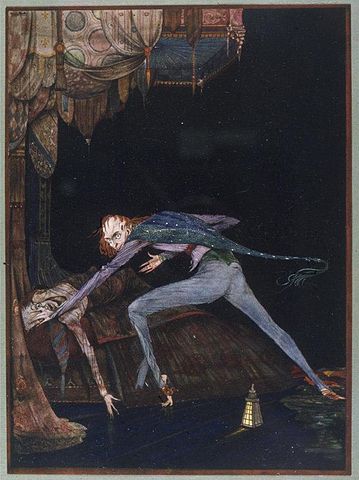
An illustration from The Mystery of Marie Roget
If this passage seems familiar, then it is because Fleming had the same idea in Casino Royale (1953). Chapter 19, which describes Bond's recovery after his savage beating at the hands of Le Chiffre, begins, “You are about to awake when you dream that you are dreaming.”

The idea is an attractive one, and interestingly Fleming isn't the first novelist to allude to it. For instance, in Jules Verne's 1897 novel, Le Sphinx des Glaces, which imagines that Poe's 1838 novel, The Narrative of Arthur Gordon Pym of Nantucket, is a true account of a voyage to Antarctica, the protagonist Mr Jeorling describes how he “dreamed that I was dreaming,” continuing that “when one suspects that one is dreaming, the waking comes almost instantly.”

The references to Edgar Allan Poe in the Bond novels confirm that Ian Fleming was familiar with the writer's work. Possibly the young Ian listened to Poe's stories, along with those of Buchan and Rohmer, at Durnford School. But wherever and whenever Fleming read the stories, they stayed with him, and it is inevitable that the ideas within them would re-emerge in Fleming's own work.

Sunday, 13 December 2015

The James Bond references in Spy (2015)

This year has seen the release of a higher than usual number of spy films, but I have to confess that I have not been keeping up with what has been termed the Year of the Spy, having missed almost every spy film released. (I did, of course, ensure I was in the cinema for Spectre.) The other week, however, I was able to catch up with one of the other entries in the unofficial series. And I'm very glad I did.

Spy is an espionage comedy, but is more than a parody of the spy film genre, offering genuine thrills, plenty of action, and an engaging plot. Essentially, the film answers the question of what would happen if Miss Moneypenny became James Bond. After the apparent death of an agent, the film sees desk-bound analyst, Susan Cooper (Melissa McCarthy), go into the field as an undercover agent to monitor and report the activities of an arms dealer, Rayna Boyanov (Rose Byrne), who knows the location of a stolen nuclear device. Needless to say, events do not run smoothly, and very quickly Susan Cooper goes beyond her orders as she tries to prevent nuclear disaster.

Director Paul Feig reportedly conceived the film as a humorous Casino Royale (2006), a favourite film of his, and it shows. Spy contains many nods to the James Bond films, in particular the classic films of Sean Connery and the more recent offerings of Daniel Craig.

The film opens with a pre-titles sequence featuring the cool, witty and dinner-suited Bradley Fine (Jude Law) – clearly a James Bond figure – in the course of a mission, with Barry-esque strains playing over the action. This is followed by a perfectly Bondian title sequence, accompanied by the equally Bondian song, 'Who can you trust?' (a title that might apply just as well to any of Daniel Craig's Bond films).

The Bond references keep on coming. We are introduced, for example, to Patrick (Michael McDonald), a Q-like character who supplies Susan Cooper with her equipment. Susan's visit to Patrick's workshop could almost have been lifted straight out of a Bond film. Equipment is hidden inside mundane items, and the scene includes gadgets being demonstrated (and going wrong) in the background. We also catch a glimpse of an Aston Martin (in this case a DB9).

Susan subsequently travels to Rome and visits a casino to keep close to Rayna Boyanov. Susan notices a waiter pour some poison into a cocktail intended for Rayna, and alerts Rayna to the threat in order to make contact with her. The poisoned cocktail naturally recalls the poisoned Vesper martini in Casino Royale. A private gambling room into which Susan stumbles is also reminiscent of Casino Royale.

In the casino, too, we see Jason Statham's rogue CIA agent Rick Ford (is there any other kind of agent these days?) in a white dinner jacket, presumably a nod to Bond's white jacket in Goldfinger (1964). Goldfinger is referenced again shortly afterwards when Susan is facing a suspicious Rayna outside the casino. Rayna's henchmen stand behind Susan, and when they lift their guns as if about to shoot Susan, she sees a reflection of their movements in Rayna's pendent. This brings to mind the pre-titles sequence in Goldfinger, when Bond sees the movement of a would-be killer reflected in the eyes of an exotic dancer. A later scene in which gun shots inside a plane depressurise the cabin must also allude to Goldfinger, specifically the well-known scene in which Goldfinger is sucked out of the plane.

There are doubtless other references, but those are the ones I spotted on first viewing. Throughout the film, however, Spy is an affectionate tribute to the Bond series, and contains the sort of exciting stunts, action and thrills that we'd expect to see in any Bond film. What's more, Spy is hilarious, and (I never thought I'd say this) Jason Statham is a revelation, as he sends up his tough-guy persona. The film is a must-see for any Bond fan.

Friday, 4 September 2015

Where is Royale-les-Eaux?

Ian Fleming set the events of his first novel, Casino Royale, in the fictional coastal town of Royale-les-Eaux in northern France. In chapter 5 of the book, Fleming places the town near the mouth of the River Somme, which puts Royale in the Picardy region, and this is implied by Fleming describing the location as being “before the flat coastline soars up from the beaches of southern Picardy to the Brittany cliffs which run on to Le Havre.”

These cliffs, known as the Alabaster coast, stretch along the Normandy coast between Le Tréport in the north to Le Havre. If we had to mark the approximate location of Royale on a map, then given the geographic references, we'd have to stick the drawing pin somewhere along Côte Picarde, probably on the south side of the Somme estuary.

 
Ian Fleming's northern France (click to enlarge)
 By the time Fleming wrote On Her Majesty's Secret Service, however, Royale-les-Eaux had drifted north. In chapter 2, Bond, motoring north between Abbeville and Montreuil, sees a Michelin signpost which reads: “Montreuil 5, Royale-les-Eaux 10, Le Touquet-Paris-Plage 15”. We can of course use this handy bit of information to an approximate location of Royale by drawing circles of 5km radius around Montreuil, 15km radius around Le Touquet, and circles of 10km radius around various points along the coast south of Le Touquet. Where the circles intersect (more or less) gives us Bond's position, and the centre-point of whichever circle south of Le Touquet fits best is a good indication of where Royale should be. This exercise in fact places Royale roughly at the same location as the seaside resort of Berck immediately north of the bay of the Authie river.

John Griswold has Royale in the same place according to a map in his Annotations and Chronologies for Ian Fleming's Bond Stories (2006), as does David Leigh in an 2004 article exploring James Bond's France. In any case, Fleming confirms that the town is on the stretch of coast south of Le Touquet when he describes Royale in On Her Majesty's Secret Service as “La Reine de la Côte Opale”, the Côte d'Opale being the 120km coastline between the borders of Belgium and Picardy.

What about the inspiration for Royale-les-Eaux? Jon Gilbert in his magnificent Ian Fleming: The Bibliography (2012) states that the town is based on the coastal towns of Deauville, just south of Le Havre, and Le Touquet. However, some of the details of Royale that Fleming provides better fits the description of Trouville, which neighbours Deauville.

As Fleming notes, Trouville, like Royale, was originally a small fishing village and, again like Royale, grew rapidly during the Second French Empire (1852-1870), when the town enjoyed the patronage of artists, the wealthy, and the aristocracy, experienced a degree of urbanisation, and established casinos, hotels, and baths. Trouville's current casino, built in 1912 by Alphonse Durville, perhaps has something of the “Negresco baroque” of Casino Royale about it (presumably Fleming's description refers to Nice's Hotel Negresco); both are decorated with gilt at least.

 
Trouville's casino (Photo: Daniel Villafruela)
Royale-les-Eaux, however, differs from Trouville in one important aspect: Royale is a spa town, whereas Trouville (nor Deauville or Le Touquet, for that matter) is not. Trouville and other coastal towns certainly developed bathing establishments for hydro-therapeutic treatments, but these were based on seawater, not natural spring water believed to have curative properties. As Fleming describes, Royale becomes known as Royale-les-Eaux as fame spreads about the curative powers of the sulphurous spring water flowing through the hills behind the town.

One obvious inspiration for this aspect of Royale-les-Eaux is the spa town of Forges-les-Eaux, which is located inland about 30km south of Abbeville. Visitors came to Forges as early as the 17th century to take 'the cure' deriving from the iron-rich springs around the town, but it wasn't until the 19th century that Forges-les-Eaux developed into a resort to rival those on the coast, establishing a spa and a casino. A history that is not so very different from that of Royale-les-Eaux.

Royale-les-Eaux is something of an amalgam of different towns, but the main inspirations appear to have been Trouville and Forges-les-Eaux. This may explain why Royale appears to have been located in Picardy for its first appearance, before being relocated to Pas-de-Calais subsequently. What is clear is that Ian Fleming was very familiar with the places and geography of northern France, and it is no wonder that his writing is infused with the memes of the region.

Sunday, 9 November 2014

Ian Fleming introduces Yardley's 'The Education of a Poker Player'

When scriptwriters looked to update Ian Fleming's Casino Royale for the twenty-first James Bond film, they decided to replace the game of baccarat, which is played in the novel, with poker. Producer Michael G Wilson explained that while baccarat was no longer popular and few people would understand it, poker has worldwide recognition and is played as international tournaments online and on television. This is indisputable, but even so, given that Bond never plays poker in the books, is there something a little, well, un-Bondian about the game? Perhaps not. The literary James Bond may not play poker, but his creator did.

In 1958, Ian Fleming wrote an introduction to a slim volume by American author Herbert O Yardley called The Education of a Poker Player, which was first published in America in 1957. Fleming read it and was so taken with it, that he urged his publisher, Jonathan Cape, to issue the book in Britain. Cape agreed (the book was published in 1959), but on the condition that Fleming pen an introduction, presumably hoping that the attachment of Fleming's name to the book would boost sales.

Ian Fleming revealed in his introduction that he enjoyed playing poker, but confessed that he wasn't a good player. He claimed not to understand poker's myriad variations (at least, before he had encountered Yardley's book), and admitted that he drank and smoked too much to win at the game. Yardley advises poker players to “never drink while playing”, as “drinking leads to carelessness in cards”, advice, incidentally, that most of the players in the poker tournament that featured in the film of Casino Royale fail to heed, James Bond included. Herbert O Yardley would not have been impressed.

Apart from the intricate descriptions of games of Five-Card Draw (Jacks or Better, Deuces Wild with the Joker, Lo Ball), Five Card Stud, Seven-Card Stud, Seven-Card Stud (Hi-Lo), what particularly struck  Fleming was the tone of the book, which in his view was as tautly-written and as full of zest, blood, sex and wry humour as any Raymond Chandler novel (qualities, indeed, that filled the pages of Fleming's own writing).

Ostensibly a guidebook to how to win at  poker, Yardley's book is an autobiographical account of his own experiences playing poker, from his time learning the game as a teenager under the tutelage of James Montgomery at Monty's Place in Washington around 1905, to his games against Chinese officials while engaged between 1938 and 1941 by China to break Japanese codes during the Second Sino-Japanese war. All this time, Yardley writes that he never lost more than three sittings in a row.

Despite his enjoyment of the game, Ian Fleming never has James Bond play poker in his novels. Poker isn't excluded altogether, however, as Fleming made several allusions to the game, usually by way of metaphor. In 'The Hildebrand Rarity' (1962), for example, when Milton Krest goads Bond with aspersions about Britain's influence in the world, he says that the three remaining powers of America, Russia and China represented “the big poker game and that no other country had either the chips or the cards to come into it.”

Ian Fleming was fascinated by card games, and poker was no exception. That the game merits only passing references in the Bond books seems a little surprising, but may reflect Fleming's poorer understanding and experience of the game compared with baccarat, canasta and bridge, with which he was far more familiar  and which consequently found significant places in the Bond novels (Casino Royale, Goldfinger and Moonraker respectively).

References

Chowdhury, A, 2007 Bond Reborn, in Kiss Kiss Bang Bang 3, 26-33
Gilbert, J, 2012 Ian Fleming: The Bibliography, Queen Anne Press
Yardley, H O, 2002 The Education of a Poker Player, High Stakes

Sunday, 8 June 2014

The greatest James Bond movies of all time

The July edition of Empire magazine features the results of a readers' poll to find out the '301 greatest movies of all time'. Three Bond films make the list: Goldfinger (number 221), Casino Royale (number 160), and Skyfall (highest-placed at number 45). Any poll of the greatest films is a subjective exercise likely to spark as much debate as agreement. Bond fans, for example, might be wondering why The Spy Who Loved Me, From Russia With Love, You Only Live Twice, or indeed others are absent, or why the three films that do appear were chosen and why they are so placed. Some explanation is provided under each entry, but we also need to look at the rest of the results to see whether the selection of Bond films follows wider trends.

Of the three Bond films that make the list, one is 'classic' Bond, and the other two are the most recent Bond films (excluding Quantum of Solace). There is no argument from me that all three deserve a place in any list of greatest films, and it is easy to imagine why they appear in this one. As Empire magazine states, Goldfinger (1964) marks “a series high point.” It is the film that defines the series, bringing us the whole package – the gadgets, the car, the humour, the charming but mad villain, the henchman, the razor-sharp lines, and Bond at his most assured and sardonic. If Bond films are formulaic, then the formula they (and many other action/spy films) follow is that set by Goldfinger.

Casino Royale (2006) is highlighted by Empire as “Martin Campbell's radical reboot.” It put Bond back in the race after the series had lost ground to seemingly superior thrillers and actioners, among them the Mission: Impossible and Bourne films. And it gave us a Bond, played by Daniel Craig, that removed the spectre of Sean Connery's Bond that had loomed over all previous portrayals. Skyfall (2012) brought rare emotion and depth to the Bond series, while still retaining the action and other familiar elements of the Bond films. And it was a huge hit.

As worthy as these films are, though, is it fair to say that Casino Royale and Skyfall are better than, say, the best of Roger Moore's outings, or that Goldfinger is the best of Sean Connery's efforts? Is EON simply making better Bond films today than they were in the past? Looking at the distribution of release dates among the entire results, we might have predicted that two of the most recent Bond films would have been selected. The histogram below shows that the distribution is heavily skewed in favour of recent films. Some 35% of films in the list were made after 2000, and almost half were made within the past 20 years.


As it seems unlikely that films today are generally better (however that may be measured) than they were of 30, 40, 50 or more years ago, I suspect that recent films have been favoured in part because they are fresher in the mind and more familiar to Empire's readers. The distribution may also reflect the demographic of those readers; a similar poll conducted by the BFI had starkly different results. The Bond films of the Moore, Dalton, and even the Brosnan eras are unlikely to have made the list of 301 films, because the individual films are too old and perhaps remembered only in vague terms.

Should Casino Royale and Skyfall have been placed higher? Possibly, though not because of their age. The scattergram below, which plots year of release against poll position, shows no clear trend (for example, for more recent films to be generally higher placed than older films, although there is a hint of that in the chart, with the oldest films having a relatively low rank).


As for Goldfinger, the film retains a level of general familiarity that other Bond films lack. Think Goldfinger, and one's mind immediately goes to the Aston Martin, or Oddjob's bowler hat, or the laser beam and the classic line, “No, Mister Bond. I expect you to die.” Think Thunderball or From Russia With Love, and the casual cinema-goer might struggle to remember the key moments or lines, at least immediately (“Isn't that the one with...?”). That is not to say, however, that Thunderball and others are the poorer films against Goldfinger. Part of Goldfinger's continued familiarity stems from the film being packed with memes – the gadget-laden car, the theme song, the golden girl, and so on – that have become very successful in popular culture, being frequently referenced and imitated in film and TV. It could also be suggested that Goldfinger stands proxy for all the earlier Bond films, representing a genre, rather than a specific film.

Nevertheless, I would have liked to have seen other Bond films in Empire's list – The Spy Who Loved Me, On Her Majesty's Secret Service, and GoldenEye, for instance. To me, three Bond films out of 23 seems a poor return for a series that has continued to entertain audiences, make huge profits, and had a significant impact on the cultural environment. I await Empire's next poll with much interest.

Sunday, 15 September 2013

The greatest Bond film never made?

If Jeremy Duns' Rogue Royale (JJD Productions, 2013) was a hand in a game of Baccarat, it would be a 'natural': near perfect and very difficult to better. His book charting the early attempts to bring Ian Fleming's first novel, Casino Royale, to the big screen is thorough and authoritative and, like the original novel, a page-turner.

Rogue Royale tells the story of screenwriter Ben Hecht's development of a script for Charles K Feldman's ill-fated production of Casino Royale, which would finally appear in 1967. Hecht's scripts bore little resemblance to the film that would be dogged by countless rewrites,  temperamental actors, a bloated cast-list, and a spiralling budget (David Niven predicted when joining the production in 1966 would be “the biggest f----up since the Flood”), and Duns, delving into the archives, offers a tantalising glimpse of the scripts that had the hallmarks of a classic Bond film.

Ben Hecht, the 'Shakespeare of Hollywood', was by the early 1960s a very well established and highly regarded screenwriter, and the ideal choice to write a Bond film. His credits included the razor-sharp comedy, The Front Page, the archetypal gangster film, Scarface, and Hitchcock's suspenseful spy thriller, Notorious. Hecht wrote several drafts of Casino Royale for Feldman. Plot ideas were developed or dropped with each subsequent script, and his final offering appears to have been as fast-paced, deftly-plotted and witty as Dr No or From Russia With Love.

From a memetic point of view, what I found particularly fascinating was how Hecht was influenced by Eon's earliest Bond films – his plots were faithful to Fleming, but his Bond was Sean Connery – and how in turn aspects of his ideas survived into the 1967 film. And, having written about how Bond's code number is pronounced, I also found it interesting that Hecht was evidently in the 'oh-oh-seven' camp, as one of his lines, “Her father Jonathan Lynd was an 0-0-7 man” shows.

Apart from Hecht's scripts, Jeremy Duns' story includes an intriguing prologue. An article in the New York Times about Gregory Ratoff's attempts to film Casino Royale in the late 1950s mentioned that Ian Fleming had written an adaptation. If true, this is an exciting revelation. While Fleming had written a number of film and TV treatments (indeed, his novels Dr No and, of course, Thunderball, are based on them), no treatment deriving from his first novel is known. Doubtless Jeremy Duns' reminder of this tantalising snippet of information will now draw Bond historians back to all available archives of Fleming material.

Just as interesting is another early script of Casino Royale. Its author is unknown, and curiously it dispensed with Bond altogether, replacing him instead with an American gangster called Lucky Fortunato. Clearly this idea was not developed much further, but it occurred to me that the use of the character formed part of a wider trend to look to American gangsters for inspiration. Fleming himself contributed to this. His first screen treatment in 1959 for what would become Thunderball pitted Bond against a Mafia villain called Henrico Largo, and his travel essay on Naples (published in Thrilling Cities) shows a fascination with an Italian-born American crime boss, Lucky Luciano. (When I saw the name Lucky Fortunato, I wondered whether the author of the script was inspired by Lucky Luciano. Indeed, the idea crossed my mind, and instantly dismissed as fanciful, that given his interest in American crime Fleming may even have had a hand in the script.)

Jeremy Duns' book on Ben Hecht's scripts and the film that never was - and what could have been the Bond-fans' favourite - is a meticulously-researched story and a superb read. I recommend it highly.

References:
Baxter, J, 1998 Woody Allen: A biography, Harper Collins
Sellers, R, 2007 The Battle for Bond, Tomahawk Press

Thursday, 29 August 2013

Casino Royale or Casino Royal?

The BBC website holds a fantastic archive of James Bond related material, which brings together a selection of interviews, documentaries and analysis broadcast on BBC radio and television over the past 50 or so years. Among the treasures is an episode of Whicker's World broadcast in 1967. In the programme, presenter Alan Whicker visits the Pinewood set of You Only Live Twice and accompanies the production crew on location in Japan. The programme is interesting for a number of reasons, but in this post I want to focus on one aspect that seems minor, but is in a way quite intriguing – the pronunciation of 'Casino Royale'.

In the programme, we're taken to a press conference in Japan. An Australian journalist asked Sean Connery for his thoughts on the rival Bond film, Casino Royale (1967), which was in simultaneous production. Notably the journalist pronounced 'Royale' as the English form 'royal', rather than in a way approximating the French pronunciation.

The pronunciation is unusual, but it had been adopted by others, including Rex Garvin and the Mighty Cravers in their late 1960s song, 'Sock It To 'Em, JB'. In it, the titles of the Bond films are shouted out, one of them being Casino Royale, pronounced Royal. More remarkably, another person to use the Royal pronunciation was the author of the original novel, Ian Fleming. In an interview on 17th August 1964 for CBC-TV's Explorations programme, Fleming told interviewer Munro Scott about the plot of his first book, 'Casino Royal' (not 'Royale'). This was no slip of the tongue; he used the English pronunciation again later in the interview.

Given that Fleming was a fluent French speaker, the pronunciation seems odd, but it is possible that he
was influenced by the pronunciation of place names such as Port Royal, a town in south-east Jamaica, or more simply that his pronunciation reflected the way the word was pronounced by those around him. In any case, Fleming's cultural environment is likely to have had a modifying effect in the way that pronunciation and accents are naturally modified to conform to the prevailing use of language.
 

If in the 1950s and 1960s, the 'Royal' pronunciation was to some extent normal, today it has faded into obscurity. The success of Daniel Craig's Casino Royale in 2006, and other films such as Battle Royale (2000), have alerted audiences to what might be termed a more accurate pronunciation, but there was already broad awareness of the pronunciation, thanks in part to the cultural prominence of the 'Royale-with-cheese' meme from Pulp Fiction (1994). The memorable dialogue between John Travolta's Vincent Vega and Samuel L Jackson's Jules Winnfield in which the Royale with cheese is extensively discussed was a lesson in pronunciation, and also permitted people to utter the word without the feelings of self-consciousness that sometimes accompanies the occasional use of foreign words.

So should we pronounce 'Casino Royale' as 'Casino Royal'? Well, maybe, from a purist point of view, but anyone doing so would no doubt puzzle others or risk being corrected. I think I'd stick to Casino Royale.


Acknowledgement:
I'm grateful to the HMSS Weblog editors for alerting me to the Rex Garvin video.

Sunday, 7 April 2013

Celebrities recall iconic scenes of Ursula Andress and Daniel Craig

When tennis champion Andy Murray returned to the beach after a swim in the sea in Florida recently, the UK's tabloid press was struck by a remarkable similarity. In that moment, Andy Murray was Daniel Craig's James Bond emerging from the sea in Casino Royale (2006). “Watch out Daniel Craig! Andy Murray has his very own James Bond moment as he emerges from sea after Miami Masters win,” read the Daily Mail headline. The Daily Express reported that Murray “jumped into the sea before emerging to show off his toned torso just like 007 star Daniel Craig.”

Even a cursory glance at the photograph of Andy Murray and the image of Daniel Craig in the sea in Casino Royale shows that the comparison is superficial to say the least. Murray's shorts weren't even close to Craig's La Perla trunks, and the only factors to support the comparison were that both Murray and Craig happened to be in the sea, they were walking towards the beach, and were well-toned. But while the comparison was tenuous, it was also inevitable, as Andy Murray follows a long line of celebrities who have been compared to James Bond simply after being photographed wading out of the sea.

In July 2010, when fashion designer Giorgio Armani was photographed in the sea wearing a pair of unflattering Emporio Armani Speedos, a headline in the Daily Mail read, “Giorgio Armani, 76, fails to pull off the Daniel Craig look in his tight white swimming trunks.” A year later, however, Armani had chosen a better pair of trunks, and this time the Daily Mail reported that he “looked fighting fit on the beach” on the island of Formentera, adding that Armani's reception the previous year, which the Mail reminded readers drew unfavourable comparisons with Daniel Craig, was perhaps what prompted the change of trunks.

Singer Rod Stewart was matched against Daniel Craig when he was seen on the beach of St Tropez in 2007. The Daily Mail's headline read, “Rod looks less 007 and more double oh no in his alarmingly tight trunks.” And in January that year, TV and radio presenter Jonathan Ross caught the eye of the Daily Mail when he was photographed on a Florida beach. Admittedly, his trunks were similar to those worn by Daniel Craig, though for the Mail the comparison was again not in his favour. “He cut a slightly less dashing figure than the muscular Craig as he played Frisbee at the water's edge”, opined journalist Kristina Pedesen.

Female celebrities enjoying a swim in the sea have not escaped the tabloid gaze either, and inevitably the media turn to another classic image from the Bond films for their principal reference point: that of Ursula Andress as Honey Ryder emerging from the sea onto the beach of Crab Key in Dr No (1962).

In March 2012, lawyer Nancy Dell'Olio was compared to Ursula Andress as she posed on a Jamaican beach for a Hello! magazine shoot. Despite the fact that Dell'Olio's bikini was frilly and purple, while that of Ursula Andress was white with belt and knife accessories, the Mail ran the headline, “Making waves: Nancy Dell’Olio, 50, strips down to a bikini to re-create THAT Dr No beach scene.” Later, in June 2012, Sally Bercow, the wife of House of Commons Speaker, John Bercow, was snapped returning to the beach after a swim in Barbados. The Daily Mail reported that she “appeared to be doing her best to impersonate Bond girl Ursula Andress.”

The use of the comparison isn't confined to the Daily Mail. A September 2010 edition of the Daily Express reported on a fashion shoot on a Florida beach at which former Spice Girl Geri Halliwell, modelled a white bikini. “Geri spices up the beach in a Bond girl bikini”, ran the headline. An earlier edition, published in April 2006, reported that Scarlet Johansson was holidaying at the Goldeneye resort. Prompted in part by the significance of the location, as well as the fact that Scarlet Johansson was photographed wearing a bikini, the Express commented that “she is more than a match for the legendary Ursula Andress.” A rather weaker link to the beach scene in Dr No was made in the Express in January 2002. Tennis star Anna Kournikova, playing in a tournament in Auckland, happened to be wearing belted shorts, but that was enough to prompt a comparison with Ursula Andress' iconic scene. The shorts were “designed in a style similar to Bond girl Ursula Andress’s famous bikini in the 1962 film, Dr No”, the paper reported.

In fact, it is not difficult to find celebrities being compared to Daniel Craig or Ursula Andress when trawling through any UK tabloid newspaper. For example, a quick search of The Sun website brought up articles in which comedian Jimmy Carr and actor Adam Sandler had been photographed on the beach and compared to Daniel Craig, and singers Sarah Harding and Ashlee Simpson had been compared to Ursula Andress.

Yes, it's lazy journalism (and it's debatable whether any of these features actually merit publication), but it nevertheless provides evidence that two iconic scenes in the Bond series have a life beyond the films and the context of James Bond and function successfully as memes in their own right. The scenes are memorable, they are frequently recalled and are persistent.

That said, it is notable that none of the newspaper stories pre-dates 2002. Obviously no one could be compared with Daniel Craig before 2006, but it seems that routine comparisons with Ursula Andress weren't made until after well after 2000. It is possible that a rise in such comparisons in the media reflects a change in the style of journalism over the years, but a resurgence in the popularity of the Bond series evident since Pierce Brosnan's tenure as Bond and during three significant anniversaries over the past 10 years (40 years of the Bond films, Ian Fleming's centenary, and 50 years of the Bond films) is likely to have been an important factor. Such renewed interest has led, for example, to endless polls of favourite Bond scenes or celebrity recreations of iconic scenes. The Bond films themselves have brought fresh attention to Ursula Andress' beach scene, specifically Halle Berry's nod to the scene in Die Another Day, and  Daniel Craig's own beach scene, which, while not necessarily written as a homage to Ursula Andress, naturally invited comparisons in the media. And any interest that Ursula Andress' scene gains reflects back on Daniel Craig's scene, which then attracts more attention, setting up something of a feedback mechanism.

With the beach scenes of Daniel Craig and Ursula Andress equally well established in cultural space, comparisons are irresistible to newspaper editors, who now have instant reference points every time a female or male celebrity is photographed staggering out of the sea after a swim.

Monday, 22 November 2010

Was James Bond religious?

Recent years have brought a number of books and articles on Bond’s religious beliefs and the morality of his adventures. These include Ian Fleming’s Seven Deadlier Sins and 007’s Moral Compass by Benjamin Pratt and the paper, ‘Christian culture, morality and James Bond’ by Frank Smith. The authors tend to be religious themselves and seek to give Bond a Christian mission. A fair reading of Fleming’s novels, however, reveals no obvious religious belief.

What little evidence religious writers present to advance their case is at best ambiguous and at worst subject to biased interpretation. One passage central to the argument for a religious Bond is his discussion with René Mathis in Casino Royale on the nature of good and evil. Bond says, ‘Now in order to tell the difference between good and evil, we have manufactured two images representing the extremes...and we call them God and the Devil’ (Chapter 20). Benjamin Pratt refers to the passage, but describes God and the Devil as personifications of real presences, rather than what Fleming may have been implying – human inventions.

Then there is Bond’s feelings of revulsion after a rich meal with Mr Du Pont in Goldfinger, which Bond attributes to the ‘puritan’ in him (Chapter 2). The use of the word puritan is interesting, and Pratt cites its as evidence of Bond’s Calvinist beliefs. It could, of course, be nothing more than a figure of speech, coming to mean, more generally, someone who is strict in morals and looks upon kinds of pleasure as sinful. Given that Bond ‘takes ridiculous pleasure’ in his food and drink (Casino Royale, Chapter 8), the use of the word hardly identifies Bond as a fire-and-brimstone bible-thumper.

Ian Fleming suggested that Bond was a latter-day St George, slaying the dragon and rescuing the maiden. But to extrapolate from this, as some have done, that Fleming intended his novels to be modern parables for the Christian reader, is wishful thinking.

Fleming’s church attendance is not recorded in the various bibliographies or his correspondence to his wife Ann, suggesting that religion did not play a significant in his life, if at all. He admitted in a letter to a Reverend Leslie Paxton that he was ‘some kind of sub-species of a Christian’ (if Fleming is professing religious belief, then this is a strangely mealy-mouthed expression of it), but this follows Paxton’s sermon against James Bond. Fleming was curious about what had been said, and the admission could be little more than a friendly gesture. Much is made of Fleming’s Calvinist grandfather, Robert, but this alone is not enough to give Fleming – and Bond – a religious identity. If Fleming occasionally alludes to religious words and concepts, then their use is a product of his cultural environment and the ideas – the memes – he inherited from his parents and social network. Naturally, Bond gained a similar background.

That's not to say that Bond is not moral (his musings in Casino Royale show otherwise), but morals are not evidence for religious belief. If Bond is a Christian, then he is a cultural Christian. He may look forward to the carols in the church at Christmas, or hobnob with the vicar at a summer fête, but he’d only be reaching for his bible when he wants to retrieve the gun hidden in it.