Showing posts with label you only live twice. Show all posts

Sunday, 3 June 2018

Babchenko plot - a case of events imitating Bond film?

In dramatic style, the assassination of Russian journalist Arkady Babchenko was revealed to have been staged by the Ukrainian authorities (apparently with the involvement of the security services) when Mr Babchenko emerged live and well at a press conference the day after his death had been announced in the media. We heard that the plan was designed to foil a real attempt on his life by Russian agents.  

Reading about the events, I couldn’t help thinking about James Bond and wondering if life was imitating art. In the film of You Only Live Twice, the Secret Service pretends to kill Bond, whose ‘death’ is subsequently announced in the press, in order to trick his enemies into thinking that he’s dead. 

Then, in The Living Daylights, James Bond stages the fake death of KGB spy chief General Pushkin, shooting him with blanks in an auditorium. The plan is to make Brad Whitaker and General Koskov think Pushkin dead and allow Bond to get to the bottom of their plot. And, in apparently shooting him, Bond also saves Pushkin’s life, as Pushkin was about to be killed by henchman Necros.

As soon as I heard the news about Mr Babchenko, I tweeted a couple of images from The Living Daylights to make the connection between the events and Bond, and judging by the newspaper headlines the next day, the UK press also made the link. 

The story was front-page news in The Sun, which featured the headline, ‘You Only Live Twice’. The Daily Star used the same headline on its front-page, and in a short column beside the headline, described the events as ‘Bond-style’. There was a second Bond-inspired headline was inside the paper: ‘I think I’ll die another day’. The words ‘You only live twice’ appeared inside the Daily Mail. These Bond-related headlines and descriptions appealed to the BBC News website, which highlighted them in its daily newspaper roundup.


The Bond films are of course fantastic in more ways than one, but events like the fake assassination in Ukraine suggest that the plots aren’t necessarily so far-fetched (or else the films have inspired real-life intelligence agencies). The headlines demonstrate that Bond-film titles – memes that can used without reference to Bond – continue to inspire newspaper editors.

Saturday, 21 April 2018

James Bond volcano erupts

The stack of rock that featured in The Man With The Golden Gun has long been known as James Bond Island, and it seems as if another natural feature is swiftly gaining a similar name, at least unofficially.
 
The crater of Mount Shinmoedake. Photo: Motamota [CC BY-SA 4.0 (https://creativecommons.org/licenses/by-sa/4.0)], from Wikimedia Commons
The eruption of the Mount Shinmoedake volcano in Japan in March captured the attention of the world’s press. The sight was spectacular, of course, and it was the first time the volcano had erupted for seven years, but the event was also notable because the volcano doubled as the exterior view of Blofeld’s subterranean lair in You Only Live Twice (1967). Activity has continued, and this week the eruption has again featured in the press and other media outlets. 


Many of the articles published since last month have mentioned the volcano’s connection to James Bond, and inevitably the words ‘James Bond volcano’ have been used. ABC News had the headline, ‘Lightning seen over Japan's so-called James Bond volcano’. Jakarta Post ran with a story with the headline, ‘”James Bond” volcano erupts in Japan, no-go warning issued’. BBC News headlined its story with ‘Mount Shinmoedake: Warning over Japan's James Bond volcano’. The headline on the Forbes website was ‘Japan's 'James Bond' volcano erupts in a spectacular display of fire and smoke’. The Telegraph simply wrote: ‘Shinmoedake, Japan's 'James Bond volcano' erupts.’ Yahoo News reported that ‘Smoke Billows from Japan's 'James Bond' volcano’. The Sun didn’t use the phrase, ‘James Bond volcano’ in its headline, but still referenced James Bond: ‘Japanese volcano used in classic 007 movie starring Sean Connery erupts.’

While Mount Shinmoedake is unlikely to be renamed officially, the references to the James Bond volcano show that You Only Live Twice and SPECTRE’s secret base continue to have a significant place in the cultural environment across the world.

Wednesday, 10 January 2018

What Little Nellie did before Bond

Little Nellie, the autogyro designed and built by Wing Commander Ken Wallis and flown by him in the film You Only Live Twice (1967), is one of the most celebrated vehicles in the James Bond series. In the film, James Bond uses the autogyro, supplied by Q Branch, to reconnoitre the Japanese landscape to find out where SPECTRE’s rockets might be launching from. A cine-camera fixed to his helmet allows him to photograph every inch.
 
Bond flying Little Nellie in You Only Live Twice

Curiously, Little Nellie had been used for a not too dissimilar purpose a few years earlier.
Thuxton, a small village near Dereham in Norfolk, is the site of a deserted medieval village or DMV – the remains of a settlement that existed in the medieval period, but for some reason (possibly plague or changes in climate, population or land use) was abandoned. In the early 1960s, the DMV at Thuxton still survived as bumps in the ground, marking the positions of dwellings (tofts), streets and fields. During that time, however, Thuxton, along with other such sites, was threatened with deep ploughing, and so it was important to excavate and survey as much as possible before the earthworks disappeared forever. 
 

That’s where Little Nellie stepped in. While archaeological excavations were taking place, Ken Wallis flew across the site in his autogyro on several occasions and took aerial photographs of the medieval tofts and yards. These images captured fine views of the excavation and the village layout, and were used by the archaeologists to help them understand the history of the site. The images form part of the site archive and can be found in Norfolk’s Historic Environment Record at Gressenhall.
 

For Wing Commander Ken Wallis and Little Nellie, it was a mission not on Her Majesty’s secret service, but on Norfolk’s archaeological service.
 
Just for fun (and while we're on the subject of photography), I took this stereo image of Little Nellie, a signed photo of Ken Wallis and Fleming's novel. Look at the image through a stereoscope to see it in glorious 3-D! (Or relax your eyes as if looking at a 'magic eye' image.)

Tuesday, 5 December 2017

An interview with Henry Hemming

The latest issue of MI6 Confidential, which celebrates the 50th anniversary of You Only Live Twice, has just been published. In this special issue, the film's dubbing editor, Norman Wanstall, talks to Matthew Field and Ajay Chowdhury, there is an article on a never-produced film treatment inspired by the novel of You Only Live Twice, and, poignantly, the magazine contains the final interview with the late Karin Dor, who played Bond girl Helga Brandt.

I'm honoured also to have contributed to the issue. Away from You Only Live Twice, the magazine includes my interview with historian Henry Hemming about his book, M: Maxwell Knight, MI5's Greatest Spymaster. In the interview, we talked about Maxwell Knight's life, his motivations, his extraordinary success running agents, and, of course, the extent to which Fleming's M was based on the spymaster.

 
It's a fascinating issue, and anyone interested in James Bond and the world of espionage, fictional or otherwise, should buy a copy. For details of how to purchase a copy, or subscribe to the magazine, click here to visit the MI6 Confidential website.

Thursday, 5 January 2017

When James Bond dreamt of Edgar Allan Poe

Edgar Allan Poe seems an unlikely influence on Ian Fleming's writing, but the 19th-century poet, story-teller, and master of the macabre nevertheless made his mark in the James Bond novels.

Ian Fleming mentions Poe three times in the Bond novels. There is one reference in Moonraker (1955); Fleming compares the ominous ticking inside the Moonraker rocket before launch to “the beating heart in Poe's story” (probably 'The Tell-Tale Heart' (1843), in which “the beating of the old man's heart...increased my fury, as the beating of the drum stimulates the soldier into courage”).

 
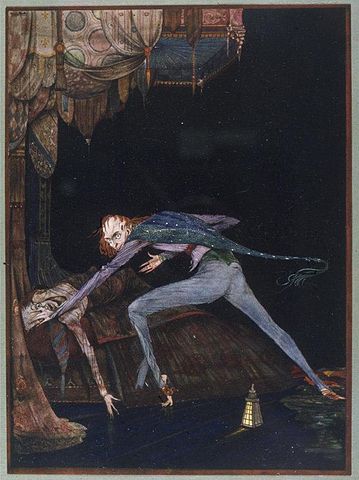
An illustration from 'Tell-Tale Heart'
Fleming himself had a fondness for the macabre, and it is appropriate that his most macabre novel, You Only Live Twice (1965), contains two references to Poe. When Tiger Tanaka describes Dr Shatterhand's castle of death, Bond is reminded of Poe, Le Fanu, Bram Stoker and Ambrose Bierce. Later, when Bond encounters Shatterhand, now revealed to be Blofeld, he comments on Blofeld's genius for creating a shrine to death. “People read about such fantasies in the works of Poe, Lautréamont, de Sade.”

But there is another allusion to Poe. In his 1842 story, 'The Mystery of Marie Rogêt', in which the detective C Auguste Dupin investigates the unsolved murder of Marie Rogêt, the unnamed narrator is subjected to a series of tests on the matter of dreams. At one point he states that “when one dreams, and, in the dream, suspects that he dreams, the suspicion never fails to confirm itself, and the sleeper is almost instantly aroused. Thus Novalis errs not in saying that 'we are near waking when we dream that we dream.'”

 
An illustration from The Mystery of Marie Roget
If this passage seems familiar, then it is because Fleming had the same idea in Casino Royale (1953). Chapter 19, which describes Bond's recovery after his savage beating at the hands of Le Chiffre, begins, “You are about to awake when you dream that you are dreaming.”

The idea is an attractive one, and interestingly Fleming isn't the first novelist to allude to it. For instance, in Jules Verne's 1897 novel, Le Sphinx des Glaces, which imagines that Poe's 1838 novel, The Narrative of Arthur Gordon Pym of Nantucket, is a true account of a voyage to Antarctica, the protagonist Mr Jeorling describes how he “dreamed that I was dreaming,” continuing that “when one suspects that one is dreaming, the waking comes almost instantly.”

The references to Edgar Allan Poe in the Bond novels confirm that Ian Fleming was familiar with the writer's work. Possibly the young Ian listened to Poe's stories, along with those of Buchan and Rohmer, at Durnford School. But wherever and whenever Fleming read the stories, they stayed with him, and it is inevitable that the ideas within them would re-emerge in Fleming's own work.

Friday, 3 June 2016

How would James Bond vote in the EU referendum?

An article in The Times this week reported on a YouGov survey, which polled 1,700 adults about how they thought fictional characters would vote in the upcoming EU referendum. The results suggested that the respondents projected their own voting intentions on the characters. Thus, in the case of James Bond, those in the leave camp imagined Bond would vote for the UK to leave the EU, while those in the remain camp thought that he'd vote to stay in.

So, with this unclear picture in mind, just how would James Bond vote? Well, it depends which Bond we're talking about. The literary Bond might well vote for the UK to leave. After all, he's deeply patriotic and is quick to defend the county against any criticism.

For instance, in You Only Live Twice (or is that EU Only Live Twice? as one reader of the Times article put it), Bond is stung by Tiger Tanaka's accusations that England has thrown away a great empire, that Suez was a pitiful bungle, that successive governments have handed control to the unions, and that England is generally declining in fortune. Bond counters, somewhat lamely, that England isn't doing too badly and that it still beats people in sports and wins Nobel prizes.

Bond hears a similar case in 'The Hildebrand Rarity', when boorish American Milton Krest tells Bond that England is a diminishing asset in the world, though he responds simply that he thinks Krest's view oversimplified and naïve.

Evidently, Bond considers that the UK (or, rather, England) still has what it takes to stand on its own. On the other hand, with his Scottish ancestry, proudly claimed in The Man with the Golden Gun, Bond might ally himself with majority opinion in Scotland, which appears to favour a remain vote.

The film Bond might lean towards a leave vote ('So does England', says Bond in The Spy Who Loved Me in response to the Log Cabin Girl telling him that she needs him). But then again, today's Bond is not so much a lone wolf, as part of team that increasingly depends on intelligence and cooperation from different agencies. Bond might view Brexit as a threat to those arrangements. No more Monsieur Aubergine. 

That said, spy chiefs appear to be sanguine about the impact of leaving the EU, given that the EU has been less important in intelligence matters than the 'Five Eyes' alliance of the US, Australia, New Zealand, Canada and the UK. Former MI6 chief David Dearlove has suggested that the cost to Britain in the case of Brexit would be low, while former CIA director Michael Hayden has said that the EU was not 'a natural contributor to national security'. These are opinions that one can imagine Bond sharing. But, as the Guardian's Ewen MacAskill suggests, the need for cooperation and intelligence-sharing across the EU is only likely to increase. 

So, if you want to know how to vote, don't ask Bond. He's as confused as the rest of us.  

Sunday, 7 June 2015

Reflections in a double sake - James Bond's Tokyo

Following a recent visit to Tokyo, guest blogger Radley Biddulph considers what James Bond might think of the city today, some 50 years after Bond's visit in You Only Live Twice (1964).
For James Bond, Tokyo is outside his comfort zone. And it shows. Exhausted on his arrival at Haneda airport, greeting the country with a well-chosen swear word and with a guide whose basic advice is that the Japanese "do everything the wrong way round", his solution is to head to a Ginza bar.

Even when he finally meets Tiger Tanaka, the head of the Japanese secret service, he insists on a tumbler for his sake (instead of the “ridiculous thimbles” he has been drinking from) and insults his host by his poor knowledge of porcelain. You can almost see the eyebrow he no doubt has permanently and ironically raised during his visit to Japan as his coping mechanism. Having recently visited Tokyo myself, I wondered what Bond would make of the country now.


A bottle of sake
Tokyo is far more accessible now than it was when Bond saw the city, Japanese food is a lot more familiar to us now and many international and well-known companies are based there. And yet, there are still things in Tokyo that may surprise … and suddenly you realise that Tokyo remains different in a number of ways.

For a start, Bond would surely have a comment or two to make on the bathrooms; the lid rises automatically when you enter the toilet, the seat is heated, and they come with a complete wash, dry and deodorizer functionality. You can just imagine an amused Bond spending some time reading the instruction manual on the wall trying out all the options, and making a mental note to mention it to Dikko when they meet in the bar later that evening.

While at the bar (probably not in Ginza, which is now more of a shopping district, but instead at the bars and nightclubs of Shinjuku), he may give sake another go. But it is falling in popularity and he may instead stick to Asahi beer. Or more probably, he’d go with shochu, which is stronger than sake and may be more to Bond’s liking. He may even drink the local whisky. And he'd enjoy it this time. Despite Bond doubting that Japanese whisky would make a good foundation for anything, it now competes on equal terms with the world’s best. 

Some things never change, and Bond would be familiar with old haunts such as Hotel Okura, still there although a little old-fashioned with a 1960s feel. But given Bond’s preference to eat at station restaurants, I think he would love Tokyo Station, which hosts an underground city of bars and restaurants, including the famous Ramen Street.  

Getting to Fukuoka on his mission to the Castle of Death, Bond would, I am sure, be in awe of the shinkansen bullet trains, getting to his destination in little more than six hours. 

Would Bond be out of his depth were he to visit Tokyo now? I hope not. I like to think he would be less dismissive, and ready to take things much more in his stride.

Sunday, 11 May 2014

How does James Bond win at rock-paper-scissors?

A recent study of 360 players at a rock-paper-scissors tournament at Zhejiang University in China revealed that players who win a round tend to stick to their winning action in the next round, while the losing player tends to play the next action in the sequence. Thus, a competitor who wins with paper against the opponent's rock will play paper in the next round, while the opponent will play paper.

This seems to contradict an earlier study by a team from University College London (UCL), which studied the results of two contests – one in which both players were blindfolded, and the other in which one player was blindfolded – which suggested that players tend to mimic each other's actions through 'automatic imitation', resulting in a high proportion of draws.

Both studies demonstrate that play is rarely random. Game theory suggests that the best strategy to adopt is one where decisions about which action to play are random, but in practice this approach appears to be difficult to sustain.

Rock-paper-scissors is a game with which James Bond is familiar. In the novel of You Only Live Twice, the head of the Japanese secret service, Tiger Tanaka, challenges Bond to a contest (chapter 1). The description of the contest, which deserves to join Moonraker's game of bridge and Goldfinger's golf match as a classic piece of sports writing, is sufficiently detailed to give us Bond's strategy over three games of rock-paper-scissors, each comprising the best of three rounds. Returning to the recent studies, how does Bond play?

Fleming tells us that Bond's strategy from the start is to play randomly. In the first round, Bond plays paper against Tiger's stone and wins. In the second round, Tiger plays stone to win against Bond's scissors. In the decider, Tiger keeps his stone, while Bond wins with paper. In this game, then, Bond does appear to play randomly, or least his strategy does not seem to fit the play typically encountered in the two studies. In contrast, Tiger's play is more calculated. By sticking to the same action over three rounds, he is likely to achieve some success against a random strategy simply by chance. But perhaps by the third round Bond's play is not so random. Fleming describes Bond's suspicions that Tiger would again choose stone, and this gives Bond the edge.

For much of the second game, Bond and Tiger show the same symbols and record a series of draws. The play appears to be consistent with 'automatic imitation' described in the UCL study. Tiger eventually wins the game, however, with Bond claiming to be continuing his random play.

In the third and final game, Bond wins the first round with stone against Tiger's scissors, and wins the second by playing paper against Tiger's stone. Again Bond can claim with some justification that his strategy was random – he “had had no method” – while Tiger appears to have adopted an approach which is consistent with the results of the study by Zhejiang University. Losing in the first round with scissors, he plays the next symbol in the sequence – rock (or stone) – in the second.

Of course, the game Fleming describes is fictional, with presumably no basis in fact. Bond was always going to win. But Fleming's writing is, as usual, so skilful and detailed that it offers a set of plausible results in the game of rock-paper-scissors that are consistent with standard and new theories of play.


Further reading:
Cook, R, Bird, G, Lünser, G and Huck, S, 2011 Automatic imitation in a strategic context: players of rock–paper–scissors imitate opponents' gestures, Proc. R. Soc. B, 22 February 2012 vol. 279 no. 1729 780-786, Published online before print 20 July 2011 doi: 10.1098/rspb.2011.1024
Wang, Z, Xu, B and Zhou, H-J, 2014 Social cycling and conditional responses in the Rock-Paper-Scissors game, arXiv:1404.5199v1 [physics.soc-ph]

Sunday, 26 January 2014

David Arnold introduces You Only Live Twice


Last Thursday I was at the British Film Institute (BFI) at London's Southbank to see film composer David Arnold introduce You Only Live Twice. The event was one in a series of 'Screen Epiphanies', in which notable individuals discuss a film that has influenced or otherwise inspired them.

I must confess that You Only Live Twice isn't my favourite Bond film. The script, which is built almost entirely around a volcano that the film makers happened to see when scouting for castles by the coast, is a shameful waste of Fleming's novel (although ironically elements of it have appeared in subsequent films). The three-Bond-girl formula, as revealed to screenwriter Roald Dahl, the 'stirred, not shaken' vodka martini, and the mysterious cameras relaying images of the helicopter picking up the car with the magnet and the capture of a space capsule back to Aki's car and Blofeld's control room respectively, suggest a careless and somewhat cynical approach to the plotting. Then there's the Japanese bath scene, which has dated badly, even without the help of Austin Powers.

So when I sat down in the auditorium, I was rather glad I'd had a fortifying cocktail (a 'gipsy martini', which contained Kina Lillet, an ingredient of Bond's Vesper martini). By way of an introduction to David Arnold's involvement with the Bond series, the audience was shown the titles sequence to Casino Royale. Brilliant stuff, and I was rather hoping the projectionist would let the film run on. Still, this set the mood perfectly, and as the interviewer brought him on to the stage, David Arnold was deservedly greeted by warm applause.

The interviewer naturally asked David Arnold about why You Only Live Twice was an epiphany. Arnold revealed that the film was the first (?Bond) film he saw. He was 8 years old or so, and was at a birthday party at community hall when a projector was brought out and You Only Live Twice was played. The screen was small and the sound poor, but the young David was entranced by the film and its music. Moments such as the Kobe dock scene and the Little Nellie sequence, and musical themes, particularly John Barry's 'Space March', helped create a life-long Bond fan and inspired his future work.

Surprisingly, David Arnold wasn't entirely sure about how he came to be involved with the Bond series. By 1996, when he began having conversations with Barbara Broccoli about scoring a Bond film, he had written the score to Stargate, and was producing Shaken and Stirred, an album of reinterpreted James Bond music and title songs. In one version, David Arnold was recommended to Barbara Broccoli by John Barry, to whom David Arnold was introduced by George Martin. At that meeting, Arnold took the opportunity to play Barry a few tracks from his album. Barry liked what he heard, and went to Barbara Broccoli. In another version, Barbara Broccoli heard some of the tracks independently and had decided to hire Arnold without John Barry's intervention.

David Arnold spoke a little about his work scoring the open ceremony of the Olympic Games in 2012, and his recent work on Sherlock and the forthcoming musical, Made in Dagenham. While open to the prospect of working again with Eon Productions, he gave no hint about his future involvement, if any, with the Bond series. As for Skyfall (scored by Thomas Newman), Arnold thought very highly of the film and the score, and was happy to have watched the film as a Bond fan on the other side of the screen.

On that note, the interview finished, and it was time to watch You Only Live Twice. Did watching the film on the big screen change my opinion of it? Possibly, a little. I admit the film is hugely spectacular. The opening space-set sequence in which the SPECTRE capsule captures the American spacecraft is creaky, but it still manages to look awesome and pack some emotional punch as one of the astronauts is cut off and drifts into the vastness of space. The sumo wrestling scene is nicely shot and integrated into the film, and reminded me that one thing the Bond films do very well is present local colour, events and customs to help ground the films and give them a sense of place (think of, for example, the bull-fighting in On Her Majesty's Secret Service, or the Palio di Siena in Quantum of Solace). The ninja drop from the roof of the volcano is epic, and with the help of Freddie Young's photography and Ken Adam's sets, audiences have no doubt that every penny spent on the film can be seen on the screen.

But for all these pluses, there still remain, for me, a large number of significant irritations – the inability of Blofeld to shoot Bond (there must be better ways of extracting Bond from moments of peril other than relying on Blofeld's procrastination), the comical effect produced by one of Mr Osato's employees ('Spectre 4', played by Michael Chow) saying everything twice, and the faults already mentioned – which all contribute to the feeling that plotting and coherence were the least of the film-makers' concerns. But then again, the Bond producers recognised as much, as they returned to Fleming with On Her Majesty's Secret Service, a fantastic film and a favourite with the fans, me included.

Monday, 23 September 2013

I shall use my time: James Bond's philosophy

As I was watching Munro Scott's 1964 interview with Ian Fleming on CBC-TV's Exploration programme the other day, I was reminded of Fleming's strong views on boredom. “Boredom is the worst sin of the human being,” he said. “It's the worst thing that could happen.” This may explain Fleming's peripatetic career and craving for excitement, which he'd find in the gambling rooms, the wartime offices of naval intelligence, or the waters off his coastal home in Jamaica, among other places.

Fleming gave the same abhorrence of boredom to James Bond. When we first meet Bond in From Russia, with Love (chapter 11), he is at his Chelsea home between missions. Bond is thoroughly bored with the prospect of the day ahead in the office, and Fleming tells us that “boredom, and particularly the incredible circumstance of waking up bored, was the only vice Bond utterly condemned.”

Fleming alludes to this view again in Bond's obituary in You Only Live Twice (chapter 21). In an addendum to M's obituary, Mary Goodnight writes about Bond's philosophy: “'I shall not waste my days in trying to prolong them. I shall use my time.'”

It's a great line, and aptly describes the boredom-busting, live-life-to-the-fullest attitude of both Bond and Fleming. It appears, however, that the words aren't Fleming's, but have instead been attributed to American writer, Jack London, best known for his novels, The Call of the Wild (1903) and White Fang (1906), and are included in a larger statement of what has been described as London's credo:

“I would rather be ashes than dust. I would rather that my spark should burn out in a brilliant blaze than it should be stifled by dry-rot. I would rather be a superb meteor, every atom of me in magnificent glow, than a sleepy and permanent planet. The proper function of man is to live. I shall not waste my days trying to prolong them. I shall use my time.”

While there is some question over the authorship of this passage (only the first line closely matches words known to have been London's, with the rest contended to be journalistic invention), it apparently pre-dates You Only Live Twice, being first published in the San Francisco Bulletin in 1916, then republished in 1956 by Doubleday in an introduction to Tales of Adventure, a collection of London's short stories.

I admit I haven't seen a copy of Tales of Adventure, and certainly not the San Francisco Bulletin, and so I remain a little hesitant about the entire matter. I would prefer to see the words on the page of the 1956 volume before committing myself to a more definite view about their origin and date, so if anyone has a scan of the page in question, then please get in touch.

Assuming the chronology of the passage is correct, it's possible that Fleming saw the lines in the 1956 edition and, rather taken with them, felt that they were appropriate for Bond as well. There is no acknowledgement of source in You Only Live Twice; while the lines beginning, “I shall not waste my days” are presented in quotation, the implication is that the words are Bond's. But if the words aren't London's in any case, what do questions of origin and source matter? Well, that's still up for debate, but there's another question: should we add Jack London's Tales of Adventure to James Bond's library?

Saturday, 7 September 2013

More than just a small island: Cameron's speech recalls You Only Live Twice

When an unnamed Russian official allegedly told reporters at the G20 summit in St Petersburg that “no-one pays any attention to Britain” and that it was “just a small island”, British prime minister David Cameron was quick to respond with an impassioned defence of the country.

“Britain may be a small island but I would challenge anyone to find a country with a prouder history, a bigger heart or greater resilience," he said, continuing by reminding people that Britain helped “clear the European continent of fascism and was resolute in doing that throughout World War II”, and that "Britain is an island that helped to abolish slavery, that has invented most of the things worth inventing, including every sport currently played around the world, that still today is responsible for art, literature and music that delights the entire world.”

Warming to his argument at a later press conference, Cameron listed a number of world-renowned British cultural icons: The Beatles, Elgar, Shakespeare, and, er, One Direction. Unfortunately there was no mention of James Bond, but perhaps if Cameron feels compelled to give the speech again, he can find room for a character that has been one of the most enduring and successful British cultural exports.

Needless to say, there was much reaction in the British media, with many newspapers applauding Cameron's “Churchillian” and “impassioned” defence of Britain. A number of commentators compared the speech to a scene in the film, Love Actually (2003), in which the British prime minister, played by Hugh Grant, says that “We may be a small country but we're a great one, too", and references a similar list of cultural icons (including Sean Connery).

For me, though, Cameron's words reminded me of a passage in chapter 8 of Ian Fleming's You Only Live Twice (1964), in which Tiger Tanaka, head of the Japanese Secret Service dismisses Britain as a world power, and questions the value of giving Britain important intelligence material. “Balls to you, Tiger! And balls again!”, James Bond retorts. “We still climb Everest and beat plenty of the world at plenty of sports and win Nobel Prizes. Our politicians may be a feather pated bunch, and I expect yours are too... But there's nothing wrong with the British people – although there are only fifty million of them.”

Both Cameron and Bond's defences allude to the notion of a small island punching well above its weight, and the idea that Britain has been responsible for many cultural, physical and scientific endeavours. No doubt politicians and commentators have been making the same defence since the end of the Second World War. But Fleming adds an interesting sentence. 'He [Bond] was still smarting under Tiger's onslaught, and the half-truths which he knew lay behind his words.' Those of a more cynical bent might wonder whether, like Bond's defence, David Cameron's speech was also to some extent an acknowledgement of uncomfortable truths.

Saturday, 27 October 2012

Skyfall - a memetic review

Warning: this review contains minor spoilers

Skyfall is an outstanding achievement. It is both a fitting celebration of 50 years of the James Bond films, and a forward-facing film relevant for our times. That the film has pulled off this trick is testament to the remarkable work of the screenwriters, director, production crew, actors, and above all Daniel Craig in bruising and arresting form. Skyfall is not just a Bond film; it is an intelligent piece of story-telling that stands on its own terms outside Bondworld.

From the start, the narrative plunges the viewer into the heart of the action and takes a grip that does not weaken for its entire two-hour running time. A hard drive containing the identities of agents embedded with terrorist organisations has been stolen. Bond's initial attempts at recovering the disk fail, and he, M and others at MI6 find themselves one step behind the instigator of the theft, whose motivation is very personal and very deadly.

Superficially, Skyfall takes very little from Ian Fleming's novels, but dig a little deeper, it becomes clear that Fleming has not been forgotten. The ultimate inspiration for Daniel Craig's Bond still derives from the literary hero. The screenwriters, John Logan and regular scribes Neal Purvis and Robert Wade appear to have turned to two books in particular. James Bond's obituary, which M writes after a bungled attempt to shoot an enemy agent, takes elements, reproduced almost verbatim, from the obituary in You Only Live Twice. Bond's childhood alluded to in Skyfall is also based on details revealed in the novel's obituary.

Bond's subsequent 'resurrection', as an out-of-shape and wrecked agent, mirrors events in the beginning of the book that follows, The Man with the Golden Gun. Though not named in the film, the psychologist in Skyfall is surely inspired by the psychologist of that and other novels, Sir James Molony (I understand the character is called Dr Hall; a missed opportunity, surely, for a clearer nod to the books). But in a twist, Bond's role in the dramatic episode in M's office in The Man with the Golden Gun is in Skyfall effectively given to the villain, Javier Bardem's Raoul Silva, and this consequently shapes the film's plot.
 
There is a clever nod to Ian Fleming when we approach the ancestral Scottish home of James Bond. The stag sitting on the gateway recalls the beast in Fleming's family crest. And as Skyfall's narrative comes to a shocking end, I cannot help but think of the shoot-out in the Dreamy Pines motor court in The Spy Who Loved Me, and the denouement of On Her Majesty's Secret Service. James Bond only lives twice, but in return he must endure the emotional pain that  accumulates with the deaths of those closest to him not permitted such a luxury.

Inevitably, Skyfall acknowledges the history of Bond film series. Javier Bardem captures the spirit of villains past, delivering a gruesome and deeply frightening amalgam of Jaws and Hugo Drax or Blofeld; in addition, Silva's island base takes us right back to Dr No's Crab Key. Sévérine, played by Bérénice Marlohe, recalls Maud Adams' tragic Andrea from The Man with the Golden Gun film. A particularly Bondian scene in a komodo dragon pit provides a nod to Bond's alligator-hopping in Live and Let Die (which is rather appropriate, given director Sam Mendes' fondness for the film). References to Goldfinger abound. The reappearance of Goldfinger's Aston Martin DB5, which brought a cheer from the audience, was accompanied by an extended musical reference to the 1964 film. And as promised, Daniel Craig delivers the sort of measured one-liners that rival the best of the witticisms of the Sean Connery era.

The titles sequence references the best of  Maurice Binder, and Adele's title song has more than a hint of Shirley Bassey. There are doubtless many more nods to the films, but it will take repeated viewings to extract them all.

Is Skyfall the best Bond film? The question is redundant. The cultural environment is always evolving, and we get the Bond for our times. Goldfinger or From Russia with Love were the best of the 1960s' Bond, The Spy Who Loved Me was perfect for the 1970s, The Living Daylights reflected society's changing mores, while GoldenEye successfully introduced Bond to a post-Cold War world. Skyfall is certainly very good, and deservedly takes its place in the pantheon of Bond greats.

Saturday, 22 September 2012

Fleming memes in the Skyfall trailer

Any Ian Fleming fans who have wondered whether Skyfall would include any elements from the James Bond novels are likely to have been reassured when viewing the main Skyfall trailer. In it, the words in Bond's obituary that we see M write are taken almost verbatim from M's obituary in the novel, You Only Live Twice. That Skyfall evidently includes Bond's 'death' and, as Bond himself puts it, his 'resurrection', suggests that some of the themes of Fleming's penultimate novel, if not its actual episodes, have been mined for ideas for the film.

The trailer appears to show another nod to Fleming. Javier Bardem's villain, Raoul Silva, tells Bond, 'She sent you up to me, knowing you're not ready, knowing you would likely die. Mommy was very bad.' I love that line. To me, it perfectly evokes the spirit of Fleming's writing. In particular, it brings to mind the torture episode in Casino Royale.

As the naked Bond is strapped to the chair and threatened with a carpet beater (chapter 17), Le Chiffre tells him, 'You are not equipped, my dear boy, to play games with adults and it was very foolish of your nanny in London to have sent you out here with your spade and bucket'. Both the delivery of the lines and the chilling allusion to childhood convey the villains' sense of absolute dominance over Bond and the confidence that their plans will prevail.

Perhaps, too, the reference in Silva's line to M as 'mommy' is an allusion to Fleming's nickname for his mother, Eve. In letters he wrote to her when he was a child, he occasionally called her 'M', and this in turn may have had some influence on the naming of Bond's chief.

Come October and November, Fleming aficionados will be carefully watching Skyfall to identify elements of the Bond novels. Just from the trailer, though, it is unlikely that they will be disappointed. We already know that Sam Mendes and Daniel Craig re-read Fleming before embarking on the film, and the result appears to be that Skyfall has inherited several memes from the books.

Reference:

Lycett, A, 1995 Ian Fleming: The man behind James Bond, Turner