Showing posts with label moonraker. Show all posts

Tuesday, 23 January 2018

Atticus and the origin of Bond's winning bridge hand

A while ago, I described how Ian Fleming’s Atticus column in the Sunday Times, which he wrote from 1953 to 1956, provided him with material for the Bond novels. The reverse was also true. Occasionally, ideas that appeared in the Bond novels would also crop up again in Atticus.


Take Moonraker, for example. In the epic bridge game between James Bond and Hugo Drax, Bond wins by means of the redoubled grand slam, beating Drax with a combination of trumps and diamonds. 

Dwight D Eisenhower, US President from 1953 to 1961, won a game of bridge with a similar hand. In Atticus of June 19th, 1955 (two months after the publication of Moonraker), we’re told that Eisenhower, a brilliant bridge player, who liked to play trumps as an opening lead, won a famous game just before the end of the Second World War against fellow US army generals Gruenther, Clark and Moses. The hand was redoubled, and Eisenhower prevailed with a grand slam in diamonds. Coincidence, or the source of the game between Bond and Drax?

Later in Moonraker, we learn that Drax owns a Mercedes 300 S, ‘the sports model with the disappearing hood’, and painted white in honour of the famous Mercedes victories at Le Mans and Nürburgring.
 
Cover artwork of the first edition of Moonraker (Cape, 1955)

Atticus mentions a similar model on July 3rd, 1955. In the piece, Atticus reported that American journalist John Bentley (‘the best American writer on fast motoring’) considered that Le Mans had lost its purpose, which was to provide a testing ground for production vehicles. Instead, limited-production cars and prototypes were permitted, and ‘the true spirit of Le Mans vanished.’ 

The Mercedes 300 SLR is mentioned as a case in point. This model is similar to Drax’s car, but, we’re told, its air-brakes are relocated behind the centres of gravity and pressure, which steady the car on racing turns and mininise tail slides, but ‘would be useless’ on normal highways. The piece is accompanied by a photograph of a white Mercedes 300 SLR driven by Pierre Levegh (who tragically lost his life at Le Mans the previous month). The piece has only a tangential connection to Moonraker, but it nevertheless draws on Fleming’s fascination of motor racing that informed passages of the Bond novel.

Atticus gave Ian Fleming the opportunity to research and read up on subjects that would prove useful for the Bond books, but Fleming also turned to the Bond books for material for his later writing.

Thursday, 5 January 2017

When James Bond dreamt of Edgar Allan Poe

Edgar Allan Poe seems an unlikely influence on Ian Fleming's writing, but the 19th-century poet, story-teller, and master of the macabre nevertheless made his mark in the James Bond novels.

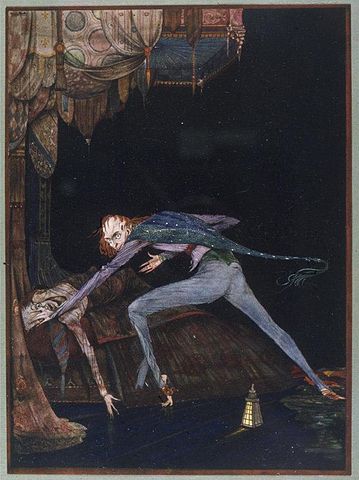
Ian Fleming mentions Poe three times in the Bond novels. There is one reference in Moonraker (1955); Fleming compares the ominous ticking inside the Moonraker rocket before launch to “the beating heart in Poe's story” (probably 'The Tell-Tale Heart' (1843), in which “the beating of the old man's heart...increased my fury, as the beating of the drum stimulates the soldier into courage”).

 
An illustration from 'Tell-Tale Heart'
Fleming himself had a fondness for the macabre, and it is appropriate that his most macabre novel, You Only Live Twice (1965), contains two references to Poe. When Tiger Tanaka describes Dr Shatterhand's castle of death, Bond is reminded of Poe, Le Fanu, Bram Stoker and Ambrose Bierce. Later, when Bond encounters Shatterhand, now revealed to be Blofeld, he comments on Blofeld's genius for creating a shrine to death. “People read about such fantasies in the works of Poe, Lautréamont, de Sade.”

But there is another allusion to Poe. In his 1842 story, 'The Mystery of Marie Rogêt', in which the detective C Auguste Dupin investigates the unsolved murder of Marie Rogêt, the unnamed narrator is subjected to a series of tests on the matter of dreams. At one point he states that “when one dreams, and, in the dream, suspects that he dreams, the suspicion never fails to confirm itself, and the sleeper is almost instantly aroused. Thus Novalis errs not in saying that 'we are near waking when we dream that we dream.'”

 
An illustration from The Mystery of Marie Roget
If this passage seems familiar, then it is because Fleming had the same idea in Casino Royale (1953). Chapter 19, which describes Bond's recovery after his savage beating at the hands of Le Chiffre, begins, “You are about to awake when you dream that you are dreaming.”

The idea is an attractive one, and interestingly Fleming isn't the first novelist to allude to it. For instance, in Jules Verne's 1897 novel, Le Sphinx des Glaces, which imagines that Poe's 1838 novel, The Narrative of Arthur Gordon Pym of Nantucket, is a true account of a voyage to Antarctica, the protagonist Mr Jeorling describes how he “dreamed that I was dreaming,” continuing that “when one suspects that one is dreaming, the waking comes almost instantly.”

The references to Edgar Allan Poe in the Bond novels confirm that Ian Fleming was familiar with the writer's work. Possibly the young Ian listened to Poe's stories, along with those of Buchan and Rohmer, at Durnford School. But wherever and whenever Fleming read the stories, they stayed with him, and it is inevitable that the ideas within them would re-emerge in Fleming's own work.

Friday, 23 December 2016

Moonraker's Christmas gift idea

If you're after a last-minute Christmas gift idea, then your thoughts may have turned to the film of Moonraker. Among the gadgets Q supplies James Bond is a dart gun worn around the wrist. Equipped with ten darts – five amour-piercing, five cyanide-tipped – the device comes in handy when Bond needs to cut the power of a rotating centrifuge trainer and help Drax take a giant step back for mankind. 'Very novel, Q', Bond says. 'Must get them in the stores for Christmas'.


Did Q succeed in getting them in the stores for Christmas? Sadly, no. The Imperial Toys Corporation produced a James Bond dart gun in 1984 (click here for details), but the darts are fired from a standard pistol-type gun, rather than one worn round the wrist. And in any case, the toy, long out of production, is hard to come by.

Replicas of the film's dart gun are built from time to time and become available to buy at specialist stores or auction sites, but a trawl of such places suggests that if you're looking for a replica of the prop, then you're out of luck. Replica dart guns were being sold on eBay for £140 in 2015, but these no longer appear to be available. Vectis Auctions, which specialises in collectible toys, were selling a reproduction of the prop in 2013, but no other examples have been offered since.

I admit I haven't looked at the websites of arms manufacturers, but it's possible that a wrist-mounted dart gun is in development and on the way to becoming science fact.

So, it seems that Q didn't follow Bond's advice. Oh well, there's always next year. In the meantime, have a wonderful Bondian Christmas.

Friday, 21 October 2016

Supersonic Buchan: Moonraker and John Buchan's The Three Hostages

While I’ve long maintained that the origin of James Bond owes more to American hardboiled thrillers by the likes of Raymond Chandler and Dashiell Hammett than it does to pre-Second World War literary clubland heroes, such as Bulldog Drummond and Richard Hannay, there is no denying that the third Bond novel, Moonraker (1955) is Ian Fleming at his most Buchan-esque.

I was reminded of this as I read the fourth Hannay adventure, The Three Hostages (1924). In the book, set after the First World War, Hannay is a retired army general eager for the quiet life at his Cotswold estate. Before long, though, he is persuaded by Macgillivray, who works for the Secret Service, to use his particular set of skills to help, unofficially, in the search for three individuals of note who have been kidnapped by a criminal gang.


Hannay has little to go on other than a piece of indifferent doggerel written by the mastermind behind the plot. The clue is enough, however, to take Hannay to one Dominick Medina, a extraordinarily handsome, clever and popular politician, the best shot in England and a poet to boot. Hannay initially seeks Medina's assistance, but realises, eventually, that Medina is the villain at the centre of the conspiracy.   

In general terms, The Three Hostages and Moonraker cover similar ground. Both have home-grown plots that begin in the refined and exclusive surroundings of London's clubland. Indeed, Hannay and Bond first meet Medina and Moonraker's villain, Sir Hugo Drax, in gentlemen's clubs (the Thursday Club and Blades, respectively). The schemes of both villains' aim to strike at the heart of the British government and bring the country to its knees, reflecting the deep-seated hatred that Medina and Drax have for Britain.

The villains, too, are cut from a similar cloth. Both are adored by the public and, at least initially, by the books' heroes. When M asks if he's heard of Sir Hugo, Bond replies that 'you can't open a paper without reading something about him'. The man's a national hero, Bond adds, and continues to give a gushing account of Drax before pausing, 'almost carried away by the story of this extraordinary man.'

Hannay's rather smitten with his man as well, and has the same thought as Bond. 'You couldn't open a paper without seeing something about Dominick Medina', he tells us. Hannay's friend, Dr Greenslade considers Medina a great man, and judging by the papers, the whole world thinks so too. When Hannay meets Medina, he remarks on the attractiveness of the man, his easy-going personality, and admits to being fascinated by him and under his spell.

Hannay tells his best friend and co-adventurer, Sandy Arbuthnot, that Medina is 'the only fellow I ever heard of who was adored by women and liked by men', a line that has a curious echo in the phrase applied to Bond by Raymond Mortimer: 'James Bond is what every man would like to be, and what every woman would like between her sheets.'

Neither Bond nor Hannay are quick to suspect Drax and Medina of villainous intent, and in a way the idea that a powerful, seemingly altruistic, and charming man is beyond suspicion has endured in fiction, finding expression, for example, in the Bond films. In the film of Moonraker, when Bond takes M and the Minister of Defence to Drax's secret laboratory, the Minister is sceptical. 'I hope you know what you're doing, Bond', he says, 'I've played bridge with Drax.' And similarly, in A View To A Kill (1985) when Bond wonders if Zorin himself was responsible for an infiltration of Zorin Industries by the KGB, the Minister of Defence splutters, 'Max Zorin? Impossible. He's a leading French industrialist... with influential friends in the government.'

Drax can't compete with Medina for looks. Drax has facial scars from the war, and has protruding front teeth or a diastema that he attempts to hide by growing a luxurious moustache. But Medina isn't perfect either. Hannay notes that Medina's head 'was really round, the roundest head' he had ever seen. He continues that Medina was 'conscious of it and didn't like it, so took some pains to conceal it' with his hair. Oddly enough, the very round head would be a villainous trait in a Bond novel. In Live and Let Die, Mr Big is described as having 'a great football of a head, twice the normal size and very nearly round.'

One final shared trait worth mentioning is that both Drax and Medina are somehow 'other' by virtue of their foreignness or perceived foreignness, which to some extent explains their villainy. Drax is of course revealed to be German. Dominick Medina is English, but his name raises a question in Hannay's mind. 'I suppose he's some sort of Dago', he says to Greenslade. On meeting Medina, Hannay remarks that his face 'was very English, and yet not quite English.'

I wouldn't go as far as to say that Ian Fleming was influenced by The Three Hostages directly, but given their common traits or memes, Buchan's novel and Moonraker certainly inhabit the same cultural environment. Famously, one critic referred to Fleming as 'supersonic John Buchan'. In the case of Moonraker, I'm rather inclined to agree.

Saturday, 24 January 2015

Winston Churchill in the James Bond books

This week saw the launch of events to commemorate the 50th anniversary of the death of Sir Winston Churchill, who died on 24th January 1965. There will be special exhibitions to celebrate Churchill's life and legacy in Paris, London and at Blenheim Palace, and on 30th January the boat that carried Churchill's coffin down the Thames, the Havengore, will retrace her route, accompanied by a flotilla of other vessels.

There is no doubt that Ian Fleming would have welcomed such a commemoration, as Winston Churchill was one of Fleming's heroes. It was an admiration that began during his childhood. Churchill and Fleming's father, Valentine, both served in the Queen's Own Oxfordshire Hussars during the First World War. When Valentine was killed on the Western Front, Churchill wrote an appreciation of his close friend for The Times. The young Fleming framed Churchill's words and subsequently hung them in every house in which he lived.

Fleming's admiration only increased during the Second World War. As a key figure in the Naval Intelligence Division, Fleming would have had many dealings with Churchill, and the relationship must have been a very positive one. As he revealed in his introduction to H Montgomery Hyde's biography of Sir William Stephenson, Room 3603: The story of the British Intelligence Centre in New York during World War II (1963), Fleming admired Churchill's courage, fortitude, and service to a cause and his country.

When Ian Fleming came to write the James Bond books, inevitably he found a place for Churchill in the novels. In From Russia, With Love (1957), Fleming states that May, Bond's housekeeper, would call no one 'sir', except the king and Winston Churchill. Later in the novel, we learn that Darko Kerim, head of T section (Turkey), has a copy on his desk of Cecil Beaton's photograph of Winston Churchill.
Cecil Beaton's portrait of Winston Churchill
But Winston Churchill seems to have a larger role – almost a speaking part – in Fleming's third novel, Moonraker (1955). As the terrifying truth of Sir Hugo Drax's plans for his Moonraker rocket emerges, M debates whether to have a word with the prime minister, and Ronald Vallance of Special Branch tells Bond that “the PM's going to broadcast” on the day of the rocket launch. At the end of the adventure, when destruction of London has been averted, M takes a telephone call from the prime minister (Bond is with M at the time), who tells M that he wants Bond out of the country to avoid the press as the Moonraker affair is hushed up.

Ian Fleming wrote Moonraker in the winter of 1954. As Winston Churchill was Prime Minister from October 1951 to April 1955 (Moonraker was published in March 1955), it is quite possible that when Fleming was describing the prime minister in the novel, he had Winston Churchill in mind.

The brief allusions to Winston Churchill in the James Bond books serve to underline Fleming's admiration of the wartime leader, which was forged in Fleming's childhood and remained with him for the rest of his life.

Saturday, 13 September 2014

The enduring popularity of Richard Kiel's Jaws

When the death of Richard Kiel was announced on 11th September, the story made news headlines around the world, and generous obituaries were published in major newspapers. This is testament to the respect and affection people around the world felt for the actor, and a measure of the extent to which Jaws, James Bond's steel-toothed adversary in the films The Spy Who Loved Me (1977) and Moonraker (1979), had pervaded cultural space.

Much of the responsibility for this must lie in Richard Kiel's interpretation of the role. He imbued the character with the perfect combination of menace, humour and humanity – remarkably without uttering a single word until his final scene as Jaws in Moonraker. As Kiel said on the BBC Radio 4 programme, The Reunion, recorded days before his death, “I said if I were to play the part, I want to give the character some human characteristics, like perseverance, frustration.”

The popularity of Jaws also stems, inevitably, from his physical attributes and macabre method of dispatching his victims. The flash of metal teeth as Jaws grimaces in pleasure at the prospect of a killing. The ease with which he bites through a metal cable, almost as if it were, say, liquorice. The view of Jaws advancing down a side street in outlandish carnival costume towards Manuela, Bond's Rio assistant, who is rooted on the spot in fear. His i
ndestructibility in his relentless pursuit of Bond. These are moments that stay with audiences long after the films have ended, and make Jaws so memorable. It helps, too, that Jaws has the same name as an equally (or more) famous shark. In contrast, Sandor and Chang, Jaws' fellow henchmen in The Spy Who Loved Me and Moonraker respectively, have largely been forgotten among all but keen Bond fans.

Jaws was a product of the The Spy Who Loved Me's scriptwriters (director Lewis Gilbert suggests in his autobiography that Jaws was the creation of Richard Maibaum, rather than Christopher Wood). However, while the character doesn't appear in Ian Fleming's original novel (published in 1962), the scriptwriters may well have drawn inspiration from the novel. When the book's heroine, Vivienne Michel, first encounters Horror, one of the two criminals intending to murder Vivienne and burn down the motel she's managing, she recalls that “when he spoke there was a glint of grey silvery metal from his front teeth and I supposed they had been cheaply capped with steel.” Horror doesn't use his teeth to kill, but it's possible that Jaws was born from this description, as well as traits or memes of other characters, most plausibly Dracula's penchant for biting necks.

Jaws has had life after Moonraker, thanks to his continued popularity. For example, the character was resurrected for the 007 Legends computer game (2012) and was one of three henchmen from the film series (the others being Nick Nack and Oddjob) to appear in the animated series, James Bond Jr (1991-2). The three characters, incidentally, also appear together during the 'Minions Anonymous' scene in the credits of the film, Inspector Gadget (1999). Richard Kiel is featured as the 'Famous Bad Guy with Silver Teeth'. The Eon series itself surely alluded to Jaws in The World Is Not Enough (1999), with the character of Bullion, Valentin Zukovsky's
gold-toothed bodyguard played by Goldie.

Jaws was additionally referenced in a number of television commercials starring Richard Kiel. In one, for the Sampo Visa Mini credit card, Kiel is in a supermarket approaching the check-outs counters. His menacing size and scowl on his face frightens the check-out girl, but when Kiel takes out his credit card (the number of which ends '007'), she relaxes and smiles, revealing metal braces on her teeth.

In another advert, for Shredded Wheat, Richard Kiel sits at a table in a restaurant and proceeds to bite off the tines of a fork and a fragment from a dinner plate before ordering three shredded wheat (a diner at a neighbouring table is incredulous that Kiel would eat three shredded wheat).

The James Bond films have produced characters that have become as well established in popular culture as James Bond, and enjoy cultural recognition in their own right. Jaws is one of them, owed principally to Richard Kiel's unforgettable, terrifying, and sympathetic, characterisation.  

Thursday, 29 May 2014

James Bond's journey through Kent - in pictures

Last year, MI6 Confidential published an article of mine in which I described my journey through Kent following the routes taken by James Bond and Sir Hugo Drax through Kent in Moonraker. I took some photographs on the way, and so I thought I'd publish a selection on the blog. You'll have to excuse the poor quality of some of them – I took them during a rainy December afternoon.
Outside Molash on the A252. Ian Fleming records that Bond took a hairpin bend on his approach into Molash on his way to Dover.

 
Fleming mentions the Charing fork, today marked by a roundabout, when Bond pursues Drax from London. 

 
The junction of Gabriel's Hill and King Street, Maidstone. The taxi marks the position of the traffic lights which momentarily hold Drax's Mercedes up.

Fleming tells us that Drax passes the Royal Star hotel, now a shopping arcade, on his way out of Maidstone.

The Sir Thomas Wyatt restaurant where Gala Brand learns the terrible truth of the Moonraker project.

Bond races down this stretch of the A20 around Wrotham Hill.


The Farningham bypass, where Bond reaches speeds of 90 miles per hour.

 
Bond's view from the Swanley junction looking south-east towards Farningham.

Sunday, 8 April 2012

Reflections in a Mercedes 300 S

I've always had a soft spot for Moonraker, both the film (not least because of its exciting laser battle in space and a villain relaxed to the point of being supine) and the novel. I was aged about 12 or 13 when I first read the novel. The story was a good one – a grotesque villain, a card game as exciting as any gun battle, a rocket targeted on London – but what gave the adventure a particular resonance with me was one of its locations.

In the last third of the book, Drax, his henchman, Krebs, and assistant, Gala Brand, drive in a Mercedes through Kent from Dover to London, pursued by Bond. On the way, Drax drives through the county town of Maidstone. Now, Maidstone was where I grew up and went to school, and it was therefore very familiar to me. So when Fleming describes streets and places, I knew exactly where he meant, and I pictured Drax's journey as if I were in the Mercedes with him.

In chapter 18, Fleming describes Drax waiting at traffic lights at the junction of King Street and Gabriel's Hill. Knowing that he took the A20 from Dover, this suggests that Drax enters the centre of Maidstone from the east on Ashford Road (the A20), which becomes King Street. To get to Gabriel's Hill, Drax needed to turn left at the lights. Instead, he pulls out slightly to overtake a car, and continues westwards into the High Street.

On the High Street, Drax passes the Royal Star Hotel. The hotel, built in the 16th century as a coaching inn, still exists, but is now an upmarket shopping centre. Drax continues westwards (actually towards the south-west), leaves the town centre and turns north-west still onto London Road (still the A20).

The next landmark is the Thomas Wyatt hotel. Gala Brand manages to persuade Drax to stop there so that she can surreptitiously look through Drax's book of Moonraker launching calculations. The Sir Thomas Wyatt is on London Road almost 2 miles north-west of Maidstone town centre. Today, travelling from London, one would leave the M20 at junction 5 and follow signs for Maidstone. The Sir Thomas Wyatt is now a Beefeater restaurant, and indeed I ate at the place a number of times when I lived in Maidstone.

The detailed references to streets and places of Maidstone show that Ian Fleming was familiar with what he was describing, probably because he frequently took the journey himself as he travelled from Dover to his London home in Ebury Street (notably Fleming placed Drax's home on the same street).