The phrase ‘Kiss Kiss Bang Bang’, long associated with James Bond, has proved successful enough in the cultural environment to have a life beyond Bond. Ian Fleming used the phrase, or, rather, a version of it, in a letter to fellow author Raymond Chandler in 1956. Fleming suggested that while Chandler's novels were 'sociological studies', his were 'pillow fantasies of the bang-bang, kiss-kiss variety'. Whether Fleming coined the term is uncertain, but it’s possible that the phrase existed in some form before then.
In any case, the phrase became inextricably linked with James Bond during the height of Bondomania in 1964/5. James Bond was known as Mr Kiss Kiss Bang Bang by Italian fans (or Japanese fans or the press depending on the account one reads), which inspired John Barry to write a song entitled ‘Mr Kiss Kiss Bang Bang’ for Thunderball (1965).
A variant of the phrase appeared in 2005, though away from the world of James Bond – as the title of Shane Black’s comedy thriller, Kiss Kiss Bang Bang, starring Val Kilmer and Robert Downey Jr. Coincidentally, given the origin of the phrase, the titles of Raymond Chandler’s novels and stories are used as chapter headings through the film.
David Leigh, who runs the excellent website, ‘The James Bond Dossier’, recently alerted me to another use of the phrase. Back in the early 1980s, Specimen, a goth band (or what has been described as a glam horror post-punk band – think of The Cure dressed as extras from The Rocky Horror Picture Show), owned and ran the goth club, The Batcave, in London. They played there, too, and one of their songs was called ‘Kiss Kiss Bang Bang’.
As with the Shane Black film, this ‘Kiss Kiss Bang Bang’ had nothing to do with Bond, although there are hints of the Bond theme in the baseline and a chord progression. This may be coincidence, but then again, possibly not. Have a look at the video and make up your own mind. The song’s not terrible either.
David has noticed another connection between the Batcave and Bond. Morten Harket, the lead singer of A-ha, who of course wrote the title song for The Living Daylights (1987), can be seen in another video shot at the venue, dancing in glam-goth-inspired attire. Look out for him 5 minutes 35 seconds into the video.
Many thanks to David Leigh for the information.

Showing posts with label kiss kiss bang bang. Show all posts
Showing posts with label kiss kiss bang bang. Show all posts
Monday, 28 August 2017


Sunday, 25 June 2017
Kiss Kiss Bang Bang and spy fiction of the 1950s, '60s and '70s
I've thoroughly enjoyed reading Kiss Kiss Bang Bang (Harper Collins, 2017), Mike Ripley's examination of the golden age of British thrillers. It's a period that began, the author contends, with Ian Fleming's Casino Royale, published in 1953, and ended in the late 1970s with tough heroics of Jack Higgins' novels and the methodical thrillers of Frederick Forsyth. In between, there were Fleming wannabes, the realistic spy thrillers of Len Deighton and John le Carré, and a whole host of bestselling books by authors who remain hugely popular still, such as Alistair MacLean, or are now long out of print and largely forgotten.

The identification of this period as a golden age is contentious – others would argue that that period belonged to the likes of John Buchan, Sapper, Peter Cheyney, and E Phillips Oppenheim – but there's no denying that the twenty year period saw an explosion of British thriller writers (many influenced by Ian Fleming or more generally the success of James Bond) who would dominate the thriller market across the world.
For me, the book gave me a sense of nostalgia. Not that I read any of these books at the time. Being born in the 1970s, I was too young, but some of the books that Mike Ripley mentions were on the bookshelves at home, among them Eric Ambler's The Levanter, John le Carré's Tinker, Tailor, Soldier, Spy (or was it Smiley's People?), and When Eight Bells Toil by Alistair MacLean. Such thrillers seeped into my consciousness at an early age.
Later, I began collecting thrillers, mainly published in the mid/late 1960s, that attempted to fill the void left by Ian Fleming, their heroes often being described on the back cover as the new James Bond or even better than James Bond (as if that were possible). Many of these are discussed by Mike Ripley too, such as DIECAST by John Michael Brett, Sergeant Death by James Mayo, and Where the Spies Are by James Leasor.
Since reading Mike Ripley's book, I've been inspired to catch up on the many thrillers that I've missed. I decided, fairly randomly, to begin with a novel by Desmond Bagley, the author of some sixteen adventures and spy novels which invariably featured rugged locations, even more rugged heroes, and Land Rovers. Bagley wrote between 1963 and 1983, the book I chose, Running Blind, being published in 1970.
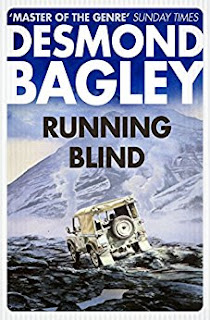
Running Blind is a Cold War thriller than falls somewhere between the realistic environment of George Smiley and the more fantastic world of James Bond. In the novel, former British agent Alan Stewart makes a routine visit to Iceland, where his girlfriend lives, but is met by another agent, who persuades him to deliver a package. When an attempt is made on his life, he realises he's been set up, forcing him to go on the run across Iceland's volcanic terrain, pursued by Russian, British, and American agents.
It's an exciting read, and while it's rather different to the James Bond books (except, maybe, John Gardner's Nobody Lives for Ever), the influence of Ian Fleming, or indeed the James Bond films, is not far away. There's a moment when Alan Stewart enters the room of Slade, a British agent whom Stewart suspects of having gone over to the Russians. Stewart looks out for a trick of the trade – hairs dabbed with saliva and stuck across the doors of the wardrobe that would be dislodged if the doors were opened.
A device of a similar nature is described in Casino Royale. When James Bond returns to his hotel room at Royale-les-Eaux, he inspects the hairs lodged in the drawer of the writing desk to make sure the drawer hadn't been opened. It's possible, though, that Desmond Bagley had been thinking of the film version of Dr No, in which Bond dabs a hair with saliva and sticks it across the doors of his wardrobe.
At another point, when Stewart confronts Slade, Slade tells him that he's 'been reading too much Fleming'. Then, as Stewart turns out the contents of Slade's wallet, he observes wryly that he found no plans for the latest guided missile or laser death ray that a master spy might have been expected to carry. A nod perhaps, at least with regard to the laser, to the film of Goldfinger.
I expect that Running Blind will be the first of many thrillers from the 'golden age' that I'll discover and rediscover thanks to Mike Ripley's Kiss Kiss Bang Bang, and along the way be reminded (as if I needed reminding) of the enormous influence that Ian Fleming's work has had on thriller and spy fiction. As Mike Ripley notes, Casino Royale wasn't so much the spy novel that ended all spy novels, but the novel that launched many more.

The identification of this period as a golden age is contentious – others would argue that that period belonged to the likes of John Buchan, Sapper, Peter Cheyney, and E Phillips Oppenheim – but there's no denying that the twenty year period saw an explosion of British thriller writers (many influenced by Ian Fleming or more generally the success of James Bond) who would dominate the thriller market across the world.
For me, the book gave me a sense of nostalgia. Not that I read any of these books at the time. Being born in the 1970s, I was too young, but some of the books that Mike Ripley mentions were on the bookshelves at home, among them Eric Ambler's The Levanter, John le Carré's Tinker, Tailor, Soldier, Spy (or was it Smiley's People?), and When Eight Bells Toil by Alistair MacLean. Such thrillers seeped into my consciousness at an early age.
Later, I began collecting thrillers, mainly published in the mid/late 1960s, that attempted to fill the void left by Ian Fleming, their heroes often being described on the back cover as the new James Bond or even better than James Bond (as if that were possible). Many of these are discussed by Mike Ripley too, such as DIECAST by John Michael Brett, Sergeant Death by James Mayo, and Where the Spies Are by James Leasor.
 |
| Some of Bond's many rivals |

Running Blind is a Cold War thriller than falls somewhere between the realistic environment of George Smiley and the more fantastic world of James Bond. In the novel, former British agent Alan Stewart makes a routine visit to Iceland, where his girlfriend lives, but is met by another agent, who persuades him to deliver a package. When an attempt is made on his life, he realises he's been set up, forcing him to go on the run across Iceland's volcanic terrain, pursued by Russian, British, and American agents.
It's an exciting read, and while it's rather different to the James Bond books (except, maybe, John Gardner's Nobody Lives for Ever), the influence of Ian Fleming, or indeed the James Bond films, is not far away. There's a moment when Alan Stewart enters the room of Slade, a British agent whom Stewart suspects of having gone over to the Russians. Stewart looks out for a trick of the trade – hairs dabbed with saliva and stuck across the doors of the wardrobe that would be dislodged if the doors were opened.
A device of a similar nature is described in Casino Royale. When James Bond returns to his hotel room at Royale-les-Eaux, he inspects the hairs lodged in the drawer of the writing desk to make sure the drawer hadn't been opened. It's possible, though, that Desmond Bagley had been thinking of the film version of Dr No, in which Bond dabs a hair with saliva and sticks it across the doors of his wardrobe.
 |
| James Bond takes precautions |
I expect that Running Blind will be the first of many thrillers from the 'golden age' that I'll discover and rediscover thanks to Mike Ripley's Kiss Kiss Bang Bang, and along the way be reminded (as if I needed reminding) of the enormous influence that Ian Fleming's work has had on thriller and spy fiction. As Mike Ripley notes, Casino Royale wasn't so much the spy novel that ended all spy novels, but the novel that launched many more.
Sunday, 29 April 2012
Women want to be with him, men want to be him – and other phrases
A feature on Vincent Cassel in the Sunday Times magazine of 23rd April 2012 began with the words: 'Vincent Cassel is married to Monica Bellucci, loves his kids and can afford to turn down any film he's offered. Women want to be with him, men want to be him.' The final sentence is a phrase associated with James Bond, and encapsulates Bond's attraction to both men and women. That the feature's writer, Stefanie Marsh, used the phrase, whether knowingly alluding to the world of Bond or not, is testament to its success as measured by its longevity and spread into wider popular culture.
The phrase is often attributed to Raymond Chandler ('Every man wants to be James Bond and every woman wants to be with him'), which potentially dates it to 1959 or earlier, but it certainly appeared in print in 1963. In a review of On Her Majesty's Secret Service published in the Sunday Times in 1963, Raymond Mortimer wrote, 'James Bond is what every man would like to be, and what every woman would like between her sheets.'
It is possible that Raymond Mortimer had adapted Chandler's line [but click here to read an update and further discussion about the origin of the phrase], but more likely the writers were expressing variants of a phrase already current in cultural space, and since the 1960s, there have been many more variants expressed. Sean Connery, for example, said in Playboy in 1965 that 'Bond is the invincible figure every man would like to be, every woman is excited by, and is everyone's survival symbol.' Even Ian Fleming had his own version. He told Jack Fishman in c 1963, 'Bond is the kind of man every girl secretly dreams of meeting and leads the life every man would like to live if he dared.'
More recently the phrase was used in Austin Powers (1997), in which Mrs Kensington, played by Mimi Rogers, said, 'Women want him, and men want to be him'. And the response from Bond directors John Glen, Martin Campbell and Michael Apted at January's CES 2012 in Las Vegas when asked why people want to see Bond films was that men want to be Bond and women want to go to bed with him.
Another phrase strongly associated with Bond that does not derive from lines in the Bond books or films is 'Kiss Kiss Bang Bang'. Around the time of Thunderball (1965), Bond was known in Italy (and/or Japan, depending on one's source) as Mr Kiss Kiss Bang Bang, and as a result, John Barry composed a piece with that phrase as the title for Thunderball. As with 'Men want to be him...' type phrases, however, 'Kiss Kiss Bang Bang' was probably already well established in popular culture. Fleming had used it himself. He also told Jack Fishman, 'I admit that Bond is...the feverish dream of the author of what he might have been – bang, bang, kiss, kiss – that sort of stuff.'
We may also add to our list the phrase, 'martinis, girls and guns', which Cheryl Crow used in her song for 1997's Tomorrow Never Dies. What these examples suggest is that memes such as phrases, which are often attributed to a single origin, may already have existed in some form in cultural space, and because of that, whether knowingly or unknowingly, they are expressed in reviews, interviews, articles, films, or song lyrics.
References:
Fishman, J, 1965 007 and me, by Ian Fleming, in For Bond Lovers Only (ed. S Lane), Panther
Jarman, C M, 2009 Licence to quote, Blue Eyed Books
The phrase is often attributed to Raymond Chandler ('Every man wants to be James Bond and every woman wants to be with him'), which potentially dates it to 1959 or earlier, but it certainly appeared in print in 1963. In a review of On Her Majesty's Secret Service published in the Sunday Times in 1963, Raymond Mortimer wrote, 'James Bond is what every man would like to be, and what every woman would like between her sheets.'
It is possible that Raymond Mortimer had adapted Chandler's line [but click here to read an update and further discussion about the origin of the phrase], but more likely the writers were expressing variants of a phrase already current in cultural space, and since the 1960s, there have been many more variants expressed. Sean Connery, for example, said in Playboy in 1965 that 'Bond is the invincible figure every man would like to be, every woman is excited by, and is everyone's survival symbol.' Even Ian Fleming had his own version. He told Jack Fishman in c 1963, 'Bond is the kind of man every girl secretly dreams of meeting and leads the life every man would like to live if he dared.'
More recently the phrase was used in Austin Powers (1997), in which Mrs Kensington, played by Mimi Rogers, said, 'Women want him, and men want to be him'. And the response from Bond directors John Glen, Martin Campbell and Michael Apted at January's CES 2012 in Las Vegas when asked why people want to see Bond films was that men want to be Bond and women want to go to bed with him.
Another phrase strongly associated with Bond that does not derive from lines in the Bond books or films is 'Kiss Kiss Bang Bang'. Around the time of Thunderball (1965), Bond was known in Italy (and/or Japan, depending on one's source) as Mr Kiss Kiss Bang Bang, and as a result, John Barry composed a piece with that phrase as the title for Thunderball. As with 'Men want to be him...' type phrases, however, 'Kiss Kiss Bang Bang' was probably already well established in popular culture. Fleming had used it himself. He also told Jack Fishman, 'I admit that Bond is...the feverish dream of the author of what he might have been – bang, bang, kiss, kiss – that sort of stuff.'
We may also add to our list the phrase, 'martinis, girls and guns', which Cheryl Crow used in her song for 1997's Tomorrow Never Dies. What these examples suggest is that memes such as phrases, which are often attributed to a single origin, may already have existed in some form in cultural space, and because of that, whether knowingly or unknowingly, they are expressed in reviews, interviews, articles, films, or song lyrics.
References:
Fishman, J, 1965 007 and me, by Ian Fleming, in For Bond Lovers Only (ed. S Lane), Panther
Jarman, C M, 2009 Licence to quote, Blue Eyed Books
Subscribe to:
Posts (Atom)