Showing posts with label anthony horowitz. Show all posts

Thursday, 7 June 2018

Reflections on Forever and a Day

This piece contains spoilers. If you haven’t read the book, do so now!

I’ve just finished reading the latest James Bond novel, Forever and a Day, and thoroughly enjoyed it. Author Anthony Horowitz knows his Bond and his own love for the character comes through on every page. Anthony Horowitz has given us an exciting, fast-paced thriller that conjures up the world of Fleming’s Bond in rich detail. Original material by Ian Fleming helps, and for this novel, Horowitz has incorporated a treatment of a story called 'Russian Roulette', set in the casino of Monte Carlo. Such is the skill of Horowitz that without reference to Fleming’s text, it is almost impossible to tell where Horowitz’s words stop and those of Fleming begin.


As was announced before publication, the novel is a prequel, taking us to events before Casino Royale. We find out how James Bond earned his licence to kill and was inducted into the double-0 section and learn about the origin of some of the traits for which he has become familiar. Bond’s principal mission is to investigate the death of his predecessor, from whom Bond has assumed the 007 code. Bond’s investigation takes him to the French Riviera and the criminal underbelly of Marseille. There he meets Jean-Paul Scipio, an enormous, corpulent gangster, the mysterious Madame Sixtine, an expert blackjack player with ambiguous loyalties, Reade Griffith, a CIA agent (not Felix Leiter), and a wealthy American businessman called Irwin Wolfe, who is used to getting what he wants.

The basis of the plot is heroin, and this is good solid Fleming territory. He did like his crime-based plots, and he had an involvement in the film The Poppy Is Also A Flower, which revolves around opium smuggling. 

The book is a page-turner. Perhaps in places it Is too rapid a read. Some of the tight spots in which Bond finds himself (the chapter 'The Acid Test' is a nail-biter) are resolved quickly. I would also have welcomed more Fleming-style digressions. 

Anthony Horowitz gives Bond fans several Easter eggs, and it is fun to spot these. And some of the cultural nods appear to go beyond Bond. In the chapter ‘Bad Medicine’, Sixtine bleeds Bond to remove the heroin from his blood. ‘All she wanted was the contents of one arm’; a reference, perhaps, to the classic Hancock’s Half Hour episode, ‘The Blood Donor’ (‘A pint? That’s very nearly an armful!’)? The villains’ plot itself could be viewed as one massive Easter egg. Wolfe explains:
‘What I am providing might be called the greatest loss-leader of all time. Although I have paid Scipio a fair market price for his product [heroin], I am going to pretty much give it away… I intend to create a nation [in this case the USA] of heroin-addicts, Mr Bond, a million future customers for Mr Scipio. ’
Reading this, it’s inevitable that those familiar with the films will think of Live and Let Die. The plot is more or less identical to Mr Big’s. Come to think of it, Forever and a Day has a literal Mr Big in the character of Scipio. 

There’s one aspect that bothers me. Throughout the book, James Bond is referred to as an assassin or is described in terms that equate to the role of an assassin. As I’ve argued before, I think this is a misreading of the character. Bond’s licence to kill doesn’t make him an assassin; it is a recognition that he has had to kill in cold blood in the course of his duties. A subtle difference, perhaps, but a difference nonetheless. Killing isn’t Bond’s primary role. In any case, we're told in Goldfinger that Bond doesn't like killing people, but when he has to do it, he does so out of duty and his sense of professionalism. Not quite the ideal candidate for the role of assassin. At M’s briefings, Bond isn’t given a photograph of a target and told to kill him or her. True, in the short story, ‘For Your Eyes Only’, M sends Bond effectively on a private mission to kill the killers of the Havelocks, friends of M. This is a difficult decision for M, and he doesn’t like making it, which underlines the rarity of such an order. It’s a little disturbing, then, returning to Forever and a Day, M appears to have few scruples when he sanctions a kill at the end of the book (the denouement is terrific, incidentally).

I won’t say much about how Bond discovers Morland cigarettes or martinis shaken, not stirred, but I’m not entirely convinced by the explanations, and would have preferred these to have already been established. After all, the debate about whether martinis should be shaken, not stirred is one that has been raging at least since 1948. It's more plausible that Bond would have been aware of the debate and formed an opinion of his own.

I love the descriptions of the food in the novel. Anthony Horowitz strikes the perfect balance. Readers expect Bond to consume copious amounts of eggs, among other things, but it can be overdone, pushing the descriptions into pastiche. Horowitz, however, has got it right. That said, I would question the unsalted butter, and where was the bouillabaisse, the regional speciality mentioned in On Her Majesty’s Secret Service?

But I’m being pedantic. Forever and a Day is a wonderful Bond novel and, along with its predecessor, Trigger Mortis, the closest thing we have to a new Ian Fleming book. With three more Fleming treatments left, I really hope Anthony Horowitz is asked to pick up his fountain pen again and go for the hat-trick. Where else can Bond go? My suggestion, for what it’s worth, is to look at the allusions to adventures in the novels that have never been expanded – the missions between the missions. Or how about a war-time adventure? Anthony, over to you!

Wednesday, 23 May 2018

Bond at Bletchley Park - a report

Inside Hut 12 at Bletchley Park
I was lucky enough to have been at Bletchley Park yesterday to attend a special press view of the new exhibition of artwork inspired by the James Bond novels: 'Bond at Bletchley Park: Illustrations and Inspirations'. The exhibition, which also explores Ian Fleming's connection to the World War Two codebreaking centre, was opened by Anthony Horowitz, who spoke about his introduction to James Bond, his interest in the wartime work at Bletchley, and his latest Bond novel, Forever and a Day

Click here to read my report on the event on the James Bond Dossier website.

Tuesday, 13 February 2018

What can we expect in Forever and a Day

The title of Anthony Horowitz’s second James Bond novel, due to be published in May by Jonathan Cape, was announced last week. The book, Forever and a Day, is set before the events of Casino Royale and sees James Bond earn his licence to kill and develop into the man we know from Ian Fleming’s novels. What else can we learn from the tantalising hints offered by the official press release?  

Anyone familiar with the novel of Casino Royale will remember that James Bond earned his double-O status during the Second World War by killing a Norwegian agent in Stockholm who was doubling for the Germans, and a Japanese cipher expert operating out of the RCA Building in the Rockefeller Centre in New York. Presumably the episodes will be referenced in the new novel, but the latter is especially interesting, as the Rockefeller Centre was also the headquarters of the British Security Coordination (BSC) headed by William Stephenson. The BSC represented British intelligence in the US during the war and was concerned with intelligence gathering, counter-espionage and special operations. If Horowitz’s novel describes or alludes to the killing of the cipher expert, will it link Bond more explicitly to the BSC? 

Probably not, judging by the synopsis: 
‘007 floats in the waters of Marseille, killed by an unknown hand. It’s time for a new agent to step up. Time for a new weapon in the war against organised crime. It’s time for James Bond to earn his licence to kill. This is the story of the birth of a legend, in the brutal underworld of the French Riviera.’ 
This appears to be a different narrative to that presented in Casino Royale, and it will be interesting to see how the two origins are reconciled.

In any case, the Marseille setting and mention of the underworld of the French Riviera are intriguing. We know from On Her Majesty’s Secret Service that this is Union Corse territory. Are the members of that criminal organisation involved in the death of 007? Will we be introduced to Bond’s future father-in-law, Marc-Ange Draco? There is no suggestion in OHMSS that Bond knew Draco before the events of that novel, so it seems unlikely that Bond and Draco would meet in Forever and a Day, but Draco could certainly be in the background.

It’s worth bearing in mind, too, that Marseille was home in the early 1950s to Jacques-Yves Cousteau’s operation to excavate two ancient wrecks. Ian Fleming reported on the underwater excavation for the Sunday Times and even attempted to dive to the site. It’s possible that this will inform Horowitz’s novel to some extent (just as it informed Fleming’s Live and Let Die), and indeed the author confirmed in a tweet that the book involves ‘lots of water.’ 

And will Bond eat one of the regional specialities? In OHMSS, Bond asks a Marseille taxi-driver whether the bouillabaisse (ideally made with rascasse or scorpion fish) chez Guido is always as good. Bond is clearly familiar with the dish and the local restaurants, and it might be in Horowitz’s adventure that he is introduced to them. 

One thing we do know is that the novel will, like Anthony Horowitz’s first Bond adventure, Trigger Mortis, contain original material by Ian Fleming. How it will contribute to Forever and a Day has not been revealed, but it makes the novel an even more mouth-watering prospect.

Friday, 11 September 2015

Trigger Mortis by Anthony Horowitz - a review

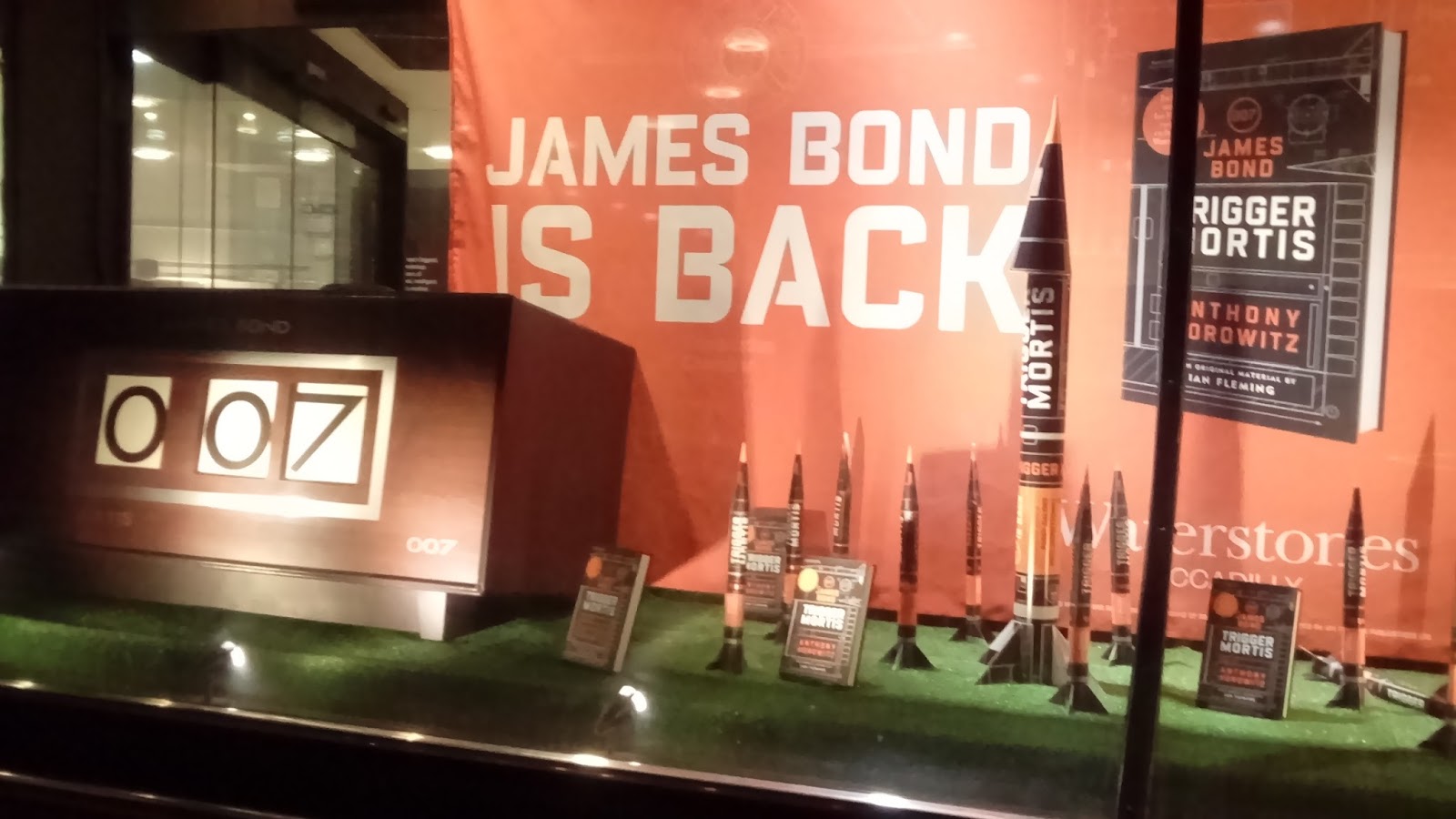
The window display of Waterstones, Piccadilly, where Trigger Mortis was launched
The cover of Devil May Care, Sebastian Faulks' James Bond novel (some might call it an extended pastiche), proclaimed that its author was writing as Ian Fleming. Anthony Horowitz, the author of the latest Bond adventure, Trigger Mortis, has gone one better. In incorporating original material by Ian Fleming, and carefully referencing the touchstones of James Bond's world, Horowitz has delivered the authentic voice of Bond's creator. It is as if the manuscript of a long lost Bond novel had been discovered in the bottom drawer of Fleming's writing desk at Goldeneye.

Trigger Mortis takes the reader back to 1957 and follows immediately from the final events of  Goldfinger. We left that adventure (spoiler alert) on Weathership Charlie off the Canadian coast; Bond, taking Pussy Galore with him, having ditched a Stratocruiser into the ocean, with Goldfinger lying dead on the floor of the plane. Back in London, Bond learns about a SMERSH plot to infiltrate the German Grand Prix and take Lancy Smith (a thinly-disguised Sterling Moss; Smith, like Moss, even drives a Vanwall) out of the race – permanently. This leads to an introduction to the mysterious Jeopardy Lane, the cold and brutal Jason Sin, and a larger, more terrifying plot with the Space Race at its core.

Anthony Horowitz began writing the book, unusually, with Chapter 3, as he weaved 'Murder on Wheels', an unmade television treatment by Ian Fleming, into the story. But it is chapters two and seven which are most infused with the spirit – and the words – of Ian Fleming. Some of the dialogue Fleming gave to Bond and M is repeated verbatim, and readers will have fun trying to identify Fleming's words among those of Horowitz (it's not easy, I can tell you). The seventh chapter, called 'Murder on Wheels', describes the race at the Nürburgring and Bond's attempt to foil SMERSH's plot. What a thrilling piece of writing, and one that rivals, or rather complements, Fleming's descriptions of Bond's other sporting ventures, skiing, scuba diving, driving, and the like.

Any book written today inevitably makes allowances for modern sensibilities, even if set in the past, but I'm glad to report that Bond retains his foibles. He smokes (though is perhaps not quite the seventy-a-day man he once was), drinks Martinis, has opinions about women's bottoms, and hasn't moderated his views about the Germans (to be fair, it is only twelve years since the end of the Second World War).

And naturally Bond remains very particular about his food (for instance distrusting food with French names if not served in France). Continuation authors have tended to make sure that Bond was well fed, and we do know what Bond eats in Trigger Mortis, but the food references this time are not intrusive. At one point Bond breaks the yolk of an egg, but we have no idea how it had been cooked. Horowitz knows when to veer away from the narrative for a Fleming-esque digression, and when get on with the story in order to, as Fleming once put it, “get the reader to turn over the page.”

Apart from Fleming's TV treatment, the novel that has most inspired Horowitz is Goldfinger. It is no secret that Trigger Mortis sees the return of Pussy Galore (lucky Bond's housekeeper, May, is away; I can't imagine her approving of Bond's house-guest), but there are nods to Goldfinger in other ways. Perhaps, though, it is the 1964 film that comes to mind more strongly with some of the episodes in the book, for instance a punishment involving gold paint, the means by which the chief villain, Jason Sin (a Korean, like Oddjob), is killed, and, before that, Jason Sin's asking Bond “Any last witticisms?” The line might have been in the first draft of dialogue given to Gert Frobe's Goldfinger before being redrafted into the classic, “Choose your next witticism carefully, Mr Bond.”

Goldfinger apart, the plot involving rockets obviously recalls the novels of Moonraker and Dr No, and reading the denouement of Trigger Mortis, I was reminded even of the latter part of the film, Octopussy.    

These allusions to the other Bond books (and films) are great fun, of course, and give readers a wonderful sense of Bond's world, but at the same time, I wonder if Anthony Horowitz, like all continuation novelists before him, has played it too safe. Though his novels could well be described as formulaic, Ian Fleming was a great experimenter, and was not averse to playing with the structure of his novels. We can see that most clearly with From Russia, with Love and especially The Spy Who Loved Me. Could a continuation novelist today ever produce a Bond book in which Bond appears in the second or even last third of the book? Probably not (although The Moneypenny Diaries are closest in that vein, and could be considered experimental Bond novels).

This is a very minor point, however, because put simply Trigger Mortis is a triumph. The novel deserves a place alongside Ian Fleming's novels and, containing Fleming's own words and ideas, must be regarded as 'canon'. But the novel can also sit comfortably alongside modern thrillers; I was particularly reminded of Lee Child's Jack Reacher novels in the passages set in American motels and diners as, over endless cups of coffee, Bond and his companion, Jeopardy Lane, piece together clues to the mystery of Jason Sin. 


Anthony Horowitz has achieved what some continuation novelists before him have struggled to do: write a continuation Bond thriller that is, well, thrilling. James Bond – and Ian Fleming – is back!

Saturday, 30 May 2015

Some thoughts about Trigger Mortis

So we now know the title of Anthony Horowitz's highly anticipated James Bond novel: Trigger Mortis. The official announcement of the title earlier this week also brought more information about what we might expect in the novel. What have we gleaned?

Trigger Mortis is not a title that immediately appeals to me. It seems to me to be something that Ian Fleming might have devised for a chapter heading, or it might otherwise be more appropriate as the title of a Young Bond novel. In its favour, though, it does follow the Fleming-esque pattern of adapting a word or saying in the manner of Live and Let Die or You Only Live Twice. Trigger Mortis might also be a nod to 'Trigger Finger', Ian Fleming's original title for his short story, 'The Living Daylights'. I also note that 'The Trigger on the Finger' is the title of sixth chapter in Dr No. I expect Trigger Mortis will grow on me and will be a more memorable title than Solo or Devil May Care. Perhaps it's a very good choice after all.

What of the original material by Ian Fleming that is heralded on the cover of the book? We already knew that the book would feature ideas from 'Murder on Wheels', Fleming's treatment for an episode of a never-made James Bond TV series. In the treatment, Bond becomes involved in the world of motor racing as he investigates a Russian plot to sabotage Stirling Moss's race at the Nürburgring circuit. We know now that 'Murder on Wheels' will form the basis of the opening part of the novel and that the book is set in 1957. Additionally, the synopsis accompanying the US edition of the novel confirms that the setting of the motor racing will be the German Grand Prix (which was won by Juan Manuel Fangio). I must admit a little satisfaction on learning the year in which the book will be set, as I suggested back in October in an earlier blog post that Ian Fleming had the Formula One championships of 1957 or 1958 in mind when he prepared the treatment for 'Murder on Wheels'.

Confusingly, though, a set of postcards that had been released by Ian Fleming Publications to promote the book ahead of the title announcement pointed to 1959. One was an image of New York's Times Square, which showed a cinema marquee advertising the John Wayne film, The Horse Soldiers, which was released in 1959. Another postcard was of the Nürburgring. The car shown is, if my identification is correct, a Ferrari 250 Testa Rossa, and what's more, it could well be the very vehicle driven by Olivier Gendebien in the Nürburgring 1000km in 1959. Whether these images were meant as deliberate red herrings or should be put down to artistic licence is uncertain.

Incidentally, the 1957 German Grand Prix at Nürburgring took place on the 4th August, while Trigger Mortis begins two weeks after the final event of Goldfinger, which John Griswold in his Annotations and Chronologies dates to 6th June. This gives James Bond a good few weeks with Pussy Galore at start of the book. Much has been made in the media of the promised reappearance of Pussy Galore, last seen in Goldfinger with James Bond on a weathership off the coast of Canada. The reference to the heroine of an earlier adventure is nothing new; Ian Fleming did it himself, for instance in From Russia, with Love, when M asks Bond about his relationship with Tiffany Case, who we saw in the previous adventure, Diamonds are Forever. However, as The Spy Command blog reminds us, this will be the first time that the heroine of an earlier novel will have a 'speaking part'.

As for the main plot, we learnt this week that the novel “places Bond in the middle of the Soviet-American Space Race as the United States prepares for a critical rocket launch.” The year 1957 was a significant time in the Space Race, as it saw the US and the USSR compete to launch artificial satellites for the first time; indeed the Space Race began with the announcement in 1955 by the US of its intention to launch a satellite. In the event, the Soviet Union beat the US to it by launching Sputnik 1 in October 1957. The attempt by the US to launch a satellite in December that year failed, though the US was successful with its second attempt in January 1958.

With its Fleming-derived action from the motor racing circuit, the reappearance of a familiar face, and its backdrop of the start of the Space Race, Trigger Mortis promises to be a very exciting James Bond novel. The 8th September, when the book will be published, can't come soon enough.

Sunday, 5 October 2014

James Bond enters the world of motor racing

Last week, Ian Fleming Publications announced that Anthony Horowitz, acclaimed author of the Alex Rider series and television scriptwriter (credits include Midsomer Murders and Poirot), will be writing the next James Bond novel, to be published in September 2015. If that wasn't exciting enough, it was additionally revealed that part of the novel will use story ideas by Ian Fleming. The unpublished story, 'Murder on Wheels', takes Bond to the motor-racing circuit of Nürburgring in Germany, where Bond must foil a Russian plot to scupper driver Stirling Moss's race. But what inspired Fleming to think about writing such a story, and what details might we expect to see in Anthony Horowitz's novel?

James Bond is no stranger to the world of motor racing. Apart from all the 'racing changes' that Bond regularly makes in his cars, we know from Moonraker (1955) that Bond 'dabbled on the fringe of the racing world' (in his teens, assuming Bond was born in 1921), and had memories of Rudolf Caracciola, the celebrated German racing driver of the 1930s, at Le Mans. It was clearly a period with which Fleming was familiar, and he alluded to the motor racing scene of the 1930s in Chitty Chitty Bang Bang (1964/65). While the magical car was based on a car built by Count Zborowski in 1920, Fleming describes Chitty Chitty Bang Bang as a Paragon Panther that raced in the 1930s.

'Murder on Wheels' is one of thirteen story outlines prepared by Ian Fleming in 1958-9 for a television series in America. The series never got off the ground, but by May 1959, Fleming had supplied seven new stories and other stories based on the Bond novels already published. Some of the outlines formed the basis for some of the short stories in the For Your Eyes Only (1960) and Octopussy (1966) collections, but for whatever reason, 'Murder on Wheels' remained unused.

The late 1950s was an exciting period for motor racing. The inaugural race of the Formula One championship was in 1950 at Silverstone, and by the mid 1950s, the championship was dominated by two drivers, Juan Manuel Fangio, the Argentinian who won five drivers' titles between 1951 and 1957, and Stirling Moss, the Briton who never won a title, but won sixteen races between 1951 and 1961. The Formula One championship of 1957 was a particular tussle between the two, with every race that season won by Fangio in a Maserati or Moss in his Vanwall. Without Fangio in the 1958 season, Stirling Moss's main competition came from compatriot Mike Hawthawn in a Ferrari. But the season was overshadowed by several drivers' deaths on and off the track.
A Vanwall in 1957, the type of car driven by Stirling Moss (photo: Terry Whalebone)

It is possible that Ian Fleming had the 1957 and 1958 Formula One seasons in mind when he wrote the outline for his story (the 1959 season was too late, as the first race was in May). From a British point of view, the emerging dominance of British drivers and cars would have been a source of national pride and excitement, and it is not difficult to imagine Fleming concocting a plot involving a Russian scheme to end this dominance and humiliate the British.

We know that Anthony Horowitz will set his novel in the 1950s, and it is not unreasonable to suggest that he will turn to the events of the late 1950s for inspiration. If so, expect to read the names of some of the drivers of the day, among them Fangio, Moss, Hawthawn, Brooks, Musso, Schell, Gregory, and the names of cars, such as Vanwall, Cooper-Climax,  and BRM, as well as Ferrari, Maserati and Porsche (and possibly even the name of a certain team-owner, who entered in 1958 with Connaught-Alta – Bernie Ecclestone). Horowitz might also be tempted to turn to the 1959 to make another Bondian connection. It was in that year that Aston Martin entered Formula One.

Given James Bond's (and Fleming's) interest in the world of motor-racing, it's perhaps curious that Bond hasn't been seen on the racing circuit before now either in the books or the films (although he comes close in the film of On Her Majesty's Secret Service (1969), when he and Tracy gatecrash a stock-car rally). The racing circuit, however, deserves to be as natural a Bondian landscape as the casino or the ski slope, and I await Anthony Horowitz's novel with a great deal of anticipation.

References:

Gilbert, J, 2012 Ian Fleming: the Bibliography, Queen Anne Press
Griswold, J, 2006 Ian Fleming's James Bond: Annotations and Chronologies for Ian Fleming's Bond Stories, Author-House