Showing posts with label frank cottrell boyce. Show all posts

Sunday, 8 March 2015

Chitty Chitty Bang Bang: from film to book

I popped into a charity shop (thrift store) the other week and saw an audio book version of Ian Fleming's Chitty Chitty Bang Bang. I can't remember the last time I listened to an audio cassette, but I had to buy it, as I couldn't leave a Fleming-related object forlorn on the shelf. Interestingly, the audio book was read by Lionel Jeffries, who played Grandpa in the 1968 film version. Another point of interest was the inlay card, which showed a drawing of the magical car. The drawing was clearly inspired, not by John Burningham's illustrations that accompanied the original publication of the children's book, but by the car that appeared in the film.

That Lionel Jeffries narrates the audio book (published in 1982) is curious given that his character in the film, Grandpa Potts, doesn't appear in Fleming's story. Indeed, if Roald Dahl, who wrote the screenplay, had stuck more closely to his first draft, then Lionel Jeffries might not have appeared in the film at all; Roald Dahl wrote the character of Grandpa into the second draft.

As for the image on the inlay card, the illustration doesn't precisely copy the film car (designed by Ken Adam), but the essential traits or memes of that car are there: the passenger section that re-uses a wooden boat, the long silver cylindrical (or slightly cone-shaped) bonnet secured with a leather strap, the gold-rimmed radiator grille and gold headlamps, and the red-and-yellow-striped wings. The Potts family (actually, the Pott family in the book) in the car looks towards the viewer in a similar arrangement to that shown on the film posters and other publicity material, the only difference being that the family on the inlay card isn't waving. In other respects, however, the families are identical, even down to the clothes.
Covers from the audio book (left) and the 1968 novelisation
It's a similar case with other editions of the novel. In 1968, Collins published a young readers' edition of the book in its 'Beginner Books' series (which includes some Dr Seuss classics). The story was Fleming's, but the car was that of the film. This is not particularly surprising; the film had just been released and Cubby Broccoli's Warfield Productions, which made the film, co-owned the copyright to the edition.
Chitty as shown in Collins' Beginner Books edition
More recently, the illustrations of Chitty Chitty Bang Bang accompanying an edition published by Galaxy in 2002 looked to the film, giving the car a cone-shaped bonnet, the same wing arrangement as Ken Adam's design, and a boat-derived passenger section.
Chitty in the 2002 Galaxy edition
The boat-derived passenger section is also seen on the Chitty that appears on the front cover of a 2005 edition published in the US by Yearling.
Chitty,Yearling edition (2005)
Think of Chitty Chitty Bang Bang, and chances are that the car designed for the 1968 film will spring rapidly to mind. It seems that artists illustrating editions of Ian Fleming's story have been no less susceptible to the influence of the film car, whose attributes have repeatedly found expression in subsequent artwork. However, as Chitty Chitty Bang Bang finds new readers with Frank Cottrell Boyce's sequels to Fleming's original book, it will be interesting to see whether Joe Berger's illustrations, which owe more to Burningham than Broccoli, change people's perceptions of the magical car.

Tuesday, 19 November 2013

Over the moon about Chitty Chitty Bang Bang


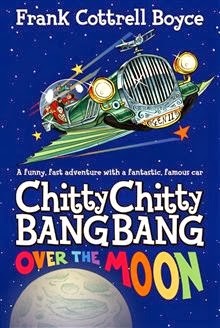
Just as Ian Fleming wrote three Chitty Chitty Bang Bang adventures, Frank Cottrell Boyce has penned a third sequel to the original series. Chitty Chitty Bang Bang Over the Moon sees the modern Tooting family – who find and restore the famous racing car (with the help of a little Chitty magic) in their first outing – adrift 1966 when Chitty Chitty Bang Bang, now fitted with a time-travelling chronojuster, is stolen. There's only one to do: find the Pott family and the 'younger' Chitty, rescue the future Chitty, and go.... back to the future.

As with any story involving time-travel, the twists, complications and paradoxes soon mount up, and this latest Chitty adventure is no exception. What happens when the past and future Chitty Chitty Bang Bangs meet? What would become of the Tootings if the future described in the first two sequels never happened as a result of their saving the world in the 1960s? As with any time-travelling story, it's probably best not to think about it too much.

The story has much to enjoy. Meeting the Potts again is like seeing old friends. Or, rather, old-fashioned friends. Frank Cottrell Boyce nicely contrasts the attitudes of today with those of the 1960s, reflecting the changes in society that have occurred over the past 50 years. So, Commander Pott is authoritative, Jeremy is independent and capable, ever ready with a map, compass, pocket knife and catapult, Mimsie makes tea and thinks about picnics, while Jemima reminds everyone that she's not very good at things because she's a girl. Of course, the Potts soon learn that to overcome the villainous Tiny Jack, they all need to work together as a family – and with the Tootings.

There are nods to the Bond series and other films. Commander Pott drives an Aston Martin DB5. Tiny Jack, who's building up his collection of (stolen) cars, already has the Batmobile and Marty McFly's DeLorean. Other allusions are probably unintentional. When Tiny Jack hijacks Big Ben (actually the Elizabeth Tower), which is flying across the sky thanks to one of Commander Pott's inventions, anti-gravity paint, I was reminded of the plot of Bond spoof, Alligator, in which the eponymous villain steals the Houses of Parliament. I expect, however, that this vague similarity is purely coincidental.

With the Potts involved in much of the action, the spirit of Ian Fleming is never far away, and Frank Cottrell Boyce further links his adventures with the original stories with references to Crackpot's whistling sweets and Monsieur Bon Bon's 'Fooj' shop. And with these references, it seems that Chitty Chitty Bang Bang's adventures have come full circle, and to an end. But I hope not. I've enjoyed reading these new adventures, and would love to see Chitty take flight again. After all, in the words of Commander Pott, never say no to adventure.

Thursday, 27 October 2011

Does Chitty Chitty Bang Bang take off?

It must have been a challenge for Frank Cottrell Boyce to write a sequel. After all, there are two Chitty Chitty Bang Bangs. There's the film incarnation, which appeared on screens in 1968 and starred in a magical musical adventure. Then there's Ian Fleming's original Chitty, which began life as a children's book in 1964. Less well known than the film version, the story takes Chitty and the Pott family on adventures in England and France, where they foil a gang of burglars and villains. Boyce's solution is to embrace both Chitties, and the result – Chitty Chitty Bang Bang flies again – is a wonderful testament to the book's cinematic and literary ancestry.

In his latest adventure, Frank Cottrell Boyce introduces us to the Tootings. Dad, an inventive engineer, loses his job, but ever the optimist, sees it as an opportunity to explore and visit new places. Excited at the prospect, Mum acquires a rusty VW camper van, much to the embarrassment of children Lucy, Jem and Little Harry. Jem soon changes his mind, though, when given the chance to restore the van with Dad.

A visit to a scrapyard brings more excitement as they encounter an old engine – once the power behind the racing car of Count Zborowski. That's when the magic begins. The Tootings quickly find out that it's the van, not them, who's driving, as it takes them from England to France, then to Egypt for reasons that slowly become clear. On the way, they encounter a glamorous nanny, and the mysterious Tiny Jack, who has his own interest in the flying van.

The story is imbued with the spirit of Ian Fleming. The author gives the Tootings the same 'never say no to adventure' philosophy shown by the original Potts, and skilfully weaves in interesting facts, just as Fleming did. The name Jem, short for Jeremy, and an allusion to the original children, Jeremy and Jemima, is a nice touch too. The illustrations, by Joe Berger, recall the art of Fleming's illustrator, John Burningham. The film is not forgotten either. There is more than a hint of the childcatcher, and fantastic toys are an important feature of the book, just as they are in the film, while descriptions of Tiny Jack's hideaway could come from the drawing board of Ken Adam. There's even a cameo role for James Bond's most famous car.

At the end of the book, the author acknowledges that there are questions concerning some of the plot details that remain unanswered. But then again, the bigger question of how a car came to fly at all is one that even Fleming never addressed. Neither book, old and new, is the worse for this – we accept the magic, which papers over all the holes. Despite the nods to the past, readers of the latest adventure don't need to be familiar with earlier incarnations to enjoy the book. It stands on its own four wheels, and serves as the perfect introduction to Chitty Chitty Bang Bang for the next generation.

Saturday, 9 April 2011

From Chitty to Camper – the magical car flies again

Chitty Chitty Bang Bang, Ian Fleming’s only children’s book (although I started reading the Bond books from the age of 12), gets a sequel. Novelist and screenwriter Frank Cottrell Boyce was invited by the Ian Fleming estate to continue the adventures of the magical car. The book, Chitty Chitty Bang Bang Flies Again, will be published in November.

The original car was based on a racing car built in 1920 by Count Zborowski, who used a pre-1914 Mercedes chassis and a six-cylinder Maybach engine, a type normally fitted to Zeppelins. For the new book, Cottrell Boyce has retained the engine, but placed it instead into a VW camper van.

Why a camper van? It is possible, simply, that Cottrell Boyce likes the vehicle, perhaps having owned or otherwise experienced one himself. But the camper van does in any case seem an appropriate choice. I don’t know how the camper van has been depicted in literature, but in recent films the camper van has either been used to evoke period (Forest Gump), or identify ex-hippies (Field of Dreams). I suspect, however, that Cottrell Boyce has picked up the idea of the camper van representing adventure and freedom in the way shown in Little Miss Sunshine. The new owners of Chitty Mark II, the Tootings, may also echo the kooky, poor, and ultimately loving and accepting, family depicted in the film. If so, then the Tootings would not be very far removed from the original Potts, a poor family on the margins of society, whose lives are changed with the arrival of Chitty Chitty Bang Bang.