If you're after a last-minute Christmas gift idea, then your thoughts may have turned to the film of Moonraker. Among the gadgets Q supplies James Bond is a dart gun worn around the wrist. Equipped with ten darts – five amour-piercing, five cyanide-tipped – the device comes in handy when Bond needs to cut the power of a rotating centrifuge trainer and help Drax take a giant step back for mankind. 'Very novel, Q', Bond says. 'Must get them in the stores for Christmas'.
Did Q succeed in getting them in the stores for Christmas? Sadly, no. The Imperial Toys Corporation produced a James Bond dart gun in 1984 (click here for details), but the darts are fired from a standard pistol-type gun, rather than one worn round the wrist. And in any case, the toy, long out of production, is hard to come by.
Replicas of the film's dart gun are built from time to time and become available to buy at specialist stores or auction sites, but a trawl of such places suggests that if you're looking for a replica of the prop, then you're out of luck. Replica dart guns were being sold on eBay for £140 in 2015, but these no longer appear to be available. Vectis Auctions, which specialises in collectible toys, were selling a reproduction of the prop in 2013, but no other examples have been offered since.
I admit I haven't looked at the websites of arms manufacturers, but it's possible that a wrist-mounted dart gun is in development and on the way to becoming science fact.
So, it seems that Q didn't follow Bond's advice. Oh well, there's always next year. In the meantime, have a wonderful Bondian Christmas.
Friday, 23 December 2016
Sunday, 18 December 2016
Organisation heads talk about the pros and cons of association with James Bond
![]() |
| A view of Vauxhall Cross, SIS headquarters |
These relationships with James Bond were raised recently by the head of MI6 (or more properly SIS) and Aston Martin's director of global marketing in statements that were in some ways rather similar. While both acknowledged the benefits their association with James Bond has brought, they also alluded to negative aspects.
In a speech to journalists at Vauxhall Cross earlier this month, the chief of SIS (known as 'C') Alex Younger described how James Bond helped create a powerful brand for SIS that gave the organisation, or at least its name, worldwide recognition. Younger also admitted that SIS requires a deep grasp of gadgets and employs a real-life Q.
But, he continued, James Bond also creates a false picture of the type of people who work for the organisation. There is no single characteristic that defines an SIS officer, whether that be an Oxbridge graduate or an expert in hand-to-hand combat, and James Bond types who are reckless, immoral, or prone to law-breaking need not apply.
Dan Balmer, director of global marketing at Aston Martin, also considered both the positive and negative aspects of an association with James Bond. He told Marketing Week last month that while the company remains open to the opportunities that an association with Bond brings, it relied too much on James Bond in the past. Its marketing, for instance, has tended to focus around the release of new Bond films, the result being that between films people stop talking about the cars and sales suffer.
Balmer spoke about how Aston Martin was planning to move beyond its perceived British and male core market (his comments about Bond hint at the fact that Bond naturally helps reinforce this perception), announcing that its marketing will now be designed to appeal to international audiences and female drivers.
In making their statements, both Alex Younger and Dan Balmer acknowledge the role, whether welcome or not, that James Bond plays in promoting their organisations and maintaining brand awareness. In memetic terms, the Bond films, to which Younger and Balmer alluded, are a highly successful vehicle for spreading ideas or memes about Aston Martin and SIS (even if inaccurate). However, the association between the organisations and Bond is so strong that the films aren't necessary to spread and reinforce those memes. The press and other media also do the job, but the association is so firmly fixed in people's minds, who wittingly or unwittingly pass it on to others, that it is practically self-replicating.
This means that, unfortunately for Alex Younger and Dan Balmer, it'll take a very long time – and the disappearance of Bond from the cultural environment – to change popular perceptions. Aston Martin and SIS will remain synonymous with Bond for a while longer yet.
Sunday, 11 December 2016
Did Phyllis Bottome invent James Bond? The case against
| The Lifeline, first edition |
The case that Ian Fleming had substantially based James Bond on the main character and events of Bottome's novel was championed by espionage writer Nigel West. He has form in the matter, having made the case in his 2009 book, Historical Dictionary of Ian Fleming's World of Espionage. West was supported by critic and publisher Simon Winder, who's own book on James Bond, The Man who Saved Britain (2006), far from being a celebration of Fleming's creation, was an exercise in subtle denigration and damning with faint praise.
Casting a more cautious eye on the matter were Pam Hirsch, who wrote a biography of Phyllis Bottome called The Constant Liberal, and John Pearson, the biographer of both Ian Fleming and James Bond.
So what were the principal arguments? The case for the prosecution, as it were, focused on two key points. The first was that the protagonist of The Lifeline, Mark Chalmers, is near-identical to James Bond. Describe Chalmers' appearance (slim, six-feet tall), attitudes (particularly towards women), philosophy, and pastimes (skiing, climbing) without mentioning his name, and anyone listening would think you were describing James Bond.
The second point concerned the events at the end of Bottome's novel. Chalmers, who has been on a secret mission in Austria gathering Nazi secrets for British intelligence on the eve of the Second World War, is captured by the Gestapo, given a severe beating, saved in the nick of time, recuperates in a hospital (actually a mental asylum where Chalmers has been resident as part of his cover), falls in love with a fellow agent (Ida Eichhorn) who has been caring for him and whom he initially disliked, and has a bedside discussion about his purpose and the nature of good and evil with a local contact (Father Martin).
Compare that to the end of Casino Royale, in which Bond is captured by a SMERSH agent, given a severe beating, saved in the nick of time, recuperates in a hospital, falls in love with a fellow agent (Vesper Lynd) who has been caring for him and whom he initially disliked, and has a bedside discussion about his purpose and the nature of good and evil with a local contact (René Mathis).
Of the two arguments, the second is strongest, yet even that only suggests that Fleming was inspired by one specific element of Bottome's book (apparently Bottome sent Fleming all her books, and it is highly likely that he had read The Lifeline before writing Casino Royale). Claiming that Bottome had invented James Bond and that, as was hinted at in the programme, a case of plagiarism could be made against Fleming, is rather more of a leap, and to me is without foundation.
Other points raised by Nigel West are minor and easily dismissed. The spy chief in The Lifeline is called B; Ian Fleming called his M. And Somerset Maugham's spy chief is R and the real one is C. Isn't it more plausible that the naming of M simply follows a convention well established in spy fiction (and reality), rather than the style of a single book? West also suggests that, like Mark Chalmers, Bond can climb like a mountain goat. In the films maybe, but evidence for this in the books, certainly Casino Royale, is lacking.
One obvious difficulty, apart from the fact that Ian Fleming first had the idea for 'the spy story to end all spy stories' during the war and before The Lifeline was published, is that The Lifeline and Casino Royale simply do not compare stylistically. Having read The Lifeline, I can confirm that it reads more like a John Buchan novel than a Fleming novel. It contains long philosophical passages and monologues, and has none of the pace and spare prose of Casino Royale. If Ian Fleming used The Lifeline as a model, then he failed miserably to follow it.
Another problem is that the events depicted in Casino Royale, except those at the end, do not mirror the events of The Lifeline whatsoever. In fact, James Bond would not feature in an Alpine-set adventure until On Her Majesty's Secret Service, published 10 years after Casino Royale. And Fleming's only story set in Austria, 'Octopussy', has Bond in a peripheral role – in Jamaica.
True, the character of Mark Chalmers is similar to Bond, but then again, so too is Ian Fleming; there is no dispute that Fleming gave Bond many of his own traits. It is worth pointing out as well (not mentioned in the documentary) that Ian Fleming acknowledged that the events of Casino Royale were based on his own experiences in the casino of Estoril in Portugal. Nigel West makes the supplementary case that Mark Chalmers was based on Ian Fleming, but this has the whiff of a circular argument. James Bond was inspired by Mark Chalmers who was inspired by Ian Fleming who provided the inspiration for James Bond. Why have a middle man at all? It seems to me that there is little need to invoke Mark Chalmers as the catalyst for James Bond when Ian Fleming's own life accounts for many of the details.
Something else that the programme didn't mention was that Ian Fleming was a literary magpie. He read widely, was in awe of certain writers (among them Raymond Chandler and Somerset Maugham), wrote fulsome reviews and bought copies of his favourite books for all his friends. Inevitably, aspects of the books he enjoyed crept into his own work. Indeed, this blog is about the things that inspired Fleming, and identifies the ideas or memes that the Bond novels share with the works of one novelist or another. Most recently, for example, I pointed out similarities between John Buchan's novel, The Three Hostages, and Moonraker, and I have made the case that the Bond novels are a British form of American hard-boiled thriller. This doesn't mean, however, that John Buchan or Raymond Chandler invented James Bond.
James Bond could not have been created unless The Lifeline and other books like it had not existed, just as the work of John le Carré and Len Deighton – the antitheses of Bond – could not have existed without Bond. Culture is created by taking or passing on, building on, and transforming ideas that already exist in the cultural environment. It lives or dies by being replicated (in the case of Bond books by being read and reprinted), exploiting a cultural niche (no one wrote quite the sort of books that Fleming wrote and the public was ready for it), and adapting to changing conditions (being made into Bond films).
So, did Phyllis Bottome invent James Bond? Not in my view, although I accept that Fleming recreated the ending of The Lifeline in Casino Royale. On balance, I'm with Pam Hirsch when she says that Bottome invented Ian Fleming as a writer. Still, I enjoyed the programme, and the fact that such a debate is the subject of a BBC documentary is testament to the continued success and cultural relevance of Ian Fleming's creation.
Sunday, 4 December 2016
On location: James Bond in Paris
Working backwards through the events of the film, the first stop on my Bond itinerary was the Pont Alexandre III that spans the River Seine. James Bond jumps from this bridge on to a boat in pursuit of May Day, who has herself just landed on the vessel after parachuting from the Eiffel Tower. A boat very much like the one Bond encounters was passing underneath the bridge as I looked over the side, and though I wasn't tempted to emulate Bond, I did consider the practicalities of Bond's jump. Not as easy as it looks, I decided.
![]() |
| The Pont Alexandre III in A View To A Kill (top) and now |
![]() |
| Bond approaching a barrier on Quai Branly (top). The site today (bottom) |
![]() |
| The steps at Pont d'Iena in A View To A Kill (top) and today |
![]() |
| View of Quai Branly from the Eiffel Tower (some of which is replicated in the film's Paris poster) |
![]() |
| Terminus Nord, Bond's favourite Parisian hotel |
![]() |
| Fouquet's, Paris |
For the James Bond fan on the look-out for Bond-related locations, Paris has a lot to offer. Not only can you visit some of the places seen on the screen and mentioned in the pages of Bond's adventures, but you can also experience something of the James Bond lifestyle by staying in the hotel Bond stays in or eating or drinking in Bond's favourite restaurants. Just don't go borrowing any taxis.
Monday, 28 November 2016
James Bond referenced in latest Paco Rabanne advert
The latest advert for Paco Rabanne's One Million Privé fragrance has a distinctly Bondian look.
In one TV spot, we see a handsome and cool hero putting on a dinner suit. He clicks his fingers, and the scene switches to a dark space, criss-crossed with laser beams reminiscent of a well-known scene from Mission:Impossible. Our hero energetically negotiates his way around the beams – he is evidently an expert gymnast – before reaching the door to what appears to be a gold vault (shades of Goldfinger?).
The action cuts to another dark empty space, lit only by a spotlight. The man clicks his fingers again, and we see him on top of a skyscraper resembling the Empire State Building like a well-groomed King Kong. The spotlight is moving around looking for him. There is a close up of the man. Keeping with the King Kong allusion, a woman stands on his open hand. The man turns to the camera and clicks his fingers again.
Instantly, the man's appearance changes. He now wears a white dinner jacket and adopts a very familiar pose: he stands facing us, the lower part of his left leg behind his right leg. His left arm is held against his body, his left hand tucked under his right elbow. The lower part of his right arm is bent upwards, his hand resting on his chin as if he is in thought.
If you put a gun in his right hand, then he'd be imitating the classic James Bond pose seen on many posters and publicity shots from the Bond films, beginning with From Russia, With Love. The reference is confirmed as the spotlight captures him, and he is enclosed in a white circle that mimics the gunbarrel sequence that traditionally opens a Bond film.
But he hasn't been caught for long, as he makes an appropriately Bondian escape holding on to the landing skid of a helicopter.
Though short, the advert is crammed with film references, among them references to James Bond (potentially five – the pose, the dinner suit, spotlight, the helicopter and the vault).
The use of the spotlight is itself interesting. In the traditional gunbarrel, it is not a spotlight we see moving across the screen at the start of the gunbarrel sequence, but simply a white dot – or possibly the sights of a gun – that is transformed into the end of a gunbarrel. The dot, however, is similar enough to a spotlight for the spotlight to be used as a proxy by photographers, film-makers and others for the gunbarrel. Simply shine a spotlight on someone and the allusion to Bond is made.
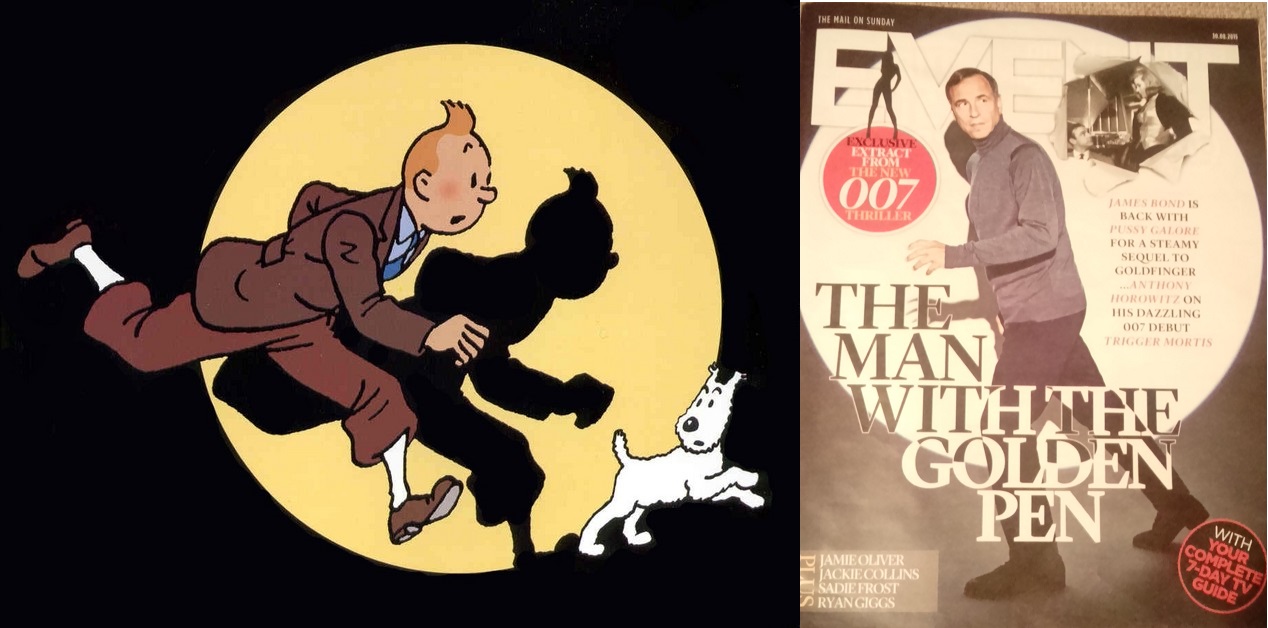
I'm reminded of the cover of the Mail on Sunday's Event magazine in August last year, which showed Anthony Horowitz caught by a spotlight. Whetting readers' appetites for a feature about Horowitz's James Bond novel, the image was clearly meant to recall the gunbarrel sequence (although there is something Tintin-esque about it too, which may also have been intended, since Horowitz is a fan of Hergé's creation).
In one TV spot, we see a handsome and cool hero putting on a dinner suit. He clicks his fingers, and the scene switches to a dark space, criss-crossed with laser beams reminiscent of a well-known scene from Mission:Impossible. Our hero energetically negotiates his way around the beams – he is evidently an expert gymnast – before reaching the door to what appears to be a gold vault (shades of Goldfinger?).
The action cuts to another dark empty space, lit only by a spotlight. The man clicks his fingers again, and we see him on top of a skyscraper resembling the Empire State Building like a well-groomed King Kong. The spotlight is moving around looking for him. There is a close up of the man. Keeping with the King Kong allusion, a woman stands on his open hand. The man turns to the camera and clicks his fingers again.
Instantly, the man's appearance changes. He now wears a white dinner jacket and adopts a very familiar pose: he stands facing us, the lower part of his left leg behind his right leg. His left arm is held against his body, his left hand tucked under his right elbow. The lower part of his right arm is bent upwards, his hand resting on his chin as if he is in thought.
If you put a gun in his right hand, then he'd be imitating the classic James Bond pose seen on many posters and publicity shots from the Bond films, beginning with From Russia, With Love. The reference is confirmed as the spotlight captures him, and he is enclosed in a white circle that mimics the gunbarrel sequence that traditionally opens a Bond film.
But he hasn't been caught for long, as he makes an appropriately Bondian escape holding on to the landing skid of a helicopter.
Though short, the advert is crammed with film references, among them references to James Bond (potentially five – the pose, the dinner suit, spotlight, the helicopter and the vault).
The use of the spotlight is itself interesting. In the traditional gunbarrel, it is not a spotlight we see moving across the screen at the start of the gunbarrel sequence, but simply a white dot – or possibly the sights of a gun – that is transformed into the end of a gunbarrel. The dot, however, is similar enough to a spotlight for the spotlight to be used as a proxy by photographers, film-makers and others for the gunbarrel. Simply shine a spotlight on someone and the allusion to Bond is made.
I'm reminded of the cover of the Mail on Sunday's Event magazine in August last year, which showed Anthony Horowitz caught by a spotlight. Whetting readers' appetites for a feature about Horowitz's James Bond novel, the image was clearly meant to recall the gunbarrel sequence (although there is something Tintin-esque about it too, which may also have been intended, since Horowitz is a fan of Hergé's creation).
Thursday, 17 November 2016
Skyfall - Home Alone or John Buchan?
The defence of Skyfall, James Bond's family home in the Scottish Highlands, against an assault by Raoul Silva and his small army in the 2012 film has been dismissed by critics as James-Bond-does-Home-Alone. I think the criticism is unfair. Not only is Home Alone a good film, but the critics are also ignoring a more fitting, literary parallel – one from the pages of John Buchan.
In a recent post, I explored the similarities between the novel of Moonraker and John Buchan's fourth Richard Hannay adventure, The Three Hostages. It seems that Skyfall also has some Buchan blood, in this case from his fifth Hannay novel, The Island of Sheep (1936).
When Valdemar Haraldsen's life is threatened by a gang of villains led by master-criminal d'Ingraville, who are pursuing by any means a claim on a 'great treasure' discovered by Haraldsen's late father, Haraldsen turns to Richard Hannay, Hannay's fellow adventurer Lord Clanroyden (formerly Sandy Arbuthnot) and an old friend of Hannay's, Mr Lombard, for help. All three had sworn an oath to Haraldsen's father to protect his son should ever the need arise.
At first, Haraldsen is persuaded to hole up at Laverlaw, Clanroyden's ancestral home in the Scottish Highlands. As Sandy explains, 'The fight must come, and I want to choose my own ground for it... Haraldsen will be safe at Laverlaw till we see how things move.' Unfortunately for Haraldsen, things move rather too quickly, as d'Ingraville and his men are drawn to the estate and make their presence felt.
Haraldsen must retreat further, this time to his own ancestral home on the Island of Sheep in the Norlands (probably the Faroe Islands). Echoing Clanroyden's views, he shares an old proverb with Hannay that 'strongest is every man in his own house.' Clanroyden agrees, and tells Hannay again that 'we must fight them, and choose our own ground for it, and since they are outside civilisation, we must be outside it too.'
James Bond has the same idea in Skyfall. Laying a trail for Silva to follow, Bond tells M that he's taking her 'back in time. Somewhere we'll have the advantage.' Arriving at the lodge, Bond tells the family gamekeeper, Kincade, that 'some men are coming to kill us. But we're going to kill them first.'
Once at the house, Hannay and the others start making preparations for its defence, rather as Bond, Kincade and M do at Skyfall. They shutter the windows and barricade the doors with furniture, and take positions at various parts of house armed with revolvers, rifles and double-barrelled shotguns.
And just as Skyfall has a secret passage – a priest-hole – that leads Kincade and M, and later Bond, away from the house and towards the chapel, Haraldsen's house boasts a little stone cell once occupied by an Irish hermit that takes people away from the house unnoticed via a set of steps to the entrance of a cave by the sea.
Haraldsen's house has no name – it is simply known as the House – but Buchan gives an interesting name to the island's principal hill: Snowfell. The name is obviously not so very different from Skyfall.
The similarity between the scenes at Skyfall in the film of the same name and the passages set on the Island of Sheep in John Buchan's novel may well be coincidence, but if the events of The Island of Sheep had been described in a Bond novel, then we would have no hesitation in claiming that the scenes in Skyfall were based on them. In any case, the similarity indicates that the Skyfall scenes have a literary antecedent. Just as the Bond novel Moonraker can trace its origins to the adventures of Richard Hannay, it seems that Skyfall has also inherited tropes or memes from Buchan's work.
In a recent post, I explored the similarities between the novel of Moonraker and John Buchan's fourth Richard Hannay adventure, The Three Hostages. It seems that Skyfall also has some Buchan blood, in this case from his fifth Hannay novel, The Island of Sheep (1936).
![]() |
| The Island of Sheep, 2012 Polygon edition |
At first, Haraldsen is persuaded to hole up at Laverlaw, Clanroyden's ancestral home in the Scottish Highlands. As Sandy explains, 'The fight must come, and I want to choose my own ground for it... Haraldsen will be safe at Laverlaw till we see how things move.' Unfortunately for Haraldsen, things move rather too quickly, as d'Ingraville and his men are drawn to the estate and make their presence felt.
Haraldsen must retreat further, this time to his own ancestral home on the Island of Sheep in the Norlands (probably the Faroe Islands). Echoing Clanroyden's views, he shares an old proverb with Hannay that 'strongest is every man in his own house.' Clanroyden agrees, and tells Hannay again that 'we must fight them, and choose our own ground for it, and since they are outside civilisation, we must be outside it too.'
James Bond has the same idea in Skyfall. Laying a trail for Silva to follow, Bond tells M that he's taking her 'back in time. Somewhere we'll have the advantage.' Arriving at the lodge, Bond tells the family gamekeeper, Kincade, that 'some men are coming to kill us. But we're going to kill them first.'
Once at the house, Hannay and the others start making preparations for its defence, rather as Bond, Kincade and M do at Skyfall. They shutter the windows and barricade the doors with furniture, and take positions at various parts of house armed with revolvers, rifles and double-barrelled shotguns.
And just as Skyfall has a secret passage – a priest-hole – that leads Kincade and M, and later Bond, away from the house and towards the chapel, Haraldsen's house boasts a little stone cell once occupied by an Irish hermit that takes people away from the house unnoticed via a set of steps to the entrance of a cave by the sea.
Haraldsen's house has no name – it is simply known as the House – but Buchan gives an interesting name to the island's principal hill: Snowfell. The name is obviously not so very different from Skyfall.
The similarity between the scenes at Skyfall in the film of the same name and the passages set on the Island of Sheep in John Buchan's novel may well be coincidence, but if the events of The Island of Sheep had been described in a Bond novel, then we would have no hesitation in claiming that the scenes in Skyfall were based on them. In any case, the similarity indicates that the Skyfall scenes have a literary antecedent. Just as the Bond novel Moonraker can trace its origins to the adventures of Richard Hannay, it seems that Skyfall has also inherited tropes or memes from Buchan's work.
Friday, 11 November 2016
A look at the Bond parody 'Kiss the Girls and Make Them Spy'
If being honest, even the most ardent of fans would concede that Ian Fleming's novels are very much of their time and contain aspects which sit uncomfortably with modern attitudes. Take the representation of homosexuality. To Fleming's credit, there are a few characters who are gay or are hinted to be gay, but their portrayal is problematic. Pussy Galore and Rosa Klebb are the lesbians of heterosexual male fantasy, and in the case of Scaramanga and Wint and Kidd, the homosexuality is a symptom of an abnormality that in part explains the criminal behaviour.
To be fair, Bond's attitude to homosexuality, as suggested for instance by his discussion with Troop about 'intellectuals' in the the Secret Service, is reasonably progressive for the time (it should be remembered that homosexual acts in private were not decriminalised in the UK until 1967), and this no doubt reflects Fleming's own relatively liberal views. After all, some of Fleming's best friends were gay.
However, it is not the gay characters that have made the Bond novels easy targets for camp parodies (we could blame instead Bond's particular habits, for instance in relation to food, and the homoerotic quality of Bond being hit on the genitals with a carpet beater), of which Cyril Connolly's 'Bond Strikes Camp' and 'The Spy who Minced in from the Cold', by Stanley Reynolds are notable examples. A rather more thoughtful parody, however, is Kiss the Girls and Make Them Spy (Harper Collins, 2001), by Mabel Maney.
The novel, set in 1965, concerns an attempt by a secret organisation, the Sons of Britain Society, to depose the Queen and return the Duke of Windsor to the throne. Enter Her Majesty's Secret Service, whose officers serve to protect the Queen, and another mysterious organisation, the Greater European Organization of Radical Girls Inderdicting Evil (G.E.O.R.G.I.E.), which is populated by lesbians sworn to protect the world from destruction wrought by men. Curiously, though, both the Secret Service and G.E.O.R.G.I.E. appear to be oblivious to the plot to kidnap the Queen until it's in full swing.
Meanwhile, James Bond is on sick leave, having suffered a nervous breakdown. In order to preserve the reputation of the Secret Service and the belief that England's top agent is still on active duty, his sister, Jane, who looks very much like James, is blackmailed by the service to take James' place. Jane's mission is to receive a medal from the Queen without raising suspicion.
James Bond's absence is, I suspect, designed to avoid breaching copyright, and there are other changes in personnel; M become N, Miss Moneypenny becomes Miss Tuppenny (and, incidentally, the head of G.E.O.R.G.I.E), and, borrowing from the films, Q becomes X. The author is familiar with the Bond novels: Jane has an unruly comma of hair, as does James, there is reference to the 'powder vine', and it's revealed that Jane's handler, Agent Pumpernickel, or 001, has a S-shaped scar on his cheek, which was made by an enemy agent to mark him as a spy. The scar not only recalls the scar that Fleming's Bond has on his cheek, but also the knife cut in the form of an inverted M that Bond receives on the back of his hand in Casino Royale.
That said, the author doesn't stick rigidly to the 'facts' of Fleming's novels. The Secret Service in Mabel Maney's novel is usually referred to as Her Majesty's Secret Service, operates in England, and exists solely to protect the Queen, just as the US Secret Service is tasked with protecting the President. And, of course, family details are wrong. Apart from the sister we never knew about, James' mother is called Sylvia, and his father, James Bond Sr, was a secret agent who Jane believes took his own life.
The Bond films are referenced as well. To prepare for her mission, Jane is required to wear a dinner suit, drink vodka martinis (shaken, not stirred), and practise raising her eyebrows, reputedly in the manner of Roger Moore. Like the film Bond, Jane has a very active love life, though falls in love with one of the agents of G.E.O.R.G.I.E, a redhead called Bridget. There are gadgets, too, in the form of deadly lipsticks.
I enjoyed the book, though as with most of the longer Bond parodies, such as ALLIGATOR and (ahem) Devil May Care, the joke wears thin after a while. However, the characters are better drawn than they usually are in parodies, and Jane is interesting enough to deserve to appear in further adventures.
There have been numerous candidates for the first female James Bond, notably Modesty Blaise, but Jane Bond has better claim than most, having a believability that others lack (that's not to say that the plot is believable, which is far more fantastic than any plot of Fleming's). It is this credibility that means that the book is not so much about a 'gay Bond' than simply an entertaining spoof of familiar Bondian tropes.
To be fair, Bond's attitude to homosexuality, as suggested for instance by his discussion with Troop about 'intellectuals' in the the Secret Service, is reasonably progressive for the time (it should be remembered that homosexual acts in private were not decriminalised in the UK until 1967), and this no doubt reflects Fleming's own relatively liberal views. After all, some of Fleming's best friends were gay.
However, it is not the gay characters that have made the Bond novels easy targets for camp parodies (we could blame instead Bond's particular habits, for instance in relation to food, and the homoerotic quality of Bond being hit on the genitals with a carpet beater), of which Cyril Connolly's 'Bond Strikes Camp' and 'The Spy who Minced in from the Cold', by Stanley Reynolds are notable examples. A rather more thoughtful parody, however, is Kiss the Girls and Make Them Spy (Harper Collins, 2001), by Mabel Maney.
The novel, set in 1965, concerns an attempt by a secret organisation, the Sons of Britain Society, to depose the Queen and return the Duke of Windsor to the throne. Enter Her Majesty's Secret Service, whose officers serve to protect the Queen, and another mysterious organisation, the Greater European Organization of Radical Girls Inderdicting Evil (G.E.O.R.G.I.E.), which is populated by lesbians sworn to protect the world from destruction wrought by men. Curiously, though, both the Secret Service and G.E.O.R.G.I.E. appear to be oblivious to the plot to kidnap the Queen until it's in full swing.
Meanwhile, James Bond is on sick leave, having suffered a nervous breakdown. In order to preserve the reputation of the Secret Service and the belief that England's top agent is still on active duty, his sister, Jane, who looks very much like James, is blackmailed by the service to take James' place. Jane's mission is to receive a medal from the Queen without raising suspicion.
James Bond's absence is, I suspect, designed to avoid breaching copyright, and there are other changes in personnel; M become N, Miss Moneypenny becomes Miss Tuppenny (and, incidentally, the head of G.E.O.R.G.I.E), and, borrowing from the films, Q becomes X. The author is familiar with the Bond novels: Jane has an unruly comma of hair, as does James, there is reference to the 'powder vine', and it's revealed that Jane's handler, Agent Pumpernickel, or 001, has a S-shaped scar on his cheek, which was made by an enemy agent to mark him as a spy. The scar not only recalls the scar that Fleming's Bond has on his cheek, but also the knife cut in the form of an inverted M that Bond receives on the back of his hand in Casino Royale.
That said, the author doesn't stick rigidly to the 'facts' of Fleming's novels. The Secret Service in Mabel Maney's novel is usually referred to as Her Majesty's Secret Service, operates in England, and exists solely to protect the Queen, just as the US Secret Service is tasked with protecting the President. And, of course, family details are wrong. Apart from the sister we never knew about, James' mother is called Sylvia, and his father, James Bond Sr, was a secret agent who Jane believes took his own life.
The Bond films are referenced as well. To prepare for her mission, Jane is required to wear a dinner suit, drink vodka martinis (shaken, not stirred), and practise raising her eyebrows, reputedly in the manner of Roger Moore. Like the film Bond, Jane has a very active love life, though falls in love with one of the agents of G.E.O.R.G.I.E, a redhead called Bridget. There are gadgets, too, in the form of deadly lipsticks.
I enjoyed the book, though as with most of the longer Bond parodies, such as ALLIGATOR and (ahem) Devil May Care, the joke wears thin after a while. However, the characters are better drawn than they usually are in parodies, and Jane is interesting enough to deserve to appear in further adventures.
There have been numerous candidates for the first female James Bond, notably Modesty Blaise, but Jane Bond has better claim than most, having a believability that others lack (that's not to say that the plot is believable, which is far more fantastic than any plot of Fleming's). It is this credibility that means that the book is not so much about a 'gay Bond' than simply an entertaining spoof of familiar Bondian tropes.
Subscribe to:
Posts (Atom)