Showing posts with label SPECTRE. Show all posts

Thursday, 26 April 2018

Who did Number 2 work for before SPECTRE?

Anyone who’s read Thunderball or seen the film will be familiar with how SPECTRE conducts itself at meetings. Members of the criminal organisation are identified by number (in the novel, numbers are changed monthly, Blofeld being Number 2 during the events of the novel; this contrasts with the film, in which Blofeld, as chairman, is always Number 1) and quizzed about their criminal fund-raising activities before getting down to the main item on the agenda, in this case the theft of two atomic bombs. This set-up has been imitated and parodied since – Austin Powers hit the mark pretty accurately – but apparently SPECTRE wasn’t the first criminal organisation to adopt this model.
 
Cover of the first edition, published by The Bodley Head (artwork by Ernest Akers)
Agatha Christie’s The Secret Adversary, published in 1922, features the pair of amateur sleuths, Tommy and Tuppence. In the novel, they’re on the search for a young woman, who’s gone missing after taking possession of a packet of secret documents, the contents of which would be dangerous in the wrong hands. 


The adventurous pair soon run up against members of a secret organisation who have a nefarious interest in the documents. At one point, Tommy follows one of the criminal agents to a house that transpires to be organisation’s headquarters, and finds himself eavesdropping on a meeting of the agent’s fellow members, an international cast of criminals that includes a Russian, an Irishman and a German. 

Hidden away, Tommy notices the arrival of another individual, who is allowed to enter the meeting room when he reveals his identity – Number 14 – to the doorman. Someone else arrives, gives his number, and gains access. Within the room, and at the head of the table, is Number 1, who, like Largo in the novel of Thunderball, is not himself the head of the organisation (who is known mysteriously as Mr Brown). 

Once everyone is assembled, they get down to business. One of the members requests more money from the organisation to pursue his part in the grand scheme. They read reports from various unions, which they have been infiltrating in order to spread discord and lay the foundations of revolution, which will be achieved with the release of the information contained in the missing documents. They agree that a certain union member, who might be a fly in the ointment, ‘must go’, and they discuss how they could induce the young woman to reveal the whereabouts of the package (‘In Russia we have ways of making a girl talk’).

Reading this, naturally I was reminded of Thunderball, and certainly there are similarities between the organisations in Ian Fleming’s and Agatha Christie’s novels: the use of numbers, the discipline, the international membership, the involvement of the unions, the threat of violence, and the business-like manner of planning world chaos. 

It seems that even in criminal organisations, there’s a standard way of doing things. Now there’s a thought – did Mr Brown and Blofeld attend the same evil business school?

Thursday, 17 August 2017

On location: Altaussee, Austria; or a visit to Mr White's house

A summer holiday to Salzburg in Austria allowed me to visit one of the locations used in the last James Bond film, Spectre. The edge of Lake Altaussee, by the alpine village of Altaussee and about one and a half hour’s drive from Salzburg, was the setting for the scene in which Bond visits Mr White. Werner Fischer, one of Eon’s local contacts during the filming of the sequence, was offering ‘In the footsteps of James Bond’ boat tours of the lake, and naturally I booked myself a place on one of them.


My fellow passengers and I had our first treat even before the boat left the jetty. Beside us, moored to another landing stage, was the thin wooden boat that Daniel Craig’s James Bond uses to motor across the lake to Mr White’s cabin.The boat is based on a traditional Austrian craft known as a Zille or Plätte.

Bond's boat in Spectre
As we pulled away from the shore and started to make our way across the lake, we heard some facts and figures about Altaussee. Unfortunately, my German was too poor to understand much, but I got the gist, and in any case, I didn’t need any translation to realise that we were heading towards a wooden building on the far side of the lake that looked rather familiar. In fact, we were following Bond’s course to Mr White’s house.
 
The view towards Mr White's house on the tour (top) and on screen
After a while, the boat pulled up to the jetty beside the building that normally serves as a bar and restaurant. This is presumably closed during the winter, allowing it to double as Mr White’s cabin in Spectre.

 
Mr White's house now (top) and as shown in Spectre
We wasted no time in disembarking and literally walking in James Bond’s footsteps towards the house. Apart from some superficial differences, the outside of the wooden building seemed little changed from its appearance on the big screen. Indeed, traces of the production still remain. The stone footings of the veranda are made of fibreglass and were fitted especially for the scene, and if I understood aright, the chimney was added too.

 
The veranda with the fake stone footings
Entering the building, I saw that the staircase seen in the film is a feature of the property (annoyingly, I didn’t take a photograph).

 
The staircase as shown in Spectre
And there is a further sign that the production crew had been there in the form of two displays of photographs and newspaper cuttings.

 
The displays inside the house
Just before Bond enters the house, we have a view back towards the lake. This shot shows the actual edge of the lake in front of the building.


The view from the house to the lake (not sure where the tree went)
Eventually, we all boarded the boat and returned across the lake back towards the village. As we approached the end of the tour, our guide let us into a secret. Bond alumnus Klaus Maria Brandauer has a house (and boathouse) here. We weren’t told whether he was there during filming, but it’s intriguing to imagine Bond’s reaction if he had bumped into Maximilian Largo, his old sparring partner in Never Say Never Again
 

The boat tour, organised by Altaussee-Schifffahrt, was excellent, although it would have been helpful to have some information at least in English. Nevertheless, if you happen to be in the area, the tour is essential.

Thursday, 3 November 2016

Spectre inspires the first Day of the Dead parade in Mexico City

In a blog about James Bond's impact on culture, I could hardly fail to mention the Day of the Dead parade, which was held in Mexico City on 29th October as part of its annual Day of the Dead festival. As I describe in a previous post, the festival traditionally involves offerings of food and drink to household ancestors, streets decorated with flowers, market-stalls selling edible skulls, and graveside feasts. This was the first year that a parade was held in the city. And the reason why it was held was due to Spectre (2015).


While I have my misgivings about the film – Blofeld revealed as Bond's step-brother? The series could have done without that complication – it is undeniably spectacular, and the Day of the Dead parade that opens the film is up there with the best of the series' pre-title sequences.

Lourdes Berho, the chief executive of the Mexico Tourist Board must have thought so too. 'We knew that this was going to generate a desire on the part of people here, in Mexicans and among tourists,' she told reporters, 'to come and participate in a celebration, a big parade.'

The thousands of people who came to view the parade saw performers in skeleton costumes and masks, floats bedecked with skeletons, and giant skeleton marionettes. Some of the participants wore costumes from the film itself. Others had costumes inspired by the film or wore more traditional costumes, such as those representing Aztec warriors.

This isn't the first time James Bond has had an impact on aspects of life beyond the normal scope of popular culture. The revolving restaurant on the summit of the Schilthorn in the Swiss Alps has been known as Piz Gloria ever since it appeared in On Her Majesty's Secret Service (1969). Maps of the region around Phuket in Thailand (well, Google maps, at least) officially record a small islet off Khao Phing Kan as James Bond Island, which formed part of Scaramanga's lair in The Man with the Golden Gun (1974).

Whether Spectre's impact on the Day of the Dead festival will be as lasting as Bond's impact on the the Schilthorn and Phuket has been remains to be seen. As David Agren reports in the Guardian, some commentators, among them the editor of Nexos magazine, Esteban Illades, took to social media to denounce the parade as populist stunt. Interestingly, though, the Guardian also reports that parades and processions have in fact been part of the festival for a some years now, even if in a relatively minor way.

What Spectre has done is given that emerging tradition a boost, and changed expectations about what the Day of the Dead festival entails. I certainly wouldn't be surprised to see the parade return next year, and indeed hear of similar parades being held elsewhere. (Look out for a parade near you!). More generally, the parade demonstrates how James Bond continues to have significance and relevance in the wider cultural environment. It may be a while yet before we hear of a Jason Bourne Island...

Sunday, 11 September 2016

Jaguar evokes James Bond in its advertising

Jaguar, the car manufacturer, is no stranger to the world of James Bond. Last year in Spectre, we saw Oberhauser's goon, Mr Hinx, put Jaguar's concept car, the C-X75, through its paces on the streets of Rome. And in Die Another Day (2001), Zao battles Bond and the ice in a Jaguar XKR. We must wait until the next Bond film (whenever that will be) to find out whether Jaguar will make another appearance, but in the meantime, the spirit of Bond lives on in Jaguar's advertising.

The Art of Performance campaign, which promotes the Jaguar XE, is currently doing the rounds on British television (see the advert on my Licence to Cook Facebook page). In the advert, the car speeds (in controlled conditions) through the streets of central London. We see close-ups of the car before it zooms through a tunnel and comes out on to Westminster Bridge in view of the London Eye and Queen Elizabeth Tower.

The locations naturally evoke the final part of Spectre, particularly the tunnel in which M's car is rammed and Bond kidnapped, and the denouement on Westminster Bridge (an association helped by the Bondian music that accompanies the advert). To some extent, the advert also recalls the beginning of the pre-title sequence of Quantum of Solace, which, with its seductive glimpses of Bond's Aston Martin before the shooting starts, could almost be a car advert itself.

Another of Jaguar's campaigns also has distinct Bond-like qualities. The 2014 Art of Villainy commercial showcased the Jaguar F-type coupé and starred Tom Hiddleston, who, in the advert, reveals the essential characteristics of a villain (style, razor-sharp wit, attention to detail, and the means to stay one step ahead, among others) before tearing through the streets of London. (For this villainous act, the advert was banned by the UK's Advertising Standards Authority, who judged that it promoted dangerous driving). The advert made the car look good, of course, but could also be viewed as Hiddleston's audition for a Bond villain (if not Bond himself).


There's more Bond-like villainy in a 2014 advert starring Nicolas Hoult. If Tom Hiddleston is Blofeld, Nicolas Hoult is Q gone bad. In the commercial for the Jaguar XE, we see Hoult descend into his innovation lab (passing through a shark-infested pool) and explain, in what could be the antithesis of a typical Q briefing, what every mastermind needs in terms of automative technology to help them achieve world domination.


All three adverts are redolent of the James Bond films, and use memes closely associated with Bond, such as the urbane, sophisticated villain, iconic landscapes, the Q-like character, and buttons and switches inside the car that bring to mind gadgets and ejector seats. The adverts were not made with reference to any specific Bond product or film, but nevertheless depend on them. Even after half a century, James Bond continues to have significant traction in the world of advertising.

Saturday, 19 March 2016

Is James Bond really a paid assassin?

There's a piece of dialogue in Spectre that slightly disturbs me. In the scene in the restaurant car of the train, Madeleine Swann asks Bond, “Why, given every other possible option, does a man choose the life of a paid assassin?” Bond replies that it was either that or the priesthood. It's an amusing line, but it does concern me that Bond seems to accept the view that he's an assassin, which he isn't, at least not according to the Concise Oxford Dictionary, which defines the verb to assassinate simply as 'murder (a political or religious leader)'.

Even if one takes a wider definition of assassin (Wiktionary defines assassinate as 'to murder someone, especially an important person, by a sudden or obscure attack, especially for ideological or political reasons') or, say, that of a hitman ('a contract killer'), he isn't really those things either. While the Bond of the cinema has occasionally been ordered to kill an identified target – Pushkin in The Living Daylights (1987), for example – Bond generally kills in the course of a mission, and usually when his own life is threatened; the killing is an unpleasant, though justified by-product, rather than the primary goal.

And yet, Bond the scriptwriters have insisted on labelling Bond as an assassin. Octopussy, as with Madeleine Swann, calls him a paid assassin, and Scaramanga in The Man With The Golden Gun (1974), who is undeniably a hitman, equates himself with Bond. “We are the same,” he tells Bond. In this instance, it's a charge Bond refutes. “When I kill it's under specific orders of my government, and those I kill are themselves killers.”

Similarly in the novels, Bond's missions are not to kill an identified target, although admittedly, on occasion, Bond is given this role. In 'For Your Eyes Only', Bond talks himself into killing Cuban hitman Gonzales with M's tacit approval, and in 'The Living Daylights', Bond is ordered to kill a Russian sniper, although in this case, it's in order to protect the life of a fellow agent.


The identification of Bond as an assassin is deep-rooted. In a review for the volume of For Your Eyes Only (1962), the Times Literary Supplement refers to Bond as a licensed assassin. In the anthology of spy stories, To Catch a Spy (1964), the volume's editor, Eric Ambler, writes in his introduction to one story, 'On Slay Down' by Michael Gilbert, that it could be subtitled, 'The recruitment of 008'. In the story, Mr Calder, an agent of an unnamed organisation (presumably MI5 in this case) travels to Slay Down near Salisbury Plain in order to kill a Maria Lipper, a clerk working in the Air Ministry who has been passing information to the opposition.

By labelling him 008, Ambler equates Calder, a cold killer (and therefore in some measure an assassin), with Bond. The story, published in 1962, is reminiscent of Fleming's short stories, 'Property of a Lady', in which Bond disrupts payment by the Soviets to a double agent (curiously the double agent is also called Maria), and '007 in New York', in which Bond is sent to New York to warn a former Secret Service employee that she's living with a KGB agent. Given the similarity, 'On  Slay Down' could be a Fleming short story, but in neither of Fleming's stories, is Bond ordered to kill.

The Bond-as-assassin meme is a long-lived and persistent one, but one that doesn't quite fit Bond's role, either in the books or the films. It's a pity that Bond isn't allowed in the films to defend himself against the accusation more robustly.

Thursday, 14 January 2016

Did the Baftas snub Spectre?


The film award season is well underway. Spectre won the award for Best Original Song at the Golden Globes, and the theme song is now up for an Academy Award (come back, Sam Smith, all is forgiven). The lack of other awards or nominations here isn't particularly surprising, especially given Spectre's lukewarm critical reception in the US.

The picture in the UK, however, is rather more curious. When the nominees for the 2016 Baftas were announced last week, there was one notable omission: Spectre hadn't been given the nod in a single category, including the technical categories. Was this a deliberate snub by BAFTA members, reflecting a degree of snobbery towards the Bond films, or was Spectre simply not that good?

When Dame Pippa Harris, chair of the BAFTA film committee, was asked by the BBC's arts editor, Will Gompertz, why Spectre (and Star Wars: The Force Awakens) had been overlooked, she gave an interesting answer: “There's a tendency with both comedies and action films for awards, generally speaking, to overlook them... When it comes to the awards season, people tend to look at what they consider to be serious dramas.”

I think Dame Pippa is being a little disingenuous here. It's true that over the course of the Bond series, few films have been recognised by BAFTA (though in fairness, the technical categories were only introduced in 1984), but Daniel Craig's Bond films have been lauded by members. Skyfall received eight nominations in 2013, while in 2007 Casino Royale received nine. Even Quantum of Solace, which divided critics, Bond fans and general cinema-goers alike,  received two nominations in 2009. Overall, then, the lack of nominations for Spectre does raise a Roger Moore-like eyebrow.

Two aspects interest me. First, Dame Pippa's response, effectively that action films can't compete with serious films, is something of a common trope, a meme that may have been true in the past, but less so now. Indeed, it belies BAFTA's own recent history (and in any case, what is Mad Max: Fury Road, which has received seven nominations, if not an action film?).

Second, why wasn't Spectre nominated? There could be all sorts of reasons related to the competition from other films or the quality of the film itself; possibly a bit of both. I wonder, though, whether the lack of nominations reveals something about the perception of Spectre and its place in the Bond series.

Daniel Craig's Bond films have been exceptional, being both highly popular and well received critically, and winning over many who would not have regarded themselves as Bond fans. Spectre does, however, seem to mark a turning point. With the re-introduction of a villain of old, the reinstatement of the gunbarrel to the beginning of the film, the upping of the humour level, and a bonkers plot twist, Spectre begins to look more, well, traditional.

Perhaps that's how BAFTA members saw it. Spectacular and enjoyable as it was, the film was an excellent Bond film, but not an excellent film. One for the fans, to be judged against other Bond films only, just like most Bond films before Casino Royale. (Up till then, only Goldeneye (I think) had been nominated for a Bafta, despite many of the Bond films, particularly the Brosnan-era ones, enjoying very positive reviews on their release.)

So did Bafta snub Spectre? Probably not. But perhaps it was a case of Spectre returning to the mean. Normal service has resumed. For a Bond film to be nominated for awards, it needs to diverge significantly from the traditional structure of the series, and jettison once again some of those standard Bond memes.

Thursday, 3 December 2015

The evolution of the SPECTRE symbol

The name of SPECTRE isn't the only aspect of the organisation last seen – officially, at least in Diamonds Are Forever to have been resurrected in the latest James Bond film. The organisation's octopus-like symbol made an appearance too.

The motif has seen a number of changes over the years. The first time we see the SPECTRE symbol is at a chess match in From Russia With Love (1963). The symbol is on a paper coaster delivered with a glass of water and a summons for Kronsteen, a chess grandmaster and SPECTRE agent. The symbol, with its four wavy tentacles and ghoulish head, is less an octopus than a jellyfish out for an evening's trick or treating. The device is seen again as an intaglio on a ring worn by Blofeld. 

From Russia With Love
The SPECTRE symbol next makes an appearance in Thunderball (1965), placed in a ring worn by SPECTRE No. 2, Emilio Largo. This time, the device is more octopus-like, presumably symbolising SPECTRE'S reach and omnipresence. The outer tentacles curve round to enclose the others, perhaps as much to fit the circular frame of the ring as for aesthetic reasons. The facial features of the octopus are reduced to alien-like eyes. 

Thunderball
The design is largely retained for You Only Live Twice (1967) and is seen on a ring worn by Blofeld. In Diamonds Are Forever (1971), however, the symbol is rather different. Adorning the front of Blofeld's bath-o-sub, the octopus has gained a thicker body and straighter and broader outer tentacles, giving the impression perhaps of an octopus wearing a cape or shawl. The eyes, though, remain alien-like.

 
Diamonds Are Forever
With SPECTRE off the screen until the latest film (apart from Never Say Never Again), there have been no developments in the symbol in the intervening period (although Stromberg's Atlantis has a certain resemblance to the octopus device). Almost to make up for it, however, Spectre (2015) contains two designs. Teaser posters for the film cleverly incorporated the octopus symbol within bullet-damaged glass, the tentacles and body being formed by the fissures surrounding the bullet hole. A similar motif was created within the film itself. 

Spectre teaser poster
SPECTRE itself adopts a more corporate-looking octopus logo, which is seen on the outside surface of a ring and on a computer screen. The body of this octopus is relatively thin and wide, while the tentacles are short and curve towards the centre, except the central tentacle, which is longer than the others and is straight and tapers like a dagger. Interestingly, the octopus only has seven tentacles. It's also worth noting that the 'shoulders' of the octopus are raised, and that the head lacks eyes.

Spectre ring 2015
Each incarnation of the SPECTRE/octopus motif is obviously different from the last, yet each could not have existed without those that preceded it. The exception is, of course, the first incarnation, and it is telling that in that case, the motif looks the least like an octopus, as if the designer was influenced mainly, if not solely, by the principal meaning of the word 'spectre'. It is possible that its resemblance to an octopus was coincidental, but was enough to influence the design of the symbol two films later.

There is one other comparison worth making. The Batman symbol has had a long history and has undergone many changes, far more than we have seen on the SPECTRE device. What is curious, though, is that the various designs of the SPECTRE symbol share certain traits with roughly contemporaneous Batman motifs. Thus, the octopus motif of Thunderball and You Only Live Twice has curved, enclosing sides, as does the bat motif used in Batman comics in 1964 and 1965. The thicker body and straight sides of the octopus in Diamonds Are Forever mirrors the thicker body and straighter sides of the bat motif that appeared in the 1966 TV series and in comics in 1970. The spidery lines seen in Spectre's 'bullet-hole' octopus recall the scored appearance of the bat motif used for The Dark Knight Rises in 2012. The official octopus symbol seen on the 2015 ring, meanwhile, has leaner qualities matched by bat motifs used in Batman Begins (2005) and later in comics, and itself has a vague appearance of a flying creature. 


These similarities are no doubt coincidental, am I am not suggesting that the motifs resemble each other in any significant way. However, sharing certain traits, the motifs suggest a common aesthetic, the designers responding to an extent to the same influences or selection pressures within the cultural environment (although the apparent influence of Christopher Nolan's Batman films specifically on the Bond films has been noted elsewhere). 

The SPECTRE symbol has seen a number of changes over the past 50 years, but remains a important and recognisable piece of Bondian iconography in popular culture and a potent symbol for James Bond's most tenacious adversary.


Note: The Batman logos are taken from an infographic published on the World of Superheroes website.

Thursday, 26 November 2015

From Bond girl to Bond woman

In interviews following the press event to launch Spectre, and leading up to the release of the film, Monica Bellucci, cast in the role of Lucia Sciarra, rejected the term Bond girl in favour of Bond woman or lady. “I am so much more mature. I'd prefer to be called a Bond woman or perhaps a Bond lady,” she told the Mail of Sunday in February 2015. In an interview for the Sunday Times, she said, “I am a Bond lady.”

The rejection of Bond girl was on the basis of her age, the description of girl simply being inappropriate for an older woman. This was echoed by former Bond girl Fiona Fullerton, who appeared as Pola Ivanova in A View To A Kill (1985). She told the Daily Express in August this year: “I kind of cringe when I'm referred to as a Bond girl because I'm not a girl any more. I'm very much of the older fraternity so I'm a Bond woman.”

A similar view was expressed in the reaction, some 20 years earlier, of actor Michael Williams to the news that his wife, Judi Dench, had been cast as M in GoldenEye. “Oh brilliant”, he said, “Bond-woman!” Judi Dench has used the term herself, writing in her autobiography, “I really shouldn't be called a Bond woman at all, but I call myself one”.

Others have accepted the term Bond women because they have considered Bond girl inappropriate for any woman, young or old, or have associated the term with passive female characters who provide little more than decoration. Halle Berry told the Daily Express in November 2002 that “Jinx [her character in Die Another Day] is the next step in the evolution of the Bond woman. Year after year, they become a little bit stronger, a little smarter.... Now they're Bond's intellectual equals and physical rivals.”

When Léa Seydoux was asked in the October 2015 issue of Total Film whether her character, Madeleine Swann was a Bond woman rather than a Bond girl, she replied, “She's a strong woman”, a response that neatly side-stepped the requirement to accept either label. The Daily Star claimed in October 2008 that Izabella Scorupco demanded to be called a Bond woman in GoldenEye, because she thought the usual term Bond girl was demeaning (although judging by interviews published in 1995, Bond girl appears not to have been so problematic).

Notably, in her foreword and chapter introductions in Bond Girls are Forever (2003), co-author Maryam d'Abo (Kara in The Living Daylights) rarely uses the term Bond girl. She writes, for example, that “it is the casting of the Bond women that garner the most attention,” and that “there has never been a Bond film without a Bond woman.” Reading this, one gets the sense that Maryam d'Abo is not entirely comfortable with the term Bond girl, although Bond girl is not rejected explicitly, and is naturally retained in the title of the book.

The earliest use of the term Bond woman that I know of dates to 1989. An advert for Elle magazine that appeared in the Daily Express in 1989 trailed the contents of the June issue. Women in the Bond films were the subject of one of the articles, presumably coinciding with the release of Licence to Kill. “A Bond girl's life has never been easy,” the advert claimed. “Wham. Bam. Thank you, ma'am. Then bang bang, you're dead. But the role of the Bond woman is changing,” the implication being that term Bond girl was not appropriate for characters such as Pam Bouvier (Carey Lowell), who was perceived as being Bond's equal. 

This trawl through various sources has traced the emergence of the term Bond woman and revealed two definitions. In one sense, it is a term that reflects age, being associated with older women. Despite the use of this newer term, Bond girl itself is not rejected. In another sense of the term, Bond woman is presented as an alternative to Bond girl, reflecting the perception that female roles in the Bond films have changed through the course of the series, and making the obvious point that the actors are women, not girls.

Whether women in the Bond films are Bond girls or Bond women, it could be argued that such labels, Bond girl especially, have largely been imposed on the actors, seemingly first emerging in the media (the earliest reference to Bond girl I know of is in the Daily Express and dates to February 1963), and becoming deeply embedded in the cultural environment. The result is that every interview at press conferences or in newspapers and magazines seems to oblige actors to engage with the term Bond girl. This may be the reason why many of the actors (beginning at least as far back as 1969 with Diana Rigg) claim that their characters are stronger, more independent, and more on equal terms with Bond than their predecessors.

Thursday, 5 November 2015

Colonel Sun in Spectre and other Bond films

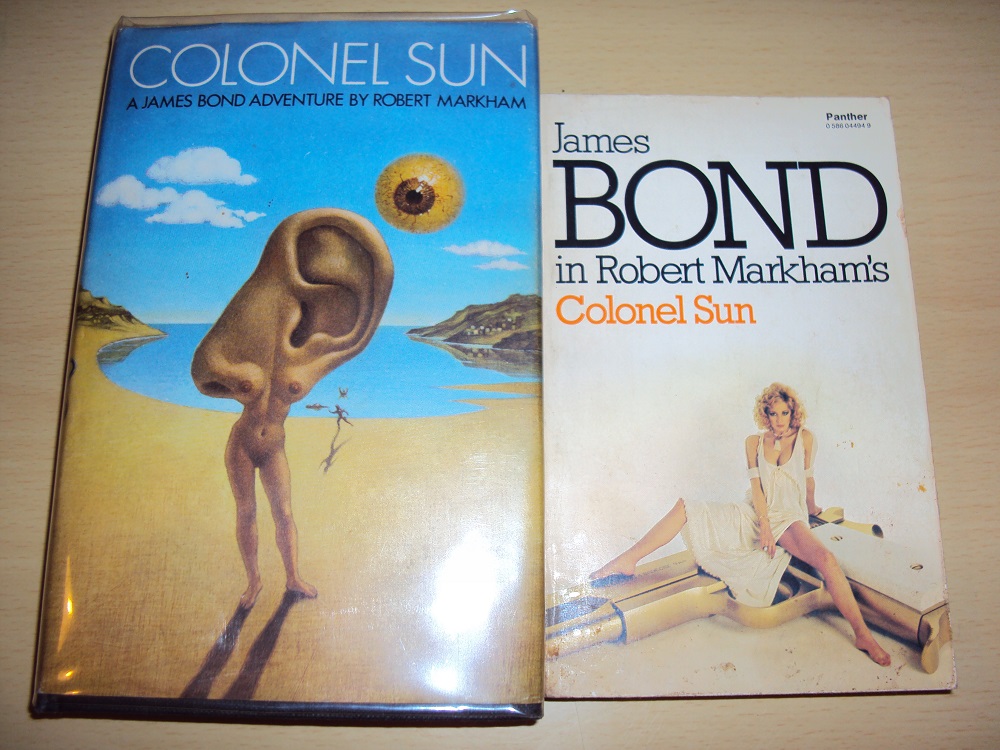
The latest Bond film, Spectre, contains many references to previous films and Ian Fleming's novels, and I listed some of these in my last post. But as Ian Fleming Publications recently revealed, Spectre also incorporates elements from Colonel Sun, the 1968 continuation Bond novel by Kingsley Amis.
 

I've identified the scene below, and while I don't describe it in detail, those who have yet to see the film may wish to look away now.

One of the classic elements of a Bond film is a scene of torture. Casino Royale had one, as did Die Another Day and, before that, The World Is Not Enough. Spectre has one too, and it is this scene, involving thin pointy instruments applied to the head and set in the villain's lair, which is lifted from Colonel Sun.

If there was any doubt that the screenwriters had looked through the pages of Colonel Sun for inspiration, it is confirmed by a line given to the villain – a philosophical thought about what the lack of eyes does to the essence of a man – which is taken almost verbatim from the novel. (I'm not certain, but I think he has another line from the novel, said when he directs Madeleine Swann to a chair.) These references, by the way, are from chapter 19, 'The Theory and Practice of Torture'.

As The Book Bond has pointed out, this may not be the first time Colonel Sun memes have been included in a Bond film. Die Another Day has the character Colonel Tan-Sun Moon, and in The World Is Not Enough (those two films again!), M is kidnapped, just as M is kidnapped in Colonel Sun.

I wonder if there is another reference. On the final page of Colonel Sun, James Bond and Ariadne, the heroine and GRU agent, talk about having to part and return to their duties. Ariadne says, “People think it must be wonderful and free and everything. But we're not free, are we?” Bond replies, “No. We're prisoners. But let's enjoy our captivity when we can.” This reminds me of the final exchange between Camille and Bond in Quantum of Solace (“I wish I could set you free. But your prison is in there”, Camille says, indicating Bond's mind).

Admittedly, this final reference seems less convincing than the others, but given the repeated nods to Colonel Sun in recent films, the writers, chiefly Robert Wade and Neal Purvis, clearly have had Amis' book in mind when coming up with ideas, and it is reasonable to suggest that their films contain other references.

Incidentally, Amis wrote Colonel Sun as Robert Markham, but the new edition of the book, published by Vintage, has dropped the pseudonym altogether. This no doubt improves the book's marketability, but the timing is interesting too. Any new Bond film brings with it glut of Bond-related books and reissues, all hoping to benefit from the film's publicity. But the reissue Colonel Sun has been a while coming; the last UK edition appears to have been published in the mid 1990s. Given that Spectre unambiguously contains elements of the novel, Vintage could almost have published Colonel Sun as a film tie-in.

Returning to Spectre, the references to Colonel Sun are significant, as until now it had been thought that there was reluctance within EON to adapt the continuation novels. Does that mean that we're going to see more of the continuation novels in the Bond films? If so, top of my list for an adaptation is Anthony Horowitz’s excellent Trigger Mortis. I wouldn't mind betting that the motor racing section of the book, which is based on material by Ian Fleming and includes Fleming's own words, will eventually make it to the big screen. Remember, you read it here first!

Tuesday, 27 October 2015

The spectre of defeat or success? A review of Spectre

Warning: This review contains minor spoilers, so if you haven't already done so, you may prefer to watch Spectre before reading on.

When the title and principal cast of Spectre were announced back in December last year, the question on everyone's mind was how would director Sam Mendes top Skyfall. For me, this was not an idle question. The Bond films have a tendency to ratchet up the thrills and spills which each subsequent film to a level of ridiculousness that eventually requires the series to go back to basics. After the massive Skyfall, would Spectre be Daniel Craig's Moonraker or his For Your Eyes Only?

I needn't have worried. In Spectre, Sam Mendes has pulled off the trick of delivering a film that is at least the equal of Skyfall in action, stunts, terrifying villains, yet retaining focus on narrative and characters. The events are as incredible as anything in a Bond film, but we care about what happens to Bond, his colleagues, his loves, and even his enemies.

From its first moments (do not take your eyes off the screen in that first minute or so or you won't fully appreciate what is a superb piece of cinema) in Mexico's Day of the Dead festival, to its near-denouement in the desert of north Africa, Spectre is mesmerising. Considering its long running time, Spectre doesn't drag, although it has its fair share of quieter moments.

Spectre see Bond attempt to get to the bottom, or rather the top, of a mysterious organisation (SPECTRE, naturally). His efforts are unauthorised, and severely test the patience of M, although M has other matters to worry about: a merger of MI6 and MI5 pushed through by a cocky intelligence chief, Max Denbigh. Bond follows a globetrotting trail, on the way meeting Mafia wife Lucia Sciarra, indestructible henchman Mr Hinx, psychologist Dr Madeleine Swann, and head of SPECTRE, Franz Oberhauser, whose connection with Bond we learn is personal, as well as professional.

Traditional Bond is back with a vengeance. Bond does what he does best, powering through any obstacle, human or otherwise, to get to the truth, using any vehicle, object or person he can lay his hands on, all the while delivering the best one-liners since the days of Roger Moore. Nevertheless, reflecting current concerns about technology, the level of surveillance in society, the control of information, and, as heard around the SPECTRE meeting room, people trafficking, Spectre is by no means old-fashioned or nostalgic.

Part of the fun of watching a Bond film is spotting the nods and references to previous films and Ian Fleming's stories. And Spectre is filled with them. The novel of Thunderball has inspired much of the organisational set-up of SPECTRE, while the short story of 'Octopussy' is alluded to in a scene that sees the return of Mr White and, more fundamentally, in the character of Oberhauser. Bond's now famous white jacket is taken from Goldfinger, while a scene featuring Q and a cable car is redolent of Moonraker and For Your Eyes Only.

The Hoffler Klinik in the Austrian mountains brings to mind Piz Gloria, but I wonder too if there isn't a reference here to Ian Fleming's early experiences in Austria when he was sent to the Forbes Dennises at their villa in Kitzbühl to further his education. One of the subjects he studied was psychoanalysis, the very discipline that Dr Swann practises. Bond's close encounter with a health drink may also hark back to Shrublands.

Then there's the film of You Only Live Twice. To list the references would be to give too much away, but the allusions are clever and thrilling.

No film is perfect, and Spectre does have its faults. The film doesn't stay in one country for very long, giving us little time to settle down and enjoy the sights. Bond doesn't even have time to get his skis out in Austria. Perhaps the film has one ending too many, and the villain, like Silva before him, is implausibly omniscient.

But these are minor points. Spectre is, well, SPECTacular, and looks sumptuous as well. (If cinematographer Hoyte Van Hoytema isn't rewarded with an Academy Award nomination, there's no justice.) I have just two requests for EON when starting on the next Bond film. Can we have a story that isn't personal for Bond? And can we have Bond go through the adventure without going rogue?

Thursday, 1 October 2015

Stepping into James Bond's shoes

The shoemakers Crockett & Jones recently announced that they have been responsible for keeping James Bond appropriately shod in the upcoming film, Spectre. The Northampton-based company has supplied several models of 'Goodyear-welted' footwear, among them three styles of boots (Camberley and Radnor in black calf leather, and Northcote in black wax calf), and three styles of shoes (Alex in black calf, Norwich in black calf, and Swansea in brown suede).

As attractive as this footwear is (and, yes, I have entered the company's Spectre competition for the chance to win a collection of Bond's shoes worth over £200), there is at least one style of shoe missing: the slip-on. The literary Bond “abhorred shoe-laces” (OHMSS, chapter 2) and, when not sporting sandals or golf shoes, wears black casual shoes or well-polished black moccasins (for example in Moonraker, chapter 3). Admittedly the Camberley boot has no laces, but it is fastened by straps, which might still cause Bond to think twice before putting them on.

Then again, Daniel Craig's Bond is pretty used to lace-ups. In Casino Royale (2006), we see him crouch down to fix his shoelaces (or pretend to) in front of a Bahamian hotel.


Curiously, it was another Northampton-based company (at least for correspondence; the company was founded in Norwich) that was among the earliest shoemakers to use James Bond to promote their range. In March 1965, the Norvic Shoe Company ran an advert alongside the first part of the serialisation in the Daily Express of The Man with the Golden Gun. The advert (“Norvic 007 shoes show the kind of man you are”) featured a style of shoe (M11) within the 'Norvic 007' range, which comprised ten styles, all branded with the 'James Bond signature' and '007 golden tag of quality'. It's difficult to tell from the picture, but to me the M11 style is a slip-on. The literary Bond would be pleased.
Advert for Norvic 007 shoes, Daily Express, March 1965
Norvic's advert reminds us that companies have been eager to associate their products with the perceived traits or memes of James Bond – in this case a man-of-the-world character and an appreciation of quality and style – for the past 50 years (longer, in fact, when one considers the 1961 adverts for a range of Bond-inspired clothing by Courtelle). The Norvic advert also reveals that the publication of the latest Ian Fleming novel was greeted with something of the fanfare that accompanies the release of every Bond film.

Thursday, 24 September 2015

Jack the Bulldog is back in Spectre

Jack the Bulldog by Royal Doulton. As seen in Spectre
The release of Skyfall in 2012 saw the re-introduction to the series of familiar characters Miss Moneypenny and gadget-master Q to great excitement. But it also featured another character, who, though having a non-speaking part, caused quite a stir too: Jack the Bulldog.

When we last saw him, Jack, the ceramic union flag-clad bulldog manufactured by Royal Doulton that sat on M's desk, had been bequeathed to James Bond following the death of M at Bond's family home, Skyfall. It is fair to say that Bond was ambivalent about Jack, but Jack must have worked his charm, because he is back in the upcoming Bond film, Spectre.

Royal Doulton began making models of bulldogs during the Second World War. The breed symbolised the determination of the British character, and ceramic models during this time wore flags and uniforms to honour the bravery of military personnel.

The bulldog is, of course, most closely associated with Britain's wartime prime minister, Winston Churchill, who came to epitomise the 'bulldog spirit'. To Ian Fleming, Churchill was a hero. Fleming greatly admired him as a wartime leader, but his admiration went back to his childhood, when, during the First World War, Churchill wrote an appreciation, published in The Times, of Fleming's father, who had been killed in action.

Ian Fleming treasured Churchill's words throughout his life, and even gave Churchill a part of sorts in one of his Bond books: in Moonraker (1955) M speaks to the prime minister on the phone, who, given the year in which the adventure is set, must be identified as Churchill. The bulldog-like appearance of Churchill is also referenced. In From Russia, with Love (1957), Fleming mentions Cecil Beaton's portrait of Churchill, whose expression Fleming likens to that of a “contemptuous bulldog”. Considering the connections between Fleming and Churchill, it seems appropriate that Jack the Bulldog should continue his association with the world of James Bond.

To coincide with the release of Spectre, the new model of Jack the Bulldog, numbered DD 007 M, will be available to order from Royal Doulton in the autumn. Anyone wishing to purchase the model can register with Royal Doulton to receive email alerts when the model is in stock. Click here to find out more. Meanwhile, we wait with interest to see what role Jack will have in Bond's latest adventure.

Wednesday, 19 August 2015

Vladimir Putin channels Blofeld - according to the Press

The image was a gift to headline writers: Russian president Vladimir Putin sitting in a mini-submarine preparing to descend into the Black Sea to explore the wreck of a 10th-century Byzantine ship currently under archaeological investigation.

The Metro went with the headline, "From Russia With Love... Putin in '007' submarine stunt", and went on to claim that Putin looked every bit a Bond villain. On its online edition, the paper ran with "Live and let dive: Is Vladimir Putin auditioning for next Bond villain?"


Presumably the paper drew on the association of futuristic submersibles (the underwater vehicles of The Spy Who Loved Me, or Diamonds Are Forever's bath-o-sub, for example) with the James Bond films, as well as the penetrating, somewhat sinister, expression on Putin's face. Perhaps, too, the khaki/beige shirt that Putin was wearing brought to mind the light-coloured Mao-type jackets favoured by Blofeld in You Only Live Twice and Diamonds Are Forever.

The Times made the same connection. “Dive another day: action man Putin (or is he Bond villain?),” ran its headline. “All that’s missing is the sinister white cat sitting on his lap,” it continued, a clear reference to Blofeld. The Daily Mail asked, “Is he trying out for a role as the next Bond villain?”, while Sky News posted a video of Putin with the headline, “Vladimir Putin takes Black Sea adventure in James Bond-esque submarine.” Meanwhile Jonathan Jones in The Independent looked more critically at the event to examine Putin's seemingly underlying nationalist motives, writing: “Think Vladimir Putin looks like a Bond villain? It’s more serious than that.”

These headlines serve to demonstrate the extent to which the 'Bond villain' as an idea or meme is firmly embedded in popular culture. When presented with the 'action man' and controversial (to say the least) Russian president in an adventurous hi-tech activity, it was to the James Bond films, rather than, say, superhero films, that journalists turned. It shows, as well, how closely underwater exploration is associated with James Bond, the sea joining snow-covered mountains and the casino as an essential Bondian environment.

And, with the reference to the white cat, Blofeld remains the archetypal Bond villain. No doubt the upcoming Spectre has brought renewed prominence to the character, but the cultural impact of Blofeld's appearance in the early Bond films, particularly You Only Live Twice, cannot be underestimated.

Friday, 7 August 2015

Some belated thoughts on the second Spectre trailer

The second trailer for the upcoming Spectre has generated enormous excitement, and it's easy to see why. Jam-packed with thrilling action, intriguing characters, exotic locations, impossible stunts, and witty dialogue, the new Bond film appears to have all the ingredients of a classic Bond film.

One of the most exciting aspects for me in the first trailer was the use of material from Ian Fleming's novels, notably the (blink and you'll miss it) reference in the form of an order of guardianship to Bond's aunt, Charmian Bond, mentioned in Bond's obituary in You Only Live Twice. There's more Fleming in the second trailer. The large table at which Franz Oberhauser, played by Christoph Waltz, sits answers more to the description of the SPECTRE table in Thunderball the novel, at which twenty SPECTRE members sit, than the table (of sorts) in Thunderball the film, at which only ten or so members are present.

The second trailer also looks back to the film series. The use of the main theme music from On Her Majesty's Secret Service is an appropriate and evocative accompaniment to what promises to be significant snow-set action, and reminds us that the original novel provides the inspiration for the character of Franz Oberhauser.

James Bond's white dinner jacket, complete with red carnation, is a nice nod to Goldfinger, in which Connery's Bond wears something similar. Indeed, Daniel Craig's jacket appears to be a close replica of that worn by Connery. Come to think of it, Roger Moore's Bond wears a white dinner jacket in Octopussy, and the garment now joins the back dinner suit and naval outfit as an essential Bond 'uniform'.

Speaking of clothing, Oberhauser gets to wear something equally iconic, a Nehru jacket of a sort first worn by Dr No and then Telly Savalas' Blofeld in On Her Majesty's Secret Service. No doubt the jacket reinforces the connection between Oberhauser and SPECTRE and possibly Blofeld himself (could they be the same person?). The dark shading of Oberhauser's jacket is certainly closer in style to Blofeld's jacket than Dr No's (though even closer, intriguingly, to the Nehru jacket that Bond wears in Dr No).

The second trailer evokes more recent films, too. Mr White, who was introduced in Casino Royale and reappeared in Quantum of Solace, turns up again in Spectre. His chilling line, "He is everywhere," echoes what he tells Bond and M in Quantum of Solace: "The first thing you should know about us, is that we have people everywhere." The similarity of the dialogue perhaps serves to underline a connection between the Quantum organisation and SPECTRE, of which all will presumably be revealed.

Another line of dialogue brought GoldenEye to mind. When Madeleine Swann (Léa Seydoux) asks Bond whether “this is really what you want? Living in the shadows? Hunting, being hunted? Always alone?”, I was reminded of the scene on the Caribbean beach where Natalya Simonova asks Bond, “How can you act like this? How can you be so cold?” Bond replies, “It's what keeps me alive”, to which Natalya responds, “No, it's what keeps you alone.” There have been similar moments of introspection in subsequent films (Paris Carver, for example, asking Bond whether he “still sleeps with a gun under his pillow”), and it seems Bond is still being asked questions about his feelings.

One aspect of the second trailer that I'm less keen on is the allusion to Bond as a rogue agent, as we see him carry out an unauthorised mission in Mexico. Bond-as-rogue-agent has become a standard trope in recent Bond films, and it is something with which I have never been entirely comfortable. After all, the Bond of the books never goes rogue (well, not properly; even his unofficial raid on Piz Gloria has M's approval, and he was brainwashed when he attempted to assassinate M in The Man with the Golden Gun), and would no doubt feel mortified at the thought of letting M down. That said, Bond does have a twinkle in his eye when he tells M he was talking some overdue holiday, and appears relaxed talking to Moneypenny about whether he's finished, so perhaps the consequences of Bond's Mexican jaunt aren't so serious and that he's acting with M's approval soon after the credits roll.

Just as recent films have tended to give us rogue Bond, so too have they made the missions personal to Bond (Quantum of Solace and Skyfall being the most recent examples). Spectre continues the trend. Again I'm not sure I wholly approve, but in the case of Spectre the personal element to the story will at least give us aspects of Fleming's novels not used till now, notably Oberhauser and Charmian Bond, which are very welcome.

Together the two trailers for Spectre promise a spectacular Bond film. October 26th could not come soon enough.

Friday, 20 March 2015

The Day of the Dead and other festivals in the Bond films

This week the Spectre production crew moved to Mexico to start filming more key scenes, including part of the film's opening sequence, which, as revealed by an official tweet, will recreate Mexico's famous Day of the Dead festival. 
The Bond films have developed something of a tradition of incorporating celebrations and festivals from around the world. Let's look at some examples.

Junkanoo (Thunderball)
The Junkanoo is a street parade of highly decorated floats, percussion-based music and exuberant dancing seen in the Bahamas each year on Boxing Day. James Bond gatecrashes the celebrations in Thunderball when he attempts to lose Fiona and Largo's henchmen, who are in pursuit, in the crowds. Bond is shot in the leg and trails blood, which leads Fiona to the Kiss Kiss Club where Bond is hiding. The tense sequence terminates with one of Bond's best lines in the film series: “Do you mind if my friend sits this one out? She's just dead.” It is said that some of the participants in the Junkanoo decorated their floats with Bond-inspired designs, and Bond's code, 007, can apparently been seen. If so, I have not spotted it yet.

The origins of the festival lies in the late 16th and early 17th century, when plantation owners in Jamaica and the Bahamas gave their slave-workers three days off at Christmas. Festivities developed, and may have included the wearing of costumes and masks and stilt-walking. The Junkanoo eventually died out in Jamaica after the abolition of slavery, but continued in the Bahamas.

The modern festival is celebrated throughout the island, but the biggest celebrations are conducted through the streets of Nassau. The main element of the Junkanoo is a parade, which is populated by thousands of participants organised into 'crews', who compete for cash prizes for best float, costume and mask. The parade, dancing and (goombay) music continue through the night and ends at dawn.

Rio Carnival (Moonraker)The carnival backdrop and its samba soundtrack helps raise the suspense in the scene in Rio de Janeiro where Jaws, clad in an outlandish carnival costume, makes his way down a narrow street towards Manuela, who is transfixed by fear at the approaching threat. As Jaws reaches her and is about to give her the 'kiss of death', revellers tumble out of a bar and sweep Jaws up in their dancing, thus rescuing Manuela.

The Rio Carnival takes place over the five days in February or March before Shrove Tuesday. It has its origins in the 17th century-tradition of estrudos, when the inhabitants of the city would run riot through the streets pelting passers-by with foul substances. These festivities were eventually banned, but not before the wealthier inhabitants had begun to organise masked balls and float parades. Meanwhile, samba schools emerged in the working-class areas of the city and these played an increasingly significant role in the evolution of the pre-Lent festivities.

The modern carnival parade, characterised by extravagant costumes, thousands of dancers, and pulsating rhythms, developed as a competition between the Grupo Especial, or elite samba schools, but carnival-goers can also enjoy street music provided by blocos and bandas, and balls held in hotels and other indoor venues.

Palio di Siena (Quantum of Solace)
James Bond finds himself among the crowds enjoying the horse racing of the palio di Siena as he pursues Mitchell, M's bodyguard who is revealed as working for Quantum. A shot is fired and someone in the crowd is hit, but Bond does not hang around as he continues to give chase with chaos developing around him.

The palio di Siena is held twice a year in July (Palio di Provensano) and August (Palio dell'Assunta), and combines white-knuckle horse racing with religious observation and festivities. It began in the 14th century with horse races around Siena's squares organised by the city's wards or contrade. In the 18th century, the numerous contrade were reduced to seventeen, and it was also decreed that no more than ten contrade could participate in palio. Today, the races are still restricted to ten contrade, whose colours are worn by the bareback riders.

The Day of the Dead (Spectre)
Day of the Dead, Coyoacan (Photo: Christine Zapata Perez)
Mexico's Day of the Dead is a two-day festival held on 1st and 2nd November. It is said to combine Aztec beliefs that the dead returned to visit their loved ones at the end of the harvest season with the Christian (and ultimately pagan) traditions of Halloween and All Souls' Day on 31st October and 1st November, which reached Mexico with the Spanish Conquistadors.

Today's festival is celebrated both in the home as food and drink and prayers are offered to deceased family members and ancestors on make-shift altars, and outside. People's front doors and paths around homes are painted and heavily laden with flowers and food, including Pan de Muerto, the bread of the dead; markets stalls sell edible skulls and ghoulish decorations, and streets are lined with marigold petals, which lead inhabitants to cemeteries, where families hold all-night vigils – and, effectively, picnics of tortillas and other treats – at the graveside. Throughout, there is a street-party atmosphere, characterised by music and much tequila-drinking.

How might the Day of the Dead be seen in Spectre? We will certainly see lots of papier-mâché skeletons (do these inspire the name of the organisation which gives the film its title?), which have become a symbol of the festival. The action may take us to a cemetery, or through bedecked streets and markets. In any case, the Day of the Dead will give the film a macabre backdrop that will be highly redolent of the Voodoo aspects of Live and Let Die, a film which director Sam Mendes has repeatedly referenced.

The use of traditional celebrations and festivals in the Bond films (we could also include, among others, the jazz funerals of New Orleans seen in Live and Let Die, or the bull-fighting shown in On Her Majesty's Secret Service) serve to enhance the spectacle and exoticism of the films, increase the tension and suspense of the scene with the juxtaposition of the celebration and the threat, and at the same time help ground the films in a degree of reality. While EON's tweet revealed something of a spoiler, I cannot wait to see how the events of the opening sequence will show the Day of the Dead.


Reference
World Party: The Rough Guide to the World's Best Festivals, London (2007)

Sunday, 1 March 2015

Spectre or SPECTRE?

How should we write the name of the 24th James Bond film? That's easy, surely: SPECTRE (that is, entirely upper case letters). That's how the name was revealed at the official launch of the film in December last year and expressed on the teaser poster. And yet, read any report about the production of the film in the printed or online media and you will invariably see the name given as Spectre. Which is correct? Is there a distinction to be made? Does it matter how the name is written? Let's consider the evidence.

Dealing with the obvious point first, SPECTRE is an acronym, standing, of course, for 'The Special Executive for Counterintelligence, Terrorism, Revenge, and Extortion'. This is the precise form given in the first edition of Thunderball (1961)), and throughout the book, SPECTRE is capitalised.

Perhaps being used to seeing the name shown in this form after reading and re-reading the Bond books countless times, I have also tended to capitalise the acronym in my blog posts and tweets, and in that I'm in good company. The official James Bond 007 website gives the name in capitals, as do leading websites devoted to James Bond films, among them MI6: The Home of James Bond 007, The James Bond Dossier, CommanderBond.net, The James Bond International Fan Club, and The Spy Command.

In contrast, the name of film is often shown in the UK press and other media outlets with only the initial letter capitalised. Empire Magazine gives the title as Spectre in its special feature on the film in its current issue, and this was the form given in last week's features on Monica Bellucci in the 'Style' section of The Sunday Times and the 'Event' section of The Mail on Sunday. The Telegraph, The Daily Express, The Guardian and the BBC news website also use this form. The Metro printed the title as 'The Spectre' on 19th February, but given the definite article in the acronym's expansion in Thunderball, I'm not sure whether the editors of that paper were not technically correct!

So who's right? Is it Spectre or SPECTRE? Well, it depends. From a grammatical point of view, the former tends to be preferred. According to Oxford University Press (publisher of the Oxford English Dictionary), “acronyms which are pronounced like words...tend to behave like words,” being entirely or partially lower case (eg Unesco, radar, Aids, Nato, Nasa). The BBC style guide offers the same advice, and probably other media organisations take a similar view. On that basis, we should be writing the name of the 24th Bond film as Spectre.

But go to the official websites of Unesco, Nato and Nasa and you will find that the acronyms are fully capitalised. From a corporate perspective, then, we should opt for SPECTRE. (Not being members of SPECTRE, we perhaps needn't worry about this, but a legal statement by LEGO advising people of the proper use of the word LEGO – Legos is discouraged – shows how sensitive corporations and organisations are to brand consistency and protection.)

Empire magazine makes an interesting distinction. In its feature, the name of the film is Spectre, but the organisation is SPECTRE. This approach seems a little fussy, and considering the arguments, I'm minded to adopt the Oxford and BBC style. On the other hand, people tend to be influenced by the behaviours of those around them, and no doubt I'm just as susceptible to this phenomenon (that is after all how aspects of culture – memes – are passed on and spread). My frequent visits to Bond-related sites or reading of Bond-related publications suggest that I am likely to stick with SPECTRE. But this could change if a wider consensus for Spectre emerges!

It seems, then, that there is no right or wrong. So long as the film is being talked and written about, creating interest and a buzz, it surely doesn't matter whether the name is Spectre or SPECTRE.

Thursday, 4 December 2014

SPECTRE returns

So now we know the title of the 24th James Bond film: SPECTRE. This is a strong title that will capture the public’s – and cinema-goers’ – attention, which will be crucial as the film gears up to compete to some extent with another blockbuster in the making, Star Wars: The Force Awakens.

Judging by the press conference held on 4th December, SPECTRE is already shaping up to be the most Fleming-esque Bond film since Casino Royale (2006). There was no confirmation that Blofeld, who was last seen (allegedly) falling into a chimney in For Your Eyes Only, will be back, but his presence is implied by the title.

While I have my concerns about resurrecting the character – can audiences banish images of Dr Evil from their minds? – Blofeld as described by Fleming is certainly a worthy opponent for Bond, and the decision is likely to be popular.

As exciting is the possibility that Fleming’s short story, 'Octopussy', will form part of the plot. The octopus-like bullet hole in the title is obviously a reference to the symbol of SPECTRE, but I wonder if it is also a nod to the short story, whose use is hinted at with the introduction of Bond's skiing instructor and surrogate father, Hannes Oberhauser, played by Christoph Waltz. Press reports claimed that Oberhauser will be Hans’ son, Franz, but whatever the case, the character is a welcome addition.

SPECTRE promises to continue the run of spectacular and exciting Bond films. I for one cannot wait until 6th November 2015.