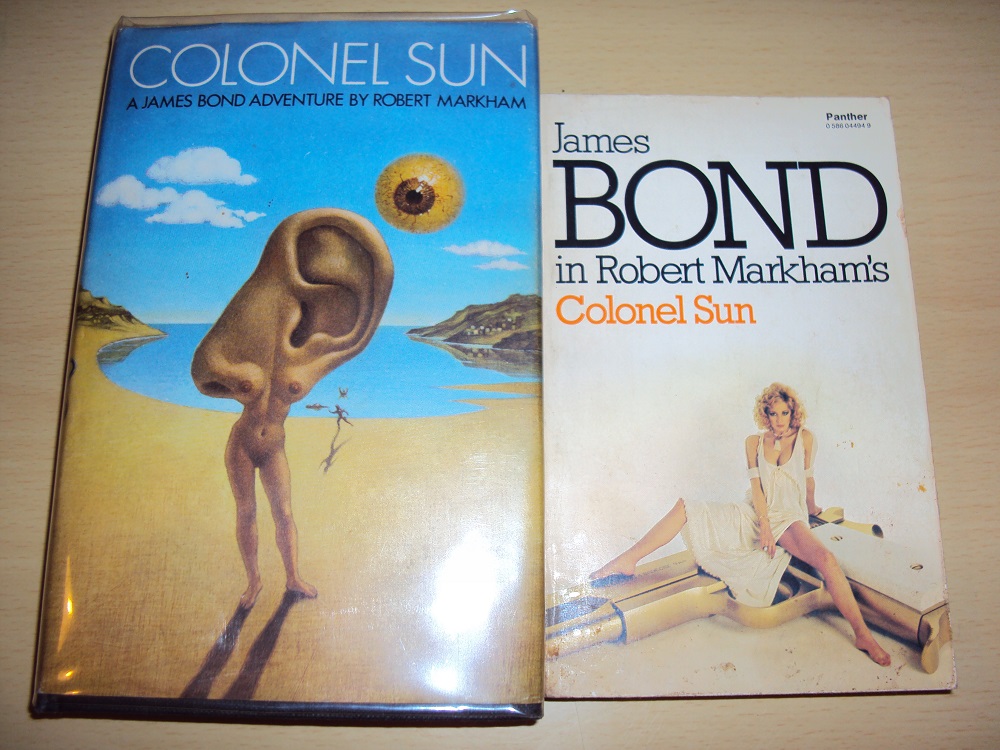
The writer and critic Kingsley Amis wrote a fair bit about James Bond. Using the name William Tanner, M's chief-of-staff, he wrote The Book of Bond, or Every Man his Own 007 (1965), a guide for wannabe James Bonds about what to eat and drink, what to read, what to wear, what to say, and so on. The James Bond Dossier, one of the earliest critical examinations of the James Bond novels, was published in the same year, this time under Amis' own name, while 1968 saw the publication of the first continuation Bond novel, Colonel Sun, written by Amis under the pseudonym Robert Markham.
But that's not all. To coincide with the publication of Colonel Sun, Kingsley Amis wrote an article, 'The new James Bond', about why he took up the challenge of writing a Bond novel and how he developed some of the ideas that would feature in the book. The article was republished, along with other literary musings originally published in the New Statesman, the Spectator, the Sunday Telegraph and other periodicals, in What Became of Jane Austen? and Other Questions (1970, Jonathan Cape).

The essay offers a fascinating insight into the process of creating a James Bond novel, though no less interesting is Kingsley Amis' explanation for picking up Bond's adventures where Ian Fleming left off. Yes, money was a consideration, but so too, more curiously, was the thought how cross with Amis the intellectual Left would get. Amis was amused at how the same left-wing critics would accuse him both of writing the book for financial reward and also of embracing the ideology of Fleming and Bond.
On that point, Kingsley Amis does concede that, like Bond, he is “pro-Western, pro-British, even, by and large, pro-American”, putting him at odds with the intellectual Left, whose favoured literary spies, he considered, were those created by Len Deighton and John le Carré. Above all, though, Amis thought it “an honour to have been selected to follow in the footsteps of Ian Fleming”.
As Mark Amory suggests, much of Amis' reasoning may have designed to address the criticisms not of the intellectual Left, but of the right-wing Ann Fleming, who was scathing of Amis' selection and efforts. “It's a left-wing plot”, she wrote in a letter to Evelyn Waugh, and in an unpublished review of Colonel Sun, considered that Amis would “slip 'Lucky Jim' into Bond's clothing.” Amis alluded to Ann's criticism when he wrote in his piece that “fears were expressed in some quarters that I might produce a sort of Lucky Jim Bond”.
As for the ideas that contributed to Colonel Sun itself, Kingsley Amis chose Greece as a location for Bond's adventure because Bond had never been there and the eastern Mediterranean was a region of British and Russian interests. But considering the traditional Britain-versus-Russia set-up too old-hat (to some extent echoing the policy of the makers of the Bond films who had shied away from having Russia as the main adversary), Amis instead created a Chinese threat and had Bond team up with a Russian agent (some ten years before the film Bond would join forces with a Russian agent).
The starting point of Colonel Sun, set as it was in the Home Counties, was determined by the close proximity of Sunningdale (a golf-course frequented by Bond), M's house in Windsor, and Heathrow (then London) Airport. Lacking the experience to plausibly take Bond skiing or gambling, Amis returned Bond to the golf course. While Amis had never played golf, he was able to take advice from a friend who had.
Amis did, however, draw heavily on his wartime experiences to arm Bond and to put Bond in realistic situations for which the use of Second World War firearms and hand-grenades were appropriate. His intention was to make Bond a “gun and fists man”, in contrast, as he saw it, with the gadget-laden hero of the films. Amis also took a tour, notebook in hand, of the Greek mainland and the islands of Naxos and Ios.
Just as Kingsley Amis followed in Ian Fleming's footsteps with the writing of Colonel Sun, he also followed in Fleming's footsteps with his article, as in 1962 Fleming prepared an article called 'How to write a thriller'. In fact, it has become something of a tradition for Bond novel authors to write about their experiences creating new adventures for Bond. The paperback edition of Devil May Care (2009) included a short essay about how Sebastian Faulks wrote the novel, and Jeffery Deaver published a piece on writing Carte Blanche in 2011. All are well worth a read.
Reference:
Amory, M (ed.), 1985 The Letters of Ann Fleming, Collins Harvill
The latest Bond film, Spectre, contains many references to previous films and Ian Fleming's novels, and I listed some of these in my last post. But as Ian Fleming Publications recently revealed, Spectre also incorporates elements from Colonel Sun, the 1968 continuation Bond novel by Kingsley Amis.
I've identified the scene below, and while I don't describe it in detail, those who have yet to see the film may wish to look away now.
One of the classic elements of a Bond film is a scene of torture. Casino Royale had one, as did Die Another Day and, before that, The World Is Not Enough. Spectre has one too, and it is this scene, involving thin pointy instruments applied to the head and set in the villain's lair, which is lifted from Colonel Sun.
If there was any doubt that the screenwriters had looked through the pages of Colonel Sun for inspiration, it is confirmed by a line given to the villain – a philosophical thought about what the lack of eyes does to the essence of a man – which is taken almost verbatim from the novel. (I'm not certain, but I think he has another line from the novel, said when he directs Madeleine Swann to a chair.) These references, by the way, are from chapter 19, 'The Theory and Practice of Torture'.
As The Book Bond has pointed out, this may not be the first time Colonel Sun memes have been included in a Bond film. Die Another Day has the character Colonel Tan-Sun Moon, and in The World Is Not Enough (those two films again!), M is kidnapped, just as M is kidnapped in Colonel Sun.
I wonder if there is another reference. On the final page of Colonel Sun, James Bond and Ariadne, the heroine and GRU agent, talk about having to part and return to their duties. Ariadne says, “People think it must be wonderful and free and everything. But we're not free, are we?” Bond replies, “No. We're prisoners. But let's enjoy our captivity when we can.” This reminds me of the final exchange between Camille and Bond in Quantum of Solace (“I wish I could set you free. But your prison is in there”, Camille says, indicating Bond's mind).
Admittedly, this final reference seems less convincing than the others, but given the repeated nods to Colonel Sun in recent films, the writers, chiefly Robert Wade and Neal Purvis, clearly have had Amis' book in mind when coming up with ideas, and it is reasonable to suggest that their films contain other references.
Incidentally, Amis wrote Colonel Sun as Robert Markham, but the new edition of the book, published by Vintage, has dropped the pseudonym altogether. This no doubt improves the book's marketability, but the timing is interesting too. Any new Bond film brings with it glut of Bond-related books and reissues, all hoping to benefit from the film's publicity. But the reissue Colonel Sun has been a while coming; the last UK edition appears to have been published in the mid 1990s. Given that Spectre unambiguously contains elements of the novel, Vintage could almost have published Colonel Sun as a film tie-in.
Returning to Spectre, the references to Colonel Sun are significant, as until now it had been thought that there was reluctance within EON to adapt the continuation novels. Does that mean that we're going to see more of the continuation novels in the Bond films? If so, top of my list for an adaptation is Anthony Horowitz’s excellent Trigger Mortis. I wouldn't mind betting that the motor racing section of the book, which is based on material by Ian Fleming and includes Fleming's own words, will eventually make it to the big screen. Remember, you read it here first!