Showing posts with label alfred hitchcock. Show all posts

Sunday, 11 January 2015

North By Northwest: the Bond connections

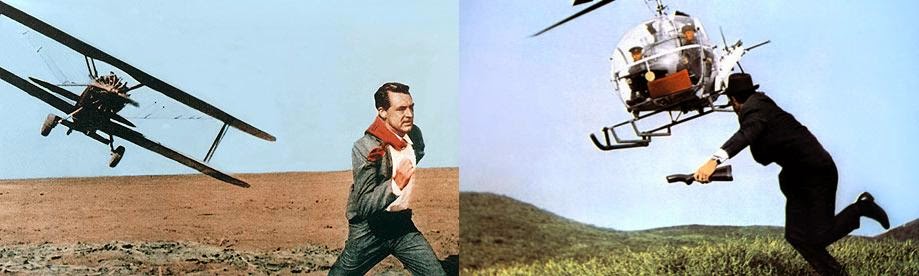
Scenes from North By Northwest (left) and From Russia With Love (right)
As I was flicking through the novel of Thunderball (1961) the other day, I was reminded about the small but influential role that Alfred Hitchcock's 1959 film of North By Northwest has in the world of James Bond. The film, starring Cary Grant as advertising executive Roger O. Thornhill on the run from a group of sinister agents – and the law – owing to a case of mistaken identity, is a classic thriller, whose combination of edge-of-the-seat action, amorous encounters, and sardonic humour would inspire both Ian Fleming and the producers of the Bond films.

The film had on its release an immediate impact on early attempts to bring James Bond to the screen. According to correspondence reproduced in Robert Sellers' book, The Battle for Bond, Ivar Bryce, Ian Fleming's friend and, effectively, producer and financier of those initial efforts, was so impressed by North By Northwest (“the best film of his life”, he wrote) when he saw it in September 1959 that he urged Fleming to see it. In Bryce's view, the film closely followed the style of Fleming's Bond adventures and represented a model for their proposed Bond film.

By October 1959, Fleming had seen North By Northwest. Robert Sellers reveals that Fleming had enjoyed the film, though complained about the humour, which he felt undermined the suspense. Still, the film must have stayed with him, because he referenced the film in the novel of Thunderball, which he wrote at Goldeneye over the winter of 1960. Chapter 9 sees SPECTRE agent Giuseppe Petacchi on board the Vindicator aircraft preparing to hijack the plane. “Five more hours to go,” he muses. “Rather a bind missing North by North-West at the Odeon. But one would catch up with it at Southampton.”

The following year, when the task of producing the first Bond film had passed to producers Cubby Broccoli and Harry Saltzman, North By Northwest may have been in the producers' minds as they considered the casting of Bond for Dr No (1962). In his autobiography, Cubby Broccoli recounts how he tried to persuade Cary Grant to take the role. Broccoli doesn't mention North By Northwest, but the film, as well as Grant's earlier spy film, Notorious (1946), provided the ideal screentest.

The plot of North By Northwest is a cat-and-mouse game setting an Everyman – albeit one that is suave and self-assured – against charming, sophisticated, vaguely European, villains. The plot's MacGuffin allows the characters to move seamlessly across iconic American landscapes by means of plane, train and automobile. Like Bond, Thornhill must rely on his wits and quickly form an uncertain alliance with a mysterious and seductive femme fatale. Grant’s physicality is impressive, particularly in the famous crop-duster scene, which sees Grant hit the deck time after time and sprint in between.

But Grant could also provide Bond's darker shading. As Jeremy Duns argues in his book, Rogue Royale (2013), Grant’s character in Notorious, T R Devlin, is closer than Thornhill is to the character of Bond. Devlin is morally ambiguous; his complicity in placing Ingrid Bergman’s Alicia Huberman in danger underscores his determination to serve the greater, patriotic, good. Alicia accedes to the mission for Devlin’s sake, but receives little reassurance in return. Devlin is in love with Alicia, but he must appear cold and unyielding in order to make her play her role convincingly.

Cary Grant's answer to Broccoli's offer was, of course, no. Grant never did sequels and Broccoli and Saltzman were offering a three-picture deal. Broccoli doesn't record his views on Grant's proto-Bond films, but the follow-up to Dr No, From Russia With Love (1963), probably the most Hitchcockian of Bond films, paid tribute to North By Northwest by alluding to the film's crop-duster scene. Just as Thornhill escapes the biplane, Bond flees from the path of a helicopter piloted by SPECTRE agents, and is forced to dive to the ground as it swoops down.

While the early James Bond films were reasonably straight adaptations of Ian Fleming's novels, there were other influences, including Hitchcock's North By Northwest. But then, North By Northwest had also impressed Ian Fleming, whose reference to the film in Thunderball is the most obvious sign that the film had had a degree of impact on his writing.

References

Broccoli, C, with Zec, D, 1998 When the Snow Melts: the Autobiography of Cubby Broccoli, Boxtree
Duns, J, 2013 Rogue Royale: the Lost Bond Film by the 'Shakespeare of Hollywood', JJD Productions
Sellers, R, 2007 The Battle for Bond: the Genesis of Cinema's Greatest Hero, Tomahawk Press

Monday, 28 May 2012

Hitchcockian moments in the Bond films

The website Letters of Note recently publicised the telegram from Ian Fleming to fellow novelist Eric Ambler in which Fleming asks whether Alfred Hitchcock would be interested in directing the film project that he and Kevin McClory were developing (and which would become Thunderball). While Hitchcock never directed a Bond film, his influence can be detected throughout the Bond series. Let's look at some of those key Hitchcockian moments.

If Hitchcock had directed a Bond film, then it probably would have looked something like From Russia With Love, which is the most Hitchcockian of the whole series, and there are characteristic elements from the very start: the opening pre-titles sequence, which misleads the viewer into thinking Bond has been killed; the Lektor decoding machine, which provides a strong macguffin to drive the plot; duplicitous or ambivalent characters (Red Grant and Tatiana); the use of a restricted location (the Orient Express); and naturally the homage to North by Northwest as Bond is attacked by a helicopter.

North by Northwest is recalled again at the climax of A View to a Kill. The sequence on top of the Golden Gate Bridge, as Bond battles Zorin and rescues Stacey Sutton, brings to mind Hitchcock's use of famous landmarks, such as Mount Rushmore (North by Northwest) and the Forth Rail Bridge (The 39 Steps). Indeed, this element is use twice in A View to a Kill, as earlier in the film the narrative takes us to another landmark, the Eiffel Tower.

Then there are moments in the Bond films of genuine Hitchcockian tension. Of particular note is Bond's escape from Piz Gloria in On Her Majesty's Secret Service and the pursuit by Blofeld's men down the mountain to the village. Just as tense is Bond's attempt to defuse the nuclear bomb in the middle of the circus in Octopussy. Both sequences allow the tension to build before being resolved, and the tension is heightened by the juxtaposition of danger and jeopardy with celebration and happiness (a Christmas event and a circus). These recall films such as Strangers on a Train, which ends at an amusement park, and Notorious, which features a scene where Devlin (Cary Grant) and Alicia (Ingrid Bergman) surreptitiously investigate a wine cellar in the midst of a party.

Before the party, at Devlin's request, Alicia had taken the cellar key, from her father, a Nazi sympathiser, without his knowing. There is a similar Hitchcockian element in Thunderball, when Bond asks Domino to locate nuclear bombs on Largo's boat, thus putting her in danger.

Like From Russia With Love, For Your Eyes Only has a very strong macguffin, in this case the ATAC device. The film also presents a classic Hitchcockian character in Kristatos, who we think is on Bond's side, but is actually the villain. The concealed intentions of Live and Let Die's Rosie Carver is rather Hitchcockian, as is her checking into Bond's hotel as Mrs Bond, which along with all uses of false names at hotels in the Bond films, recalls The 39 Steps and the scene where Richard Hannay (Robert Donat) and Pamala (Madeleine Carroll) stay at a Scottish Inn under false names.

There are doubtless other Hitchcockian moments in the Bond films. While the involvement of Hitchcock in the Bond series presents an interesting 'What if?', we can see shades of his style throughout the series.