Any list of Bond girls from Skyfall would surely include Judy Dench's M. Central to the narrative, M appears throughout the film and (spoiler alert for those few people who haven't yet seen the film) at the end dies cradled in the arms of James Bond in a scene that recalls the death of Bond's wife, Tracy, in On Her Majesty's Secret Service. For many fans, M's prominence in Skyfall marks the culmination of a gradual enhancement of M's role that began with GoldenEye (1995), but has been particularly associated with the films of Daniel Craig. Unlike the character portrayed by her predecessors, Bernard Lee and Robert Brown, Judy Dench's M doesn't simply brief Bond and send him on his mission at the start of the film and congratulate Bond at its conclusion, but remains personally engaged in operational matters for the duration of the mission and is even seen in the field. But to what extent has M's role actually changed through the film series? How far has M's screen time increased? How has the role of M evolved?

To answer these questions, or at least present some reasonably useful observations, I scanned all the Bond films and made a note of the scenes in which M appears. I began to record the length of each scene, but stopped early in the series owing to lack of time, and so for the purpose of this analysis, screen time is measured by the number of scenes in which M appears. Without re-watching the films in their entirety, it's highly likely that I've missed the odd scene here and there, but the general trends should be clear.
The first four films in the series show a gradual rise in the number of M's scenes. Starting with a single appearance in Dr No to brief Sean Connery's Bond and order him to take the Walther PPK, M, played by Bernard Lee, has two appearances in From Russia with Love – a briefing and a scene in which he listens to a recording of Bond's questioning of Tatiana Romanova – and three appearances in Goldfinger (a briefing, a meeting at the Bank of England and a mid-mission update). In Thunderball, M has four scenes, including two scenes in a situation or war room. M has fewer scenes in You Only Live Twice, but this reduction is more than made up for in On Her Majesty's Secret Service, in which he has six scenes, including a scene at his home. The number of scenes is exceptional, however, and in Diamonds Are Forever returns to a number approaching the average (4.8 scenes per film).
Apart from Live and Let Die, M's appearances during Roger Moore's tenure are remarkably consistent in structure and function. Films from The Man With The Golden Gun (1974) through to A View To A Kill (1985) have four or five scenes, which follow a reasonably standard pattern. There is a briefing in M's office, followed by a second meeting in response to new information or, in M's view, some foolhardy action by Bond. M is then seen outside secret service headquarters to meet Bond at an arranged rendezvous (such as Checkpoint Charlie in Octopussy, the first film for Robert Brown as M) or at a regional headquarters (for instance in Brazil in Moonraker), before finally appearing at the mission's conclusion to congratulate Bond or explain Bond's absence (usually to General Gogol). There are, of course, variations to this pattern, but overall the structure of M's scenes have a similarity that the scenes in the films of the 1960s lack. For Your Eyes Only (1981), in which the role of M is shared by Q and chief-of-staff Tanner, and to a lesser extent Timothy Dalton's first Bond film, The Living Daylights (1987), also fit this model.
In Licence to Kill (1989), Bond operates outside the secret service and consequently M takes a marginal role in the film, appearing in just two scenes. On the face of it, the number of scenes in which Judy Dench's M appears during her tenure hovers around the average for the series. But no doubt M's screen time is greater than it had been during, for example, Roger Moore's era. Another significant development is that Judy Dench's M takes a much more direct role in Bond's mission compared with her predecessors, appearing in the situation room, regional or temporary headquarters or in the field more often than she appears in her office. There are nods to earlier tropes, however. The World Is Not Enough (1999) and Tomorrow Never Dies (1997), has the sort of humorous coda that would fit comfortably in any Roger Moore film. Both The World Is Not Enough and Skyfall are clear outliers, with the former's 11 scenes, and the latter's 20-odd scenes (including the final scene introducing Mallory as the new M). In these films, M is part of the narrative and naturally has a substantially increased presence.
While it could be claimed that M's enhanced and proactive role evident during the Pierce Brosnan and Daniel Craig eras has been driven more by Judy Dench's status as a highly-respected actor and a 'national treasure' than the demands of plot and Bond tradition, the role doesn't necessarily seem so different from M's role in, say, Thunderball, in which M monitors events from a situation room throughout the film. We can also note that Daniel Craig wasn't the first Bond to visit M's home. The difference between the more recent films and their antecedents is the rise of technology (at least the sort of technology imagined by the film-makers) to rapidly analyse events and maintain communication with Bond and other agents. With such technology available, one would surely expect any modern M, whoever plays the character, to have an active presence for the duration of a mission. Necessary, too, given the increasing political oversight and scrutiny intelligence services now face, a reality reflected by the number of committee meetings and ministerial meetings Judy Dench's M attends (although oversight has been hinted at in earlier films, with such statements as “No. 10's making ugly noises about Operation Bedlam”).
Returning to the Connery and Moore eras, an explanation for the uniformity of M's appearances for most of the 1970s and 1980s, which contrasts with the more diverse nature of M's role in the 1960s, might lie in the fact that the stories depicted in Roger Moore's films rely more on original scenarios and less on the pages of Ian Fleming. This perhaps makes it more likely that particular elements or memes of one film, such as those which best show the amusing interplay between Bond and authority figures, would be repeated in the next film and given some variation. As certain scenes are repeated, they become more familiar and begin to define a new or revised formula until audiences and film-makers expect them as part of the Bond experience. Returning to Fleming in Connery's films, combined with fresh story elements, or introducing an original story for You Only Live Twice, the structure of M's scenes was less stable and was effectively re-set for each film.
There are two other points worth making. The first is that M isn't the only character to have had increased screen time during the course of the series. To an extent, Q has also become more prominent (compare the character's screen time in, say, Octopussy, with From Russia With Love or Thunderball). Again this is a product of familiarity, as characters gradually become so well established within the James Bond's team, that their contributions are expected and welcomed. Finally, as I scanned through the Bond series, I noticed how the clothes style of Bernard Lee's M had changed. For all films from Dr No to On Her Majesty's Secret Service, he wears a bow tie and a suit. Thereafter, until Moonraker, he wears a tie and blazer (at least most of the time). The choice of bow tie is probably not significant, but I wondered whether it was a nod to Ian Fleming, who preferred to wear the item. Perhaps it seemed fitting to the producers and director of Dr No to include something of Fleming in the character of James Bond's chief.
This brief analysis has, I hope, highlighted some trends in the evolving role of M in the Bond films and suggested that the role of M as played by Judy Dench retains elements of the M of her predecessors, and is perhaps not so radical a depiction as might first be thought. And where there is difference, the realities of a changing world are likely to influence the role of M, just as much the whims of the film-makers, if not more so. What of the future? Mallory's introduction as M suggested a return to the traditions of the early Bond films, as his office deliberately recalled the Bernard Lee era. Perhaps, then, we can expect something of a traditional portrayal too. I wouldn't be too certain of that. While I predict that Mallory won't be seen so often in the field, and we may see more briefings taking place in M's office, the depiction of smart technology will make it inevitable that M will be shown to have the same high level of contact with James Bond as his predecessor had, enabling him to follow Bond's mission as events unfold.

In an article in the Times published on April 20th, journalist Oliver Moody reported on the opening up of the archives of one of the UK's most famous high-street retailers, Marks and Spencer. Of special interest was the description of how, in the decades following the end of the Second World War, Marks and Spencer introduced new foods, often to bemused, suspicious, and culinary conservative consumers. Looking at some of the foods mentioned, the piece could have been describing James Bond's typical diet, which serves to remind us just how unfamiliar and exotic Bond's food was to the early readers of Ian Fleming's novels.
One of the items that consumers had particular trouble with was the avocado, or the 'avocado pear'. The fruit was introduced into Marks and Spencer's stores in 1959, six years after Fleming described James Bond eating an avocado in Casino Royale (1953). In the intervening time, avocados remained a rarity, and so when they appeared on the stores' shelves, naturally consumers were confused about how to eat them. According to Marks and Spencer records, consumers routinely attempted to eat avocados as a dessert fruit. Apparently one lady stewed the fruit and served it with custard. (That's not to say that the avocado can never be used as a dessert fruit, avocado fool, a preparation made with blended fruit, cream, icing sugar and lemon juice, being a perfectly good exception).
If only consumers had turned to Fleming for guidance. Admittedly, in Casino Royale (chapter 8), Bond eats half an avocado as a dessert to accompany Vesper Lynd's strawberries and cream, but at least the preparation – the avocado is served with a little French dressing – is correct. And in Live and Let Die (1954), Quarrel serves Bond and Solitaire an 'avocado pear salad', which we know is intended as a savoury course, because for dessert guavas and coconut cream is on the menu (chapter 23).
Returning to the Times' piece, Oliver Moody lists spaghetti bolognese, hamburgers and prawns as some of the items that began to find a regular place on the British dinner tables during the 1960s and 70s, items with which James Bond was again already familiar. In New York Bond enjoys a 'flat beef Hamburger' (Live and Let Die, chapter 1), and lunch with Goldfinger includes a prawn – well, shrimp – curry as a first course (Goldfinger (1959), chapter 11). And in Thunderball (1961, chapter 4), while recuperating at Shrublands health farm, Bond fantasises about eating 'a large dish of Spaghetti Bolognese containing plenty of chopped garlic'. No doubt the reference reflected Fleming's own tastes, and during 1960 Fleming became something of a connoisseur of Italian food. Describing his visit to Naples in June that year in his Sunday Times' 'Thrilling Cities' series, Fleming recommended the local speciality, spaghetti alla vongole, although a postcard written by Fleming and his wife Ann to Evelyn Waugh mentions the “feelthy sphagetti” [sic], with Fleming commenting that he'd prefer Naples to London “if the food were better”.
Today, Bond's diet seems mundane, old-fashioned, even. Much of the food that Bond consumes that was once exotic and exciting is now commonplace, and indeed in Britain has long been incorporated into the national culinary identity. Retailers, such as Marks and Spencer, along with the growth of foreign travel, have played a significant role in this transformation, but James Bond was responsible in part, at least, for introducing the idea of the food to a public emerging from the restrictions and austerity of the 1940s and 50s. As Fleming said, “My contribution to the art of thriller writing has been to attempt the total stimulation of the reader all the through, even to his taste buds.”
References
Amory, M (ed.), 1985 The letters of Ann Fleming, Collins Harvill
Biddulph, E, 2009 'Bond was not a gourmet': An archaeology of James Bond's diet, Food, Culture and Society 12.2, 131-50
Fleming, I, 1963 Thrilling Cities, Cape
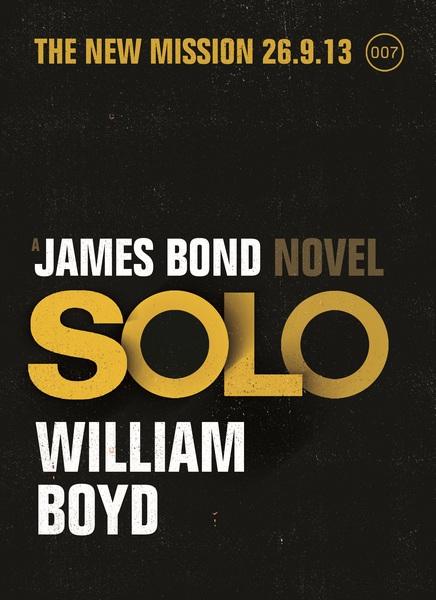
The title of William Boyd's James Bond novel, due to be published in the UK on 26th September, was announced at the London Book Fair. The book will be called 'Solo'. As the HMSS Editors point out, Solo recalls the 1960s TV series, The Man From UNCLE, and specifically the character Napoleon Solo, which Ian Fleming had a hand in creating. A Mr Solo of the Unione Siciliano was also a character in the novel Goldfinger (chapter 17, Hoods' Congress). It seems unlikely that these references were in William Boyd's mind when he settled on the title, although a villain with a Napoleon complex might count as a nod to Fleming's role in The Man From UNCLE!
More seriously, the official press release includes a statement by William Boyd, which provides a strong indication as to the significance of the title. In the novel, Bond will "go solo" on a "self-appointed mission of his own, unannounced and without any authorization." What's more, Boyd has confirmed that the book will be set partly in Africa. Given Boyd's interest in the continent, there had been speculation that he'd send Bond there, and in an earlier post, I suggested that Bond would visit West Africa, possibly Nigeria (perhaps relating to the events of the Biafran War). However, 1969 proved to be momentous year for many reasons, and I also reflected on the events that Boyd might allude to in the novel, if not directly involve Bond.
For more information and discussion about William Boyd's Solo, I also recommend The Book Bond, The James Bond Dossier, and the novel's official website.
I recently listened to a short extract of Ian Fleming’s interview on the BBC’s radio programme, Desert Island Discs. Little of the broadcast, originally made in August 1963, survives, although we have a record of the music, books and luxury item Fleming would have taken with him to the hypothetical desert island (a list that all 'castaways' appearing on the long-running programme have to provide).
Fleming's responses to presenter Roy Plomley's questions are likely to be familiar to any student of Fleming, and concerned Fleming’s early career, his war exploits, how he came to write the first Bond novel on the eve of his wedding, his writing regime, the origin of Bond as a mixture of wartime commando and secret service agent, and so on. But the interview also offered, for me at least, some additional information. At one point in the interview, Plomley asked Fleming about criticisms of violence and sadism in his books. Fleming replied that “the old days of getting a crack on the head with a cricket stump have rather gone out”, continuing that he thought it “ridiculous to go on writing thrillers in the old Bulldog Drummond, John Buchan way.” The response was similar to something he said in interview with Jack Fishman (published in 1965 in For Bond Lovers Only): “I didn't believe in the heroic Bulldog Drummond types. I felt these types could no longer exist in literature.” His Desert Island Discs interview reveals that he had added Buchan's Richard Hannay to his list of out-dated heroes.
I wonder, though, whether Fleming's later interviews incorporated a relatively new response that had been repeated and honed to provide a neat explanation for the style of his books, but wasn't necessarily in Fleming's mind when he began to write them. In his discussion with Raymond Chandler on thriller writing, broadcast in 1958, Fleming addressed the subject of torture and violence. “I was brought up on Dr Fu Manchu and thrillers of that kind”, he said, admitting that “even Bulldog Drummond gets in the grips of the villain.” The implication is that Bond wasn't the first hero to be routinely tortured by the villain, and that the Bond novels follow a tradition that existed in the books Fleming read as a child. Certainly, Fleming didn't reject those books as old-fashioned in that discussion, but it is possible that over time Fleming developed a narrative to explain his style and to offer in response to criticisms of 'sex, sadism and snobbery'. It was a narrative that looked more strongly to American style thrillers and away from Bulldog Drummond and other 'clubland' heroes.
While the Bond books have a pace, a sense of location, and a level of sex and violence that clearly derive from hard-boiled thrillers, in particular Raymond Chandler and Dashiell Hammett, connections to the books of Fleming's childhood, notably in relation to his villains, cannot be ruled out. Moonraker's Sir Hugo Drax, for example, has more than a passing resemblance to Carl Peterson, the villain of Sapper's Bulldog Drummond novels, while Dr No could come from the pages of Fu Manchu (which Fleming admits in his Fishman interview influenced his writing).
When tennis champion Andy Murray returned to the beach after a swim in the sea in Florida recently, the UK's tabloid press was struck by a remarkable similarity. In that moment, Andy Murray was Daniel Craig's James Bond emerging from the sea in Casino Royale (2006). “Watch out Daniel Craig! Andy Murray has his very own James Bond moment as he emerges from sea after Miami Masters win,” read the Daily Mail headline. The Daily Express reported that Murray “jumped into the sea before emerging to show off his toned torso just like 007 star Daniel Craig.”
Even a cursory glance at the photograph of Andy Murray and the image of Daniel Craig in the sea in Casino Royale shows that the comparison is superficial to say the least. Murray's shorts weren't even close to Craig's La Perla trunks, and the only factors to support the comparison were that both Murray and Craig happened to be in the sea, they were walking towards the beach, and were well-toned. But while the comparison was tenuous, it was also inevitable, as Andy Murray follows a long line of celebrities who have been compared to James Bond simply after being photographed wading out of the sea.
In July 2010, when fashion designer Giorgio Armani was photographed in the sea wearing a pair of unflattering Emporio Armani Speedos, a headline in the Daily Mail read, “Giorgio Armani, 76, fails to pull off the Daniel Craig look in his tight white swimming trunks.” A year later, however, Armani had chosen a better pair of trunks, and this time the Daily Mail reported that he “looked fighting fit on the beach” on the island of Formentera, adding that Armani's reception the previous year, which the Mail reminded readers drew unfavourable comparisons with Daniel Craig, was perhaps what prompted the change of trunks.
Singer Rod Stewart was matched against Daniel Craig when he was seen on the beach of St Tropez in 2007. The Daily Mail's headline read, “Rod looks less 007 and more double oh no in his alarmingly tight trunks.” And in January that year, TV and radio presenter Jonathan Ross caught the eye of the Daily Mail when he was photographed on a Florida beach. Admittedly, his trunks were similar to those worn by Daniel Craig, though for the Mail the comparison was again not in his favour. “He cut a slightly less dashing figure than the muscular Craig as he played Frisbee at the water's edge”, opined journalist Kristina Pedesen.
Female celebrities enjoying a swim in the sea have not escaped the tabloid gaze either, and inevitably the media turn to another classic image from the Bond films for their principal reference point: that of Ursula Andress as Honey Ryder emerging from the sea onto the beach of Crab Key in Dr No (1962).
In March 2012, lawyer Nancy Dell'Olio was compared to Ursula Andress as she posed on a Jamaican beach for a Hello! magazine shoot. Despite the fact that Dell'Olio's bikini was frilly and purple, while that of Ursula Andress was white with belt and knife accessories, the Mail ran the headline, “Making waves: Nancy Dell’Olio, 50, strips down to a bikini to re-create THAT Dr No beach scene.” Later, in June 2012, Sally Bercow, the wife of House of Commons Speaker, John Bercow, was snapped returning to the beach after a swim in Barbados. The Daily Mail reported that she “appeared to be doing her best to impersonate Bond girl Ursula Andress.”
The use of the comparison isn't confined to the Daily Mail. A September 2010 edition of the Daily Express reported on a fashion shoot on a Florida beach at which former Spice Girl Geri Halliwell, modelled a white bikini. “Geri spices up the beach in a Bond girl bikini”, ran the headline. An earlier edition, published in April 2006, reported that Scarlet Johansson was holidaying at the Goldeneye resort. Prompted in part by the significance of the location, as well as the fact that Scarlet Johansson was photographed wearing a bikini, the Express commented that “she is more than a match for the legendary Ursula Andress.” A rather weaker link to the beach scene in Dr No was made in the Express in January 2002. Tennis star Anna Kournikova, playing in a tournament in Auckland, happened to be wearing belted shorts, but that was enough to prompt a comparison with Ursula Andress' iconic scene. The shorts were “designed in a style similar to Bond girl Ursula Andress’s famous bikini in the 1962 film, Dr No”, the paper reported.
In fact, it is not difficult to find celebrities being compared to Daniel Craig or Ursula Andress when trawling through any UK tabloid newspaper. For example, a quick search of The Sun website brought up articles in which comedian Jimmy Carr and actor Adam Sandler had been photographed on the beach and compared to Daniel Craig, and singers Sarah Harding and Ashlee Simpson had been compared to Ursula Andress.
Yes, it's lazy journalism (and it's debatable whether any of these features actually merit publication), but it nevertheless provides evidence that two iconic scenes in the Bond series have a life beyond the films and the context of James Bond and function successfully as memes in their own right. The scenes are memorable, they are frequently recalled and are persistent.
That said, it is notable that none of the newspaper stories pre-dates 2002. Obviously no one could be compared with Daniel Craig before 2006, but it seems that routine comparisons with Ursula Andress weren't made until after well after 2000. It is possible that a rise in such comparisons in the media reflects a change in the style of journalism over the years, but a resurgence in the popularity of the Bond series evident since Pierce Brosnan's tenure as Bond and during three significant anniversaries over the past 10 years (40 years of the Bond films, Ian Fleming's centenary, and 50 years of the Bond films) is likely to have been an important factor. Such renewed interest has led, for example, to endless polls of favourite Bond scenes or celebrity recreations of iconic scenes. The Bond films themselves have brought fresh attention to Ursula Andress' beach scene, specifically Halle Berry's nod to the scene in Die Another Day, and Daniel Craig's own beach scene, which, while not necessarily written as a homage to Ursula Andress, naturally invited comparisons in the media. And any interest that Ursula Andress' scene gains reflects back on Daniel Craig's scene, which then attracts more attention, setting up something of a feedback mechanism.
With the beach scenes of Daniel Craig and Ursula Andress equally well established in cultural space, comparisons are irresistible to newspaper editors, who now have instant reference points every time a female or male celebrity is photographed staggering out of the sea after a swim.